

On this page:
What Is Risk? Types of Global Risk Systemic Risk and Cascading Failures Vulnerability and Exposure Resilience: Building the Capacity to Withstand Shocks The Sendai Framework Case Study: COVID-19 as a Global Risk Event Building Global Resilience: Strategies and Challenges ConclusionIn December 2019, a cluster of pneumonia cases appeared in Wuhan, China.
Within three months, the world had shut down.
Schools closed across six continents. Supply chains collapsed. Borders sealed. Economies contracted at rates not seen since the Great Depression. Over seven million people died. And the world discovered, in real time, just how interconnected and therefore how fragile the systems it depends on actually are.
COVID-19 was not a surprise to epidemiologists. They had been warning about pandemic risk for decades. The risk was known. The preparation was insufficient. And the consequences were global — not because the virus was uniquely deadly, but because the systems through which modern human life is organized had been built for efficiency, not resilience.
That gap between known risk and adequate preparation is exactly what this Geography unit is about.
In geography, risk refers to the probability that a hazard will cause harm to people, places, or systems, combined with the severity of that potential harm. Risk is not the same as a hazard. A hazard is a potential threat. Risk is what happens when that threat meets a vulnerable system.
Global risks are threats that operate at a planetary scale, affecting multiple countries simultaneously, crossing borders regardless of political boundaries, and whose consequences cascade through interconnected systems in ways that are difficult to predict or contain.
The World Economic Forum Global Risks Report, published annually, identifies the most significant global risks based on surveys of thousands of leaders across business, government, civil society, and academia. In recent years, the top risks consistently include:
What is striking about this list is how interconnected these risks are. Climate change drives extreme weather, which damages agriculture, which creates food insecurity, which drives migration and conflict, which destabilizes governments, which reduces capacity to respond to the next crisis. Risks do not arrive one at a time.
Climate change is the defining environmental risk of the 21st century. Its consequences — rising seas, intensifying storms, prolonged droughts, shifting agricultural zones, and melting ice — are already being felt and will intensify regardless of how rapidly emissions are reduced, due to the carbon already in the atmosphere.
Biodiversity loss is accelerating at rates that alarm biologists. The current rate of species extinction is estimated to be 100 to 1,000 times the natural background rate. The loss of biodiversity undermines ecosystem services — pollination, water purification, soil fertility, flood regulation, and disease control — which underpin all human economic activity.
Deforestation and land degradation destroy carbon sinks, disrupt water cycles, drive species extinction, and reduce agricultural productivity. The Amazon rainforest, often called the lungs of the Earth, is approaching a potential tipping point beyond which large sections could transition irreversibly from rainforest to savanna, releasing enormous quantities of stored carbon.
Cybersecurity threats and attacks on digital infrastructure pose growing risks to essential services. Power grids, water treatment systems, hospital networks, financial systems, and transport infrastructure are all increasingly dependent on digital systems that are vulnerable to malicious attack or accidental failure.
Artificial intelligence risks include both near-term concerns (job displacement, algorithmic bias, surveillance) and longer-term questions about the development of AI systems whose behavior is difficult to predict or control.
Misinformation and disinformation spread through digital networks can undermine public health responses, erode trust in institutions, destabilize democratic governance, and incite violence. The COVID-19 pandemic demonstrated how rapidly false information about vaccines, treatments, and the origins of disease could spread and cause real harm.
Pandemic risk was dramatically underestimated before COVID-19 demonstrated what a highly infectious respiratory virus could do to interconnected modern societies. The conditions that enabled COVID-19 — dense urban populations, global air travel connecting every city on Earth, high-intensity livestock farming creating opportunities for zoonotic spillover, and weakened pandemic preparedness systems — have not fundamentally changed.
Antimicrobial resistance (AMR), the growing inability of antibiotics and other antimicrobial drugs to kill bacteria, fungi, and parasites, represents a slow-moving but potentially catastrophic global health risk. Routine surgeries, cancer treatment, and care for premature babies all depend on effective antibiotics. The WHO has described AMR as one of the greatest threats to global health.
Conflict and fragile states create conditions in which all other risks are harder to manage and more damaging in their effects. Countries experiencing conflict are significantly more vulnerable to famine, disease, displacement, and economic collapse.
Inequality and social fragmentation, within and between countries, create conditions for political instability, erosion of social trust, and reduced collective capacity to respond to shared challenges.
Nuclear risk has not disappeared with the Cold War. Approximately 13,000 nuclear warheads remain in the world's arsenals. Tensions between nuclear-armed states, including the US, Russia, China, India, Pakistan, Israel, and North Korea, create an ongoing risk of catastrophic miscalculation.
One of the most important concepts in this unit is systemic risk — the risk that failure in one part of a complex, interconnected system triggers failures across the whole system, often in ways that are difficult to predict.
Modern global systems — supply chains, financial networks, food systems, energy grids, and digital infrastructure — are tightly coupled and highly interconnected. This interconnection creates efficiency and enables extraordinary levels of economic activity. But it also means that shocks can cascade rapidly and unpredictably through the entire system.
The 2008 global financial crisis is a classic example of systemic risk. The collapse of a segment of the US mortgage market triggered a cascade of failures through interconnected financial institutions globally, ultimately causing a recession that cost tens of millions of jobs worldwide, most of them in countries that had nothing to do with the original problem.
The 2021 Suez Canal blockage, when a single container ship ran aground and blocked one of the world's most important shipping routes for six days, disrupted global supply chains in ways that revealed just how dependent modern economies are on a small number of critical chokepoints.
Tipping points — thresholds beyond which a system shifts abruptly and irreversibly into a different state — are a particularly serious form of systemic risk in natural systems. Climate scientists have identified multiple potential tipping points in the Earth's climate system, including:
These tipping points could be triggered by relatively modest amounts of additional warming and could interact with each other in ways that accelerate overall change far beyond what any single tipping point would produce alone.
Not all people and places are equally exposed to global risks. Vulnerability determines how badly a given risk affects a particular community, region, or country.
The same patterns that characterize vulnerability to geophysical hazards apply to global risks more broadly. Poorer communities with weaker institutions, less financial cushion, and more dependence on vulnerable systems face greater harm from the same risk event than wealthier, better-prepared ones.
Among the most risk-exposed communities on Earth. They face existential climate risks from sea level rise and intensifying tropical cyclones, limited economic diversification options, geographic isolation that increases supply chain vulnerability, and limited capacity to absorb and recover from shocks.
Face heightened food security risk from climate change affecting their agriculture, limited access to global markets, and exposure to political instability in neighboring states.
Concentrate millions of people in often poorly constructed housing, with limited emergency response capacity, facing growing climate risks from flooding, heat, and water stress.
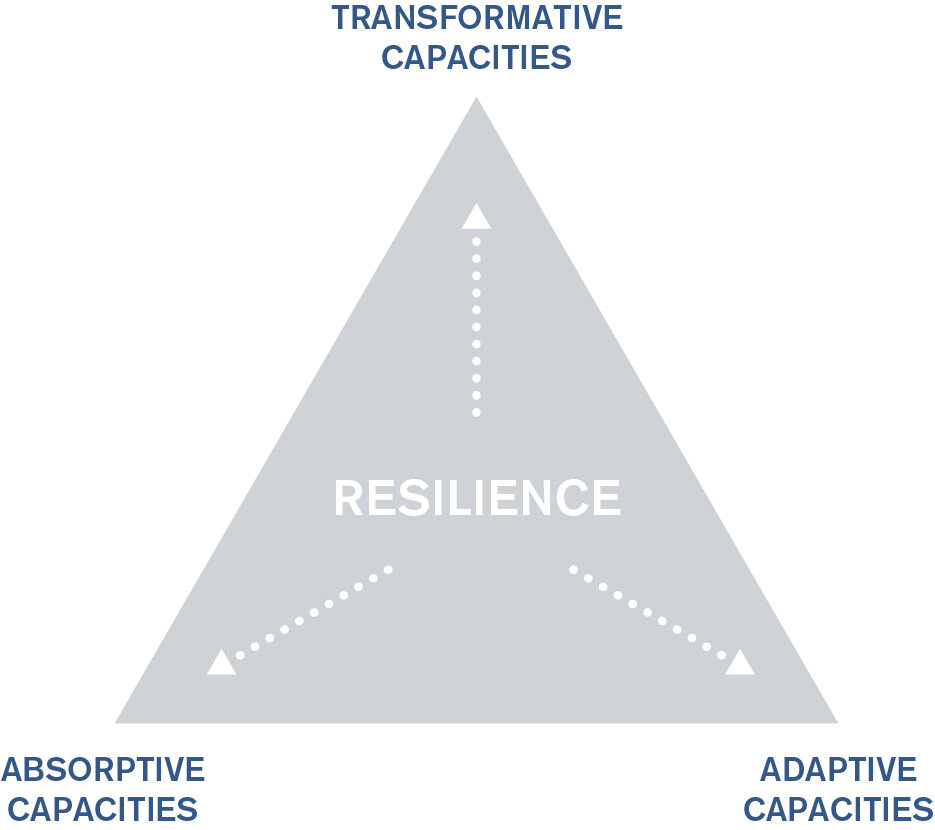
Resilience is the capacity of a system — whether a community, an ecosystem, an economy, or a state — to absorb disturbance and reorganize in ways that maintain its essential functions, structures, and identity.
Resilience is not the same as rigidity. A resilient system is not one that never changes; it can adapt and recover when disruption occurs, retaining the capacity to meet people's needs through and after the disturbance.
The Sendai Framework for Disaster Risk Reduction 2015 to 2030 is the primary international agreement for managing disaster risk. It commits countries to:
The Sendai Framework is notable for its emphasis on prevention and risk reduction rather than just response, recognizing that investing in resilience before disasters is far more cost-effective than responding after them.
COVID-19 provides the most comprehensive recent case study of how global risks materialize and why resilience matters.
Origins and spread: The virus emerged at the intersection of wildlife, livestock, and human populations in China and spread globally through air travel networks in weeks, demonstrating how interconnected modern movement systems eliminate geographic barriers to infectious disease spread.
Differential vulnerability: The pandemic's impacts were deeply unequal. Low-income countries faced greater mortality from COVID-19 itself due to weaker healthcare systems, while also suffering severe economic damage from lockdowns and global trade disruption. Vaccine distribution was profoundly inequitable; high-income countries secured the majority of early vaccine doses, leaving lower-income countries exposed for much longer.
Systemic cascades: COVID triggered cascading failures across health systems, supply chains, education, mental health, domestic violence rates, and political stability in ways that illustrated the interconnection of global systems.
Resilience factors: Countries that responded most effectively combined strong public health infrastructure, effective communication, high levels of social trust, economic capacity to support affected workers and businesses, and the institutional agility to adapt policies as the situation evolved. Countries scoring highly on these dimensions, including South Korea, New Zealand, and Taiwan, achieved significantly better outcomes than those that did not.
Building resilience to global risks requires action at multiple scales simultaneously.
The fundamental challenge of global risk governance is that risks are global but governance remains primarily national. Climate change, pandemic disease, financial contagion, and cybersecurity threats do not respect borders, but the institutions most capable of responding to them are organized around national interests that frequently conflict.
The world faces a set of interconnected global risks — climate change, pandemic disease, biodiversity loss, geopolitical instability, and technological disruption — that are unprecedented in their scale, their speed, and their potential to cascade through the systems human civilization depends on.
None of these risks are inevitable disaster. Each can be managed, mitigated, or adapted to — if the political will, institutional capacity, and international cooperation can be mobilized in time.