

On this page:
The Climate System: How It Works The Greenhouse Effect Evidence for Climate Change Causes of Climate Change Impacts of Climate Change Vulnerability: Who Is Most at Risk? Resilience: Building Capacity to Cope Mitigation: Reducing the Cause Adaptation: Adjusting to the Inevitable The Justice Dimension ConclusionThe climate has always changed. Ice ages have come and gone. Sea levels have risen and fallen by hundreds of meters over geological time.
But what is happening now is different, not in the fact of change, but in its speed, its cause, and its consequences for the eight billion people currently living on this planet.
For the first time in Earth's history, one species is the primary driver of global climate change. And for the first time, we have the scientific tools to understand what we are doing, the evidence to see it happening in real time, and the technological capacity to respond. Whether we respond effectively and who bears the cost when we do not is one of the defining questions of this century. It is also the heart of this Geography unit.
Before understanding how the climate is changing, it helps to understand how it works.
Climate is the long-term pattern of weather in a region, typically measured over 30-year periods. It is distinct from weather, which refers to short-term atmospheric conditions. Climate is shaped by a complex system of interacting components: the atmosphere, oceans, land surface, ice sheets, and living organisms that exchange energy and matter continuously.
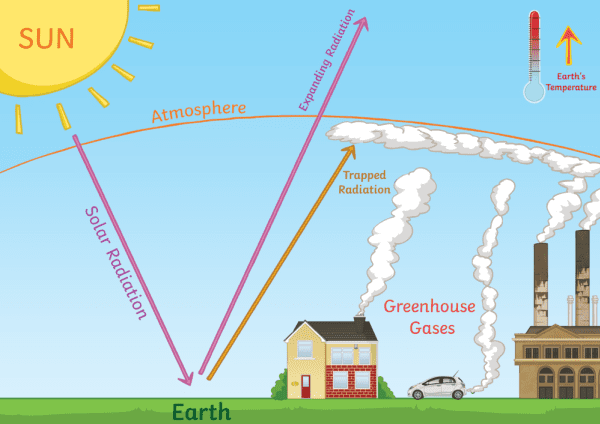
The greenhouse effect is the natural process that keeps Earth warm enough to support life. Without it, the average surface temperature would be approximately minus 18 degrees Celsius instead of the current plus 15 degrees.
Here is how it works:
The greenhouse effect is not the problem. The enhanced greenhouse effect is. Human activities, primarily burning fossil fuels and deforestation, have increased the concentration of greenhouse gases in the atmosphere, trapping more heat and raising global temperatures beyond natural levels.
Key Greenhouse Gases:
The scientific evidence for human-caused climate change is overwhelming and comes from multiple independent lines of inquiry.
Global average surface temperatures have risen by approximately 1.1 to 1.2°C since pre-industrial times. The last decade (2011-2020) was the warmest on record. The ten hottest years ever recorded have all occurred since 2010.
Ice cores from Antarctica and Greenland contain trapped air bubbles showing a clear relationship between greenhouse gas concentrations and temperature over 800,000 years. Current CO₂ levels are unprecedented in that entire period.
Global average sea levels have risen by approximately 20 cm since 1900. The rate of rise has accelerated; the rate in the last decade is nearly triple the rate in the first decade of satellite records.
Arctic sea ice extent has declined dramatically. September minimum ice extent has decreased by approximately 13% per decade since 1979. The Arctic is warming at two to four times the global average rate (Arctic amplification).
Glaciers worldwide are retreating at historically unprecedented rates. The Rhône Glacier, Athabasca Glacier, and glaciers across the Himalayas, Andes, and Alps are all losing mass rapidly, threatening freshwater supplies for hundreds of millions.
Natural Causes: Milankovitch cycles (variations in Earth's orbit driving ice ages), volcanic eruptions (temporary cooling, e.g., Mount Pinatubo 1991 cooled global temps by ~0.5°C for two years), and solar variability (small effect over human timescales).
Human Causes: Natural factors alone cannot explain the warming observed since the mid-20th century. The scientific consensus (IPCC) is that human activities are the dominant cause.
The impacts of climate change are already being felt across every region of the world. They are not future possibilities; they are present realities.
Heat waves are becoming more frequent, more intense, and longer-lasting. The 2003 European heat wave killed an estimated 70,000 people. The 2021 heat dome over western Canada and the US Pacific Northwest pushed temperatures to nearly 50°C in areas previously unaccustomed to extreme heat.
Climate change is intensifying the water cycle. Wet regions are generally getting wetter, and dry regions drier. This increases flood risk in some areas while deepening drought in others. The Amazon rainforest is experiencing more frequent and severe droughts, threatening its ability to function as a carbon sink.
Rising seas threaten low-lying coastal areas and small island states. Bangladesh could lose 17% of its land area by 2100 under high-emission scenarios. The Maldives, with an average elevation of just 1.5 meters above sea level, faces an existential threat.
As oceans absorb CO₂, they become more acidic. Ocean pH has decreased by approximately 0.1 units since industrialization, representing a 26% increase in acidity. This threatens marine organisms with calcium carbonate shells or skeletons (corals, oysters, many plankton species).
Species are shifting their geographic ranges toward the poles and to higher altitudes. Timing mismatches are emerging (flowers blooming before pollinators arrive). Coral bleaching events threaten reef systems that support approximately 25% of all marine species.
Changing precipitation patterns, more frequent droughts, and heat stress on crops are affecting agricultural productivity. Crop yields of wheat, rice, and maize are projected to decline. Glacial retreat threatens freshwater security of hundreds of millions in South and Central Asia.
Vulnerability to climate change is determined by three factors: Exposure (degree exposed to climate hazards), Sensitivity (degree affected by climate hazards), and Adaptive capacity (ability to adjust or recover).
The cruel irony of climate change is that the countries and communities that are most vulnerable are typically those that have contributed least to the problem.
Most Vulnerable Regions and Groups:
Resilience is the ability of a system to absorb disturbance and reorganize while undergoing change so as to retain essentially the same function and structure. Building resilience involves:
Mitigation refers to actions that reduce greenhouse gas emissions or enhance carbon sinks, addressing the root cause of climate change.
Energy Transition: The single most important mitigation action is transitioning away from fossil fuels toward renewable energy. Solar and wind power have become dramatically cheaper — the cost of solar electricity has fallen by over 90% in the last decade.
Reducing Deforestation and Restoring Forests: The REDD+ program provides financial incentives for developing countries to protect their forests.
Carbon Capture and Storage (CCS): Captures CO₂ from industrial processes or directly from the atmosphere and stores it underground. Remains expensive and not yet deployed at scale.
Kyoto Protocol (1997): First binding international agreement to reduce greenhouse gas emissions, though only covered developed countries, and the USA never ratified it.
Paris Agreement (2015): Committed nearly all countries to nationally determined contributions to limit warming to well below 2°C above pre-industrial levels, ideally to 1.5°C. Progress has been insufficient; current pledges would lead to approximately 2.5 to 3°C of warming by 2100.
Even with aggressive mitigation, some degree of climate change is now locked in due to past emissions. Adaptation refers to adjustments in natural or human systems in response to actual or expected climate change and its effects.
In the most extreme cases, communities face managed retreat — planned relocation away from areas that can no longer be safely inhabited. Several communities in the Pacific Islands and Alaska are already planning or implementing relocation due to sea level rise and coastal erosion.
Climate change is fundamentally a justice issue. The countries that have emitted the most greenhouse gases historically (industrialized nations of Europe and North America) are generally better positioned to cope. The countries that have emitted the least are often most vulnerable.
This raises questions of climate justice: who is responsible for causing climate change, who should bear the cost of adaptation, and what is owed to countries and communities that face the worst consequences of a problem they did little to create.
Loss and damage — the concept that wealthy, high-emitting countries should compensate vulnerable nations for climate impacts beyond what can be adapted to — has become one of the most contested issues in international climate negotiations. A Loss and Damage Fund was agreed at the COP27 climate summit in 2022, though the details of funding remain unresolved.
The science is clear. The impacts are visible. The solutions exist.
What remains uncertain is not the physics of climate change, but the politics of response. Whether the world moves fast enough, fairly enough, and collectively enough to avoid the worst outcomes depends on decisions being made right now by governments, corporations, and individuals.
For Geography students, this unit connects physical geography to the atmosphere, oceans, and ice with human geography — vulnerability, inequality, governance, and justice. Climate change is not a single topic. It is the thread that runs through almost every other challenge this course examines.
The planet is warming. How we respond will define the geography of the world your generation inherits.