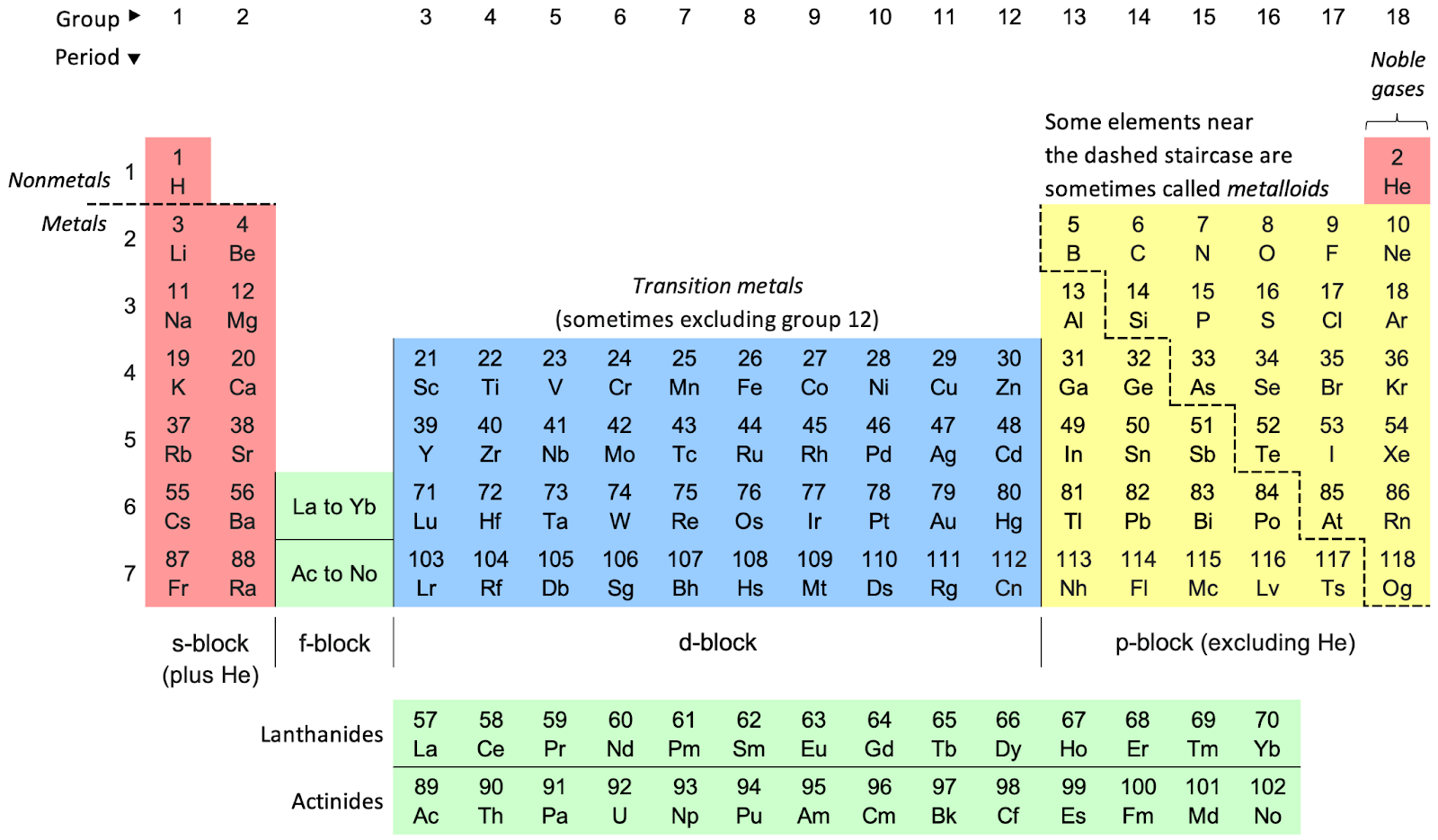
The Periodic Table: Classification of Elements
Some elements in the periodic table can cause explosions when combined with water and other
elements, such as neon, do not explode at all. Some elements, such as lithium and potassium, may
seem very different, but because of the periodic table, we can understand the periodic
relationship between them and the properties that cause them to behave like one another.
The periodic table is one of the most useful tools in chemistry. Once you learn how to read it,
you will be able to identify and understand the elements' properties.
What Is the Periodic Table?
The periodic table is a list of elements ordered by the atomic number.
- The table is arranged in vertical columns. Elements in the same column share similar
chemical properties and reactivity because they have the same number of valence electrons.
- Elements in the same horizontal row have the same number of filled electron shells.
The periodic table helps chemists understand and predict the elements' chemical properties.
Historical Development
Elements were first classified by Dmitri Mendeleev in 1869. He grouped elements by atomic mass
and discovered repeating patterns in their properties. He predicted that there were some
elements that were yet to be found and left gaps in his table for elements like gallium and
germanium, which were discovered later. The modern periodic table is arranged by periodic law
which states that the properties of elements are a periodic function of their atomic number.
Structure of the Periodic Table
Groups (Vertical Columns):
1 to 18 are used to number the periodic table. Elements in the same group have the same number of
valence electrons and therefore similar chemical behavior.
Examples:
- Group 1 (Alkali Metals): Lithium (Li) and sodium (Na) are very reactive and
even violent with water.
- Group 17 (Halogens): Fluorine (F) and chlorine (Cl) are reactive and form
salts with metals.
Periods (Horizontal Rows):
The table is numbered 1-7 with each number corresponding to the number of electron shell levels.
In a period, the properties change from metallic to non-metallic.
Blocks:
s-block
groups 1-2 (plus helium); valence electrons
in s-orbital.
p-block
groups 13-18; valence electrons in
p-orbital.
d-block
Transition metals; valence electrons in
d-orbital.
f-block
Lanthanides and actinides; electrons in
f-orbital.
Classification of Elements
Metals
Found on the left and center of the table.
Characteristics:
- Good conductors of heat and electricity.
- Malleable and ductile.
- Tend to lose electrons, forming positive ions (cations).
- Usually have high melting and boiling points.
- Examples: Sodium (Na), Iron (Fe), Copper (Cu)
Nonmetals
Located on the right side of the periodic table.
Characteristics:
- Poor conductors of heat and electricity.
- Brittle in solid form.
- Tend to gain or share electrons, forming negative ions (anions) or covalent bonds.
- Low melting and boiling points.
- Examples: Oxygen (O), Nitrogen (N), Sulfur (S)
Metalloids
Located along the stair-step line between metals and nonmetals.
Characteristics:
- Exhibit mixed properties of metals and nonmetals.
- Semi conductors, which are often used in electronics.
- Can behave like metals or nonmetals depending on the reaction.
- Examples: Boron (B), Silicon (Si), Arsenic (As)
Transition Elements
Located in the d block of groups 3-12.
Characteristics:
- Multiple oxidation states.
- Form colored compounds.
- Often act as catalysts in chemical reactions.
- Examples: Iron (Fe), Copper (Cu), Nickel (Ni)
Inner Transition Elements
- Lanthanides: Shiny and high melting metals used in magnets and
electronics.
- Actinides: Radioactive, including Uranium (U), and Thorium (Th).
Periodic Trends
The periodic table helps predict how elements behave.
Atomic Radius
Distance from the center of the nucleus to the outermost shell of the atom.
Trend:
- Across a period: decreases
- Down a group: increases
Explanation: Across a period: decreases due to a stronger nuclear
charge, resulting in electrons being closer to the nucleus. Down a group: increases as
new electron shells are added, resulting in a higher distance from the nucleus.
Ionization Energy
Energy needed to remove an electron from a gaseous atom.
Trend:
- Across a period: increases
- Down a group: decreases
Example: sodium loses one electron more easily compared to neon, which holds electrons
more tightly.
Electronegativity
Tendency of an atom to attract electrons in a bond.
Trend:
- Across a period: increases
- Down a group: decreases
Note: Fluorine is the most electronegative atom.
Electron Affinity
Change in energy when an atom gains an electron.
Trend:
- Across a period: more negative (more energy released)
- Down a group: less negative (less energy released)
Note: Chlorine easily gains an electron, thus forming Cl⁻.
Metallic vs. Nonmetallic Character
- Metals: lose electrons, form cations, and their reactivity
increases down a group.
- Nonmetals: gain electrons, form anions, and their reactivity
decreases down a group.
Importance of the periodic table
The periodic table is much more than just a table to be memorized. It:
- Predicts chemical reactions: alkali metals violently react with water, and halogens form
salts with metals.
- Explains bonding: elements in group 14 form covalent compounds, whereas group 17 elements
form ionic compounds.
- The periodic table of elements exhibits certain properties on a consistent basis as one
moves from left to right and from top to bottom. These properties include melting points,
density, and hardness.
- Unexplored "gaps" in the table indicate missing elements.
Example: Though lithium (Li) and potassium (K) are far apart in the periodic
table, both produce hydrogen gas when they react with water.
Reactive fluorine (F) gas has high electronegativity, and inert neon (Ne) gas does not react
at all because its valence shell is full.
Summary
- The periodic table allows quick classification of elements, chemical reactions, and
prediction of unknown properties to chemists.
- Periodic table is organized by atomic number not atomic mass. It consists of 7 rows
(periods) and 18 columns (groups).
- The columns (groups) contain elements with the same number of valence electrons, and
thus exhibit similar chemical behavior.
- The rows (periods) contain elements with the same number of filled electron shells, and
exhibit chemical properties that change in a systematic way.
- The classification of elements as metals, nonmetals, and metalloids is based on features
such as conductivity, malleability, and the behavior of electrons in these elements.
- The transition metals and inner transition metals are distinguished by special
properties, including multiple oxidation states.
- Periodic trends include atomic radius, ionization energy, electronegativity, and
electron affinity.
The periodic table is the foundation of all chemistry. It is one of the most important tools and
represents the map of chemical behavior. It allows the prediction of reactivity, the formation
of compounds, and the behavior of elements in nature.