

On this page:
Introduction What Is An Atom? Discovery of Electron Discovery of the Nucleus Structure of the Nuclear Atom Atomic Number and Mass Number Isotopes Electron Organization and Levels of Energy Stability and Nuclear Forces Ions and Atomic Charge Significance of the Nuclear Atom Overview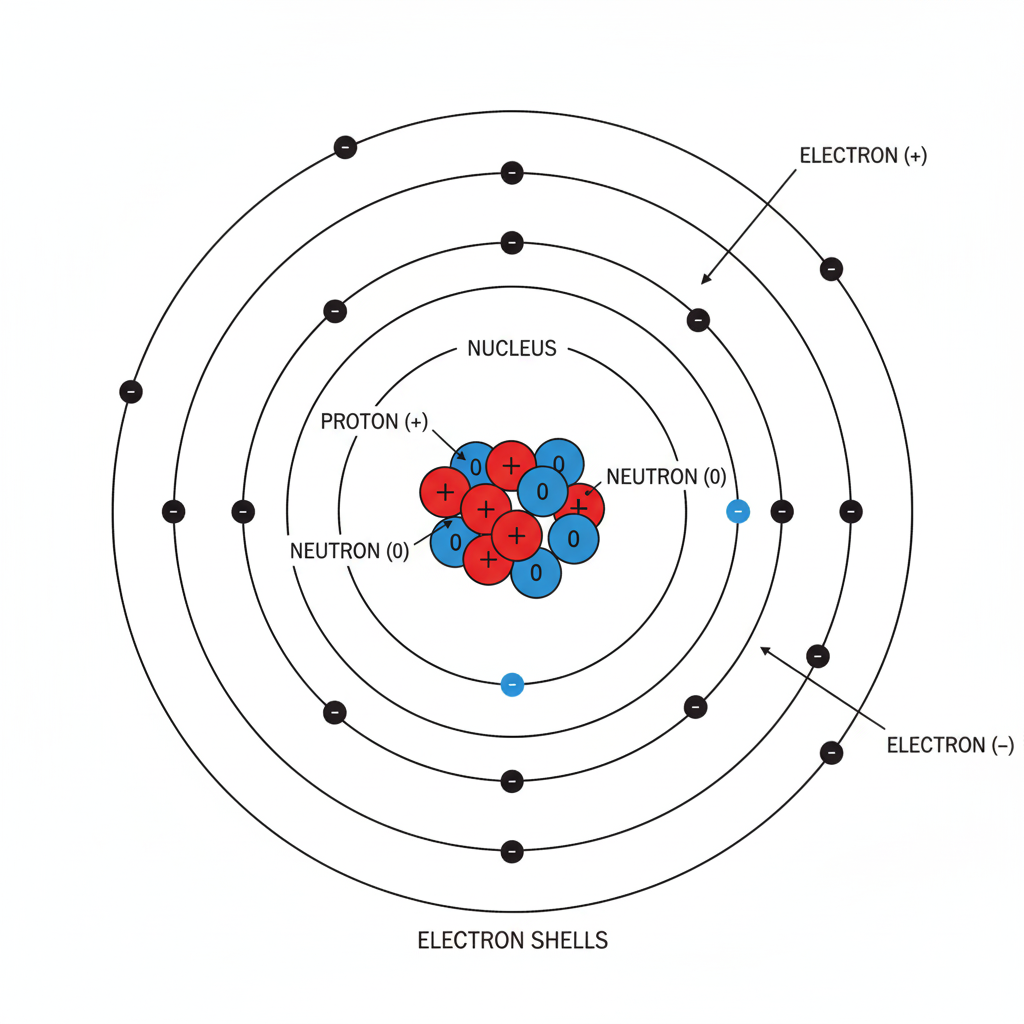
The devices we use, the air we breathe, and all other things in the universe are made of matter. This matter is made up of extremely small particles called atoms. These atoms, in turn, are made of particles, which determine the properties of the atom, such as mass and charge, and the way it chemically reacts with other atoms. An atom is not a solid entity; it has a centre and a number of electrons that orbit it in specific locations. This is the definition of a nuclear atom.
It is equally important to understand the nuclear atom for other subjects such as radioactivity, electrical phenomena, and the stability and structure of matter. The nuclear model signifies that most of the mass in an atom is located in the nucleus, while most of its volume is space, since all matter is made up of atoms.
Atoms are the smallest units of an element that keep the element's chemical identity. Each atom contains:
In the nucleus are large subatomic particles, and electrons are smaller and constantly in motion around the nucleus.
Atoms are key in making up all the chemical and physical properties of matter. An average human hair can contain millions of atoms.
J.J. Thomson discovered the electron in 1897 as he was studying cathode rays. He showed that atoms contain negatively charged particles that are of low mass.
The existence of electrons showed that atoms can be broken down into smaller particles.
In 1911, Ernest Rutherford performed the 'gold foil experiment.' He directed alpha particles at a thin gold foil and made three observations:
From these three observations, Rutherford made some conclusions.
As a result of these conclusions, Rutherford created his own atomic model, which dethroned the 'plum pudding' model created by Thomson. The nucleus of an atom includes two key types of subatomic particles:
| Particle | Charge | Location | Relative Mass |
|---|---|---|---|
| Proton | +1 | Nucleus | ~1 u |
| Neutron | 0 | Nucleus | ~1 u |
| Electron | −1 | Electron cloud | ~1/1836 u |
Key points of the above table:
Atomic Number (Z) - The number of protons in the nucleus determines the identity of the element. In neutral atoms, the number of protons equals the number of electrons. For example, in the case of Hydrogen, Z=1, in the case of Carbon, Z=6, in the case of Oxygen, Z=8.
Mass Number (A) - The mass number is the total number of protons and neutrons. The mass of electrons is negligible. Thus, A = number of protons + number of neutrons.
Isotopes are atoms of the same element that have an identical number of protons but a different number of neutrons.
All isotopes of an element exhibit the same chemical behavior because they have the same number of electrons arranged in the same way, but they exhibit different physical properties, such as different masses and different nuclear stability.
For example, Carbon-12 and Carbon-14 (both have 6 protons but have a different number of neutrons). Isotopes have many applications, including in the fields of nuclear medicine, research, and radiocarbon dating.
Electrons are found at certain levels of energy (shells) around the center of the atom.
Positively charged protons repel each other in the nucleus, but the nuclear force can counter this:
Ions are formed when an atom loses or gains electrons.
Ions are very important in the study of electricity, electrochemistry, and chemical reactivity.
Nuclear atoms aid our understanding of:
Examples include:
Without such understanding, one can not comprehend modern chemistry, physics, & nuclear science.
The nuclear atom model represents an atom as a nucleus, dense with protons & neutrons, with surrounding electrons arranged in layers of quantized energy. This structure accounts for the identity, mass, chemical behavior, & nuclear stability of an element.