

On this page:
Introduction Atomic Structure and Stability Formation of Ions Electron Transfer and Ionic Bonding Coulomb's Law Crystal Lattice Structure Properties of Ionic Compounds Energy Changes in Ionic Bond Formation Ionic Behavior and the Periodic Table Naming Ionic Compounds Real-World Applications and Industrial Relevance Why the Ionic Model Matters in DP Chemistry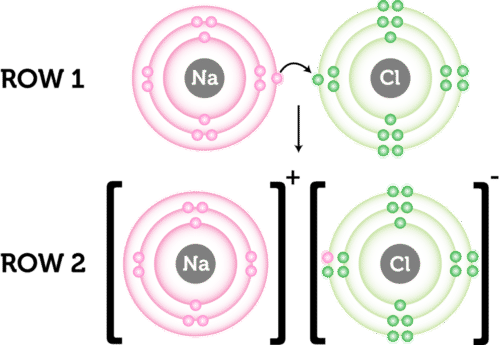
Look at table salt (NaCl). It looks very simple, but it is made up of a very complex and ordered lattice of ions. The ionic model describes a process in which atoms lose and gain electrons to create ions, which then settle in a crystal lattice. This model is very important in DP Chemistry because it integrates the atomic structure, lattice energy, periodic trends, and the properties of materials.
Atoms are made of:
Each atom possesses electron shells, or energy levels, surrounding the nucleus (like planets orbiting the sun), with the outermost one being the valence shell, which influences its chemical reactivity. The full valence shell makes the atom more stable. This is called the 'noble gas configuration', which describes the state of minimal energy.
The sodium atom (Na) contains one valence electron, and as a result, is likely to lose this electron, resulting in the formation of a positively charged sodium ion [Na⁺].
On the other hand, the chlorine atom (Cl) possesses seven outermost shell electrons and therefore, is likely to gain one electron - resulting in the formation of a negatively charged chlorine ion [Cl⁻].
This strong drive for electronic stability (noble gas configuration) is the basis of ionic bonding, whereby the transfer of electrons between two atoms allows each to achieve a full valence shell (octet).
Ions are charged particles that can be formed when an atom loses or gains an electron(s).
The amount of charge formed, and the size of the ionic radius (how big or small an atom or ion can be), change based on the number of electrons that are gained or lost. E.g:
This explains the periodic law, which helps to determine the arrangement and electrostatic attraction of the elements.
Ionic bonding happens when there is an electrostatic attraction between a cation and an anion. This type of attraction is non-directional and can happen anywhere in a structure.
Example: Sodium Chloride (NaCl)
The strength of ionic bonds can be determined by using Coulomb's law:
E ∝ (Q₁ × Q₂) / r
Where:
(Q₁) and (Q₂) are the charges of the opposing ions, and
(r) is the distance that separates the two opposing ions.
The higher the charges of the ions and the smaller the distance, the stronger the bond. This energy is known to be the lattice energy.
Ionic compounds don't form individual molecules; instead, they create large three-dimensional lattices with the following characteristics:
Lattice Consequences
Lattice Arrangement
The above characteristics of ionic compounds explain differences in ionic packing efficiency. For example, there are differences in the structures of NaCl, CsCl, and CaF₂.
Ionic compounds such as sodium chloride (NaCl) and magnesium oxide (MgO) have strong electrostatic attraction due to high lattice energy, making it difficult to break apart the compounds, thus requiring high temperature to melt and boil these compounds. Example: NaCl melts at 801°, and MgO melts above 2,800° due to higher lattice energy.
In a solid form, the ions that compose the lattice of an ionic solid. This accounts for the rigidity of the solid and the ordered arrangement that develops into a crystal. For example, NaCl has a cubic shape, while the CaF₂ shape is a fluorite cubic crystal.
Under an external force, the ionic solid undergoes shifts in the layers of the lattice, and due to the movement, like charges in the shifted layers repel, leading to fractures.
An ionic solid is non-conductive because the ions in the solid form are immobile. However, it becomes conductive when the ionic solid is melted (molten) or dissolved in water (aqueous) as the ions contained in the liquid state are mobile.
Water molecules that are in the liquid state are polar and can effectively solvate (surround) the ions of an ionic solid. This solvation effectively overcomes the electrostatic attraction (lattice energy) that resists the dissolving of the ionic solid. This results in the dissociation of the dissolved ions, forming an electrolytic solution, enabling the conductivity of the solution.
The enthalpy changes that happen in the process of forming one ionic bond involve:
The stability of the solid ionic compounds can be quantified in terms of lattice energy:
U = k × (Q₁ × Q₂) ÷ r₀
Where:
• U = lattice energy (energy released when an ionic lattice forms)
• k = proportionality constant
• Q₁ and Q₂ = charges of the cation and anion
• r₀ = distance between the ion centers (sum of ionic radii)
The greater the lattice energy, the greater the bonding strength, the greater the melting point, and the greater the thermostability.
Example: The lattice energy of MgO is about 3,960 kJ/mol, while that of NaCl is about 786 kJ/mol. NaCl has a lower lattice energy than MgO. This creates a relationship that can be found in the Periodic Table.
Valence electrons by group:
Example: Mg²⁺ + O²⁻ → MgO
Ionic formulas. Periodic trends create a bond strength and stability.
An example of an ionic formula is: Mg²⁺ + 2Cl⁻ produces MgCl₂.
The sum of the positive and the negative charges in a compound must be equal; as such, the compound must be neutral. Formal charges can also be applied to verify correct ionic formulas.
Composing metallic first and nonmetal last. Composing nonmetal these end in "-ide."
Examples:
The ionic model describes:
Base for: