

On this page:
Introduction What Is a Proton Transfer Reaction? Brønsted-Lowry Theory Conjugate Acid-Base Pairs Strong and Weak Acids and Bases Amphiprotic Substances Factors Affecting Proton Transfer Indicators of Proton Transfer Proton Transfer Reactions We Encounter Daily Key TakeawaysWhy does lemon juice taste sour? Why does soap feel slippery? Why does some food make your stomach feel acidic? It is because of the tiny particles called protons. The movement of protons is a proton transfer reaction and is a key element in the understanding of acids, bases, and a number of other chemical reactions.
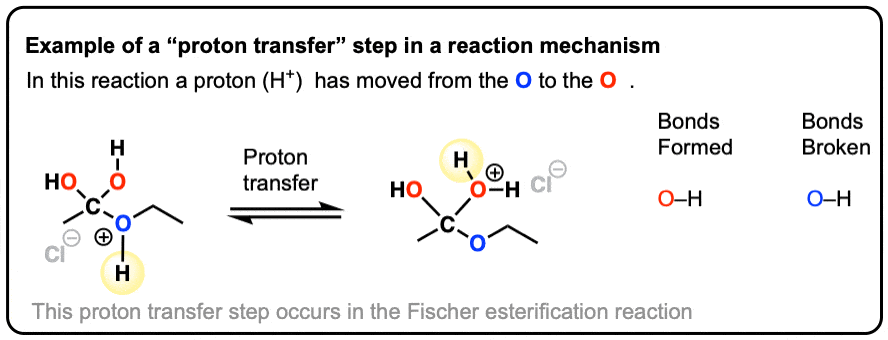
A proton transfer reaction is a type of chemical reaction where a proton (H⁺) is transferred from one chemical species to another.
Simply put:
Example: When hydrochloric acid is mixed with water, the following reaction occurs:
Notice the change that proton transfer creates new ions. It alters the pH and the conductivity.
The Brønsted-Lowry Theory is the most commonly used way to explain proton transfer.
This theory is applicable to every solvent. So, it is more complete than the Arrhenius theory.
Key Note: Every reaction that involves the transfer of a proton will contain a set of conjugate acid-base pairs, and this is essential for understanding the behavior of the reaction and whether it will reverse.
The conjugate acid of a base is formed when that base gains a proton.
The conjugate base of an acid is formed when that acid loses a proton.
Example:
Notice the pairs:
These pairs help chemists to determine if a reaction is reversible. In other words, these pairs help chemists predict that a reaction will proceed in both directions until it reaches equilibrium.
Strong acids and strong bases are different from weak acids and weak bases.
Completely donate or accept protons in water.
Examples: HCl, HNO₃, NaOH
They will completely react, leaving very few reactants.
Partially donate or accept protons.
Examples: CH₃COOH, NH₃
The reaction reaches equilibrium where both products and reactants exist together.
Equilibrium in proton transfer: Both forward and backward reactions can occur.
The stronger acid transfers its proton to the stronger base.
The reaction shifts to favor the weaker acid-base pair which is more stable.
Amphiprotic substances can act as acids and bases.
Example: H₂O
Other amphiprotic substances: HCO₃⁻, HSO₄⁻, and HPO₄²⁻
Amphiprotic substances are important because they can buffer biological systems and the pH in the lab.
Several factors influence proton transfer:
Stronger acids will transfer protons more easily.
Stronger bases will accept protons more efficiently.
Polar solvents (like water) make proton transfer easier.
Higher concentrations increase collisions which increases the reaction.
Higher temperatures increase the rate of reaction.
Food is subdivided into simpler constituents by HCl (hydrochloric acid) present in our stomachs.
Soaps react with alkaline and acidic solutions to eliminate grease.
When baking soda (NaHCO₃) comes in contact with any reactive acid, there is production of carbon dioxide, which causes the dough to rise.
Proton transfer takes place in the action of antacids, which neutralize excess acid in the stomach.
If you understand why acid and base behave differently, then you understand proton transfer reactions.
Proton transfer reactions explain the interaction between acids and bases in your stomach, in cleaners, in baked goods, and in medicines. Knowing how these reactions work helps chemists predict how substances will react, balance chemical equations, and use reactions in a desired way.
Keep these points in mind, and you will see proton transfer reactions as more than abstract equations, but as processes that influence day-to-day and lab chemistry.