

On this page:
Introduction What's Energy? Why Measuring Enthalpy is Important Measuring Enthalpy Changes 1) Calorimetry 2) Hess's Law 3) Calculating Bond Enthalpy Accuracy and Precision in Measuring Enthalpy Practical Considerations Units and Conversions Example Calculations Why This Matters in Chemistry Summary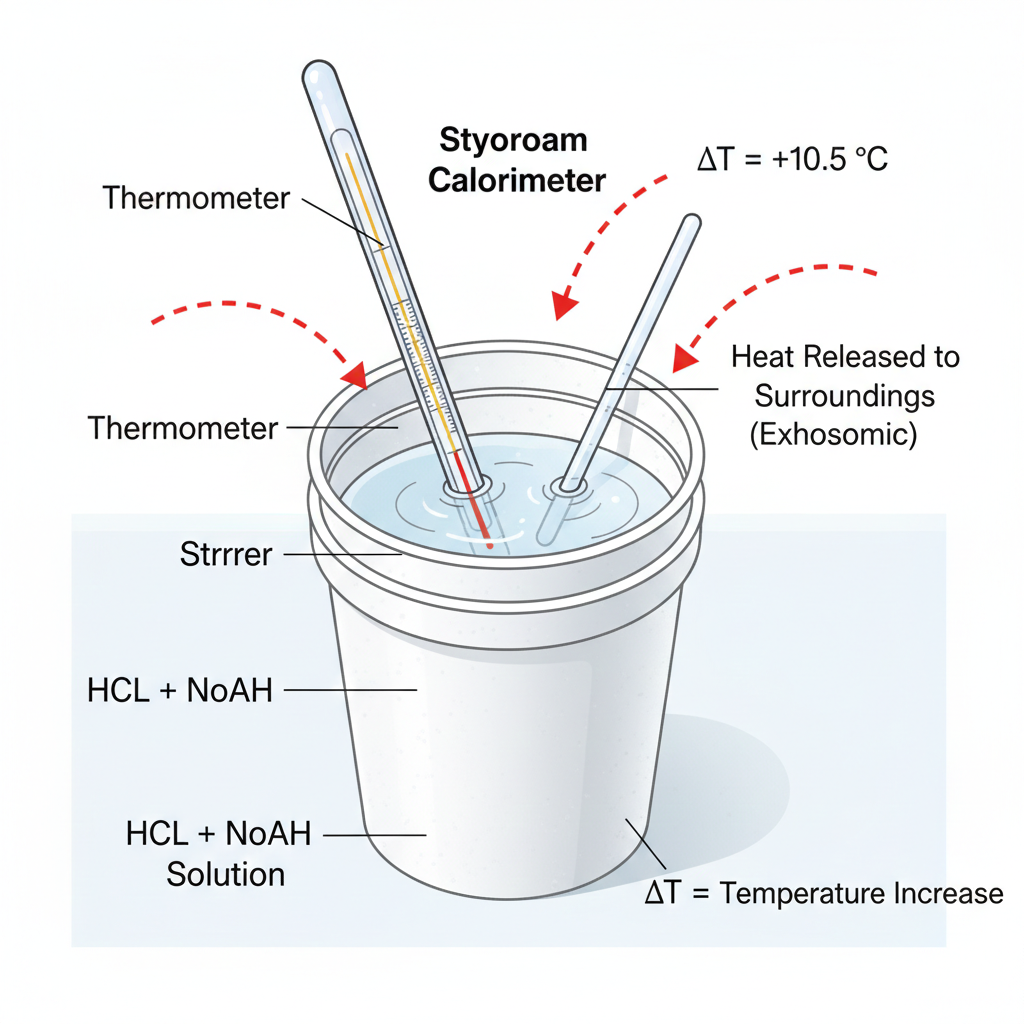
Some reactions are hot, and some are cold. Some mix chemicals and release energy, while some mix and absorb energy.
When performing chemistry reactions, it is important to understand enthalpy changes to measure the energy involved in the reaction. This energy is important to know when designing a reaction that fuels the reaction (i.e., when designing a cooking fuel).
Enthalpy (H) is the energy in the system of chemistry at constant pressure. Enthalpy will tell the chemists how much energy is released and how much energy is absorbed.
Example:
Enthalpy change (ΔH) is given by the formula,
ΔH = Hproducts - Hreactants
If ΔH is negative, it is exothermic; if ΔH is positive, it is endothermic.
Measuring enthalpy changes is important for several reasons.
There are several different methods for measuring enthalpy changes, depending on the interpretation of the reaction.
Direct measurement of heat changes using a calorimeter.
Indirect calculation using known enthalpy changes of related reactions.
Calculation using average bond energies.
Calorimetry is the measurement of heat changes in a chemical reaction. When heat is exchanged in a reaction, a device known as a calorimeter is used.
We can create an experiment to determine the thermal energy of a neutralization reaction rather simply. To determine the thermal energy of a reaction, we simply need to determine the temperature change caused by the reaction and then plug this value into a formula.
Equipment:
We use the following to calculate the energy change (thermal energy) of the reaction (q) to find the change in heat (ΔH):
Q = mcΔT
m = mass of solution (g)
c = specific heat capacity (4.18 J/g/K for water)
ΔT = temperature change (K or °C)
There is a relationship between q and ΔH where: ΔH = -q / (moles of limiting reactant), where the negative sign states that the system lost heat to the surroundings.
An example of this reaction is the Neutralization of an acid with a base. Measure the temperature change (ΔT) of the water and use this data to calculate ΔH of the neutralization reaction.
Important Points to Remember
Hess's Law states that we can find the change in heat (ΔH) for a reaction that cannot be directly measured by finding the ΔH for related (preceding) reactions, and then using their ΔH values to calculate the ΔH of the reaction in question.
The total enthalpy change (ΔH) for all the steps in a process in the same direction is equal to the ΔH for the total process. This is true regardless of the nature of the individual steps. ΔH is independent of the reaction pathway.
The reaction of carbon with oxygen (C + O) to yield carbon dioxide (CO₂) is probably the hardest to measure directly. However, the enthalpy change for the reaction of carbon monoxide (CO) with oxygen (O₂) to yield carbon dioxide (CO₂) can be calculated using Hess's law.
Another indirect method involves the use of average bond enthalpies.
ΔH ≈ Σ(Broken bonds) - Σ(Formed bonds)
Example: ΔH for the combustion of CH₄ (methane)
Limitation: This method is the least accurate; it only works for approximate values. Preferred for gaseous states.
Both in physics and in chemistry, measurement must be accurate and precise. This is also true in the measurement of enthalpy.
Uncertainty: Every measurement has a built-in uncertainty, which is a possible range of values around the measured value, expressed as ±
For example, ΔH = −57.3 ± 0.5 kJ mol⁻¹
When measuring enthalpy in the laboratory, we must:
50.0 cm³ of 1.0 mol dm⁻³ HCl reacts with 50.0 cm³ of 1.0 mol dm⁻³ NaOH. The temperature increases from 20.0°C to 25.5°C.
Step 1: Calculate q
Mass of solution = m = 100g
Specific heat capacity: c = 4.18 J g⁻¹ K⁻¹
ΔT = 25.5 - 20.0 = 5.5 K
Formula: Q = mcΔT
Q = (100 g)(4.18 J g⁻¹ K⁻¹)(5.5 K)
Q = 2299 J ≈ 2300 J
Step 2: Convert to kJ
q = 2300 J ÷ 1000 = 2.30 kJ
Step 3: Calculate ΔH per mole
The moles of HCl: = 0.050 L × 1 mol/L = 0.050 mol
ΔH = -2.30 kJ / 0.050 mol = -46.0 kJ/mol
Negative → exothermic
Measuring enthalpy changes shows:
All of this hinges on measuring:
For example, to accomplish this you need:
ΔH involves all of these. Errors in any of these will give wrong ΔH and wrong conclusions.
Energy is not visible in Chemistry. However, enthalpy changes provide a measure that allows us to appreciate it.