

On this page:
Introduction What is the matter? The Particle Model of Matter Atoms - The Basic Units of Matter Molecules: Structures Designed from Atoms Solid State Liquid State Gas State Kinetic Energy and Motion of Particles Behavior of Particles and States of Matter Diffusion The Evidence of the Particle Model Density and the Arrangement of Particles The Conservation of Matter Importance of the Particle Model The Particle Model Summary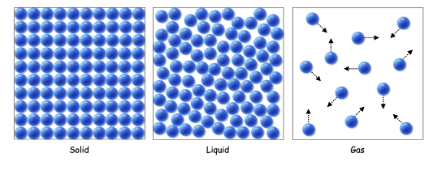
Every substance in the observable universe, whether it is as common as air or as complex as biological organisms, is made of tiny, discrete particles. Even though these fundamental particles are too tiny to see, they still determine the observable properties and behaviors of matter. A solid understanding of these interactions explains why some substances are denser than others, why they can change from one state to another, and why they react chemically. The particle model is one of the more important models in Chemistry as it is used to explain the different behaviors of matter at the atomic and molecular level.
Matter is anything that has mass and takes up space. This includes all solids, liquids, and gases. All matter is made up of atoms and molecules, which are:
While we cannot see individual particles of matter, we can see and measure their collective behaviors, which we can then describe in terms of matter's physical and chemical properties.
The particle model gives us a good explanation of matter's behavior on a microscopic scale:
This theory helps us to understand phenomena like:
An atom is the smallest unit of an element that still has the chemical properties of that element. Atoms are very, very small; about 1 x 10^-10 meters. It is not possible to see individual atoms with a light microscope. The special type of microscope that permits direct viewing of individual atoms is a scanning tunneling microscope (STM) or an electron microscope. Some examples of atoms include:
Atoms form the fundamental basis of all substances and the basis for molecular design and chemical activity.
Molecules come from the chemical connection of 2 or more of the same or different atoms.
Some instances include:
The structure of the molecule controls its physical and chemical characteristics of the molecule. This includes polarity, reaction, and what phase the molecule exists in. Most substances that occur in nature exist in multiple molecular arrangements.
The motion of the particles known as kinetic motion, contributes to thermal energy. The motion of particles (which is what defines thermal energy) is an indicator of how much kinetic energy there is. This defines how much motion there is. All particles are always in motion, and the more you add to the temperature, the more kinetic energy there is, which also defines the more motion there is. The lower the temperature, the less motion.
The motion of the particles is what defines thermal expansion; the motion defines the kinetic energy of what is in the container, which also defines the more motion there is.
The motion of the particles is what defines the state of the particles. There is a change in energy transfer, while the particles remain the same. This is called phase change.
Some common examples include:
Diffusion is the random movement of particles. There is movement from one area, and then it is concentrated in one area, while the surrounding area is less.
Examples include:
Diffusion from Solid to Liquid to Gas is the fastest in that order.
The experimental and observational evidence also supports the particle model. The evidence for the various aspects of the particle model includes the following:
The evidence supports the fundamental aspects of matter.
The equation for density states:
Density = Mass / Volume
Density also describes how particles are arranged:
The arrangement of particles explains the following:
The law of conservation of matter states that matter cannot be created or destroyed in any physical change.
In melting, boiling, or freezing, the number of particles stays the same. Only the arrangement of these particles in space and the kinetic energy of the particles change. The total mass of the system is conserved.
The particle model is one of the most essential models as it allows one to explain and predict the following:
To understand the behavior of matter at the particle level is essential to facilitate sophisticated chemical analysis and molecular modeling.
Here are the key principles:
For Chemistry, the Particle Model helps explain how Chemistry and Physics interact on a molecular and atomic level.