

On this page:
Introduction What is a gas? What Is an Ideal Gas? Kinetic Molecular Theory of Gases Gas Pressure Gas Variables Temperature and the Kelvin Scale Boyle's Law Charle's Law Avogadro's Law Moles and Gas Volume Real Gases and Ideal Behavior Diffusion and Effusion Applications of Ideal Gases Why Ideal Gases Matter In Chemistry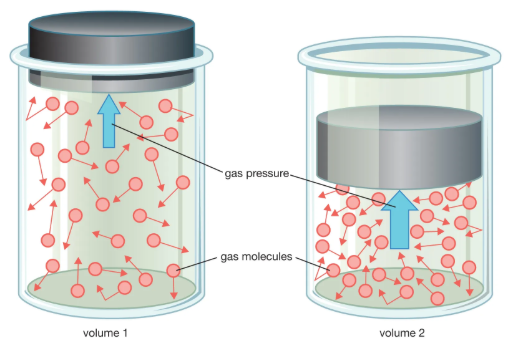
Air is invisible but has mass, pressure, and energy. It expands, compresses, and moves all the time. Chemists study the behavior of gases using the ideal gas model, which simplifies the behavior and allows the prediction of the relationships of pressure, volume, and temperature. Knowledge of ideal gases allows one to make quantitative calculations in any system, from an engine to the atmosphere.
A gas is a state of matter in which the particles:
Example: When a balloon is inflated, there is an expanding gas that is taking up all the available volume.
Here are the assumptions about an Ideal Gas:
Ideal conditions are not possible, but at high temperature and low gas pressure, many gases begin to behave as though they are ideal gases.
The kinetic molecular theory of gases explains the macroscopic behavior of gases based on particle movement. The individual gas molecules:
The average temperature of the gas is directly proportional to the average kinetic energy. The mathematical expression for the average kinetic energy of gas particles is:
Where:
Eₖᵢₙ = average kinetic energy of particles (J)
kᴮ = Boltzmann constant (1.38 × 10⁻²³ J·K⁻¹)
T = absolute temperature (K)
Gas pressure is the result of constant collisions of gas molecules with the walls of the containers. The pressure exerted is a result of:
Pressure can be measured in pascal (Pa) or can be expressed in other units such as atm, bar, or torr.
The state of a gas can be described with the help of the following gas variables:
These variables are interconnected with each other, which lays the foundation for various gas laws.
Temperature is a measure of the average kinetic energy of the particles in a substance. The Kelvin scale is a critical component in gas law calculations, as it is the only temperature scale that begins at a point where all particle motion ceases (0 K). Therefore, all Kelvin values are positive.
Temperature in Kelvin can be calculated from degrees Celsius by the equation:
K = °C + 273.15
The law was discovered by Robert Boyle and states that at constant temperature, the pressure of a fixed amount of gas is inversely proportional to its volume.
Mathematically:
P ∝ 1/V
or
P₁V₁ = P₂V₂
This means:
Example: Compressing a syringe increases pressure as volume decreases.
The law was discovered by Jacques Charles, and states that at constant pressure, the volume of a fixed amount of gas is directly proportional to its absolute temperature.
Mathematically:
V ∝ T
or
V₁/T₁ = V₂/T₂
This means:
Example: A heated balloon expands as the temperature of the gas increases.
Proposed by Amedeo Avogadro, states that at constant temperature and pressure, the volume of a gas is directly proportional to the number of moles.
Mathematically:
V ∝ n
or
V₁/n₁ = V₂/n₂
This means:
Example: Adding more air increases balloon volume at constant temperature and pressure.
This equation makes it possible to make a quantitative calculation of an unknown property of a gas.
At standard temperature and pressure (STP):
This relationship connects:
Moles ⇄ Gas Volume ⇄ Number of Particles
The mole is a unit of measurement that allows a quantitative relationship to be made between microscopic particles of gas and the macroscopic volume of gas.
The behavior of real gases differs from that of ideal gases because of:
The ideal gas approximation is better under:
Examples include: the scent of perfume and the escape of helium from a balloon.
Ideal gas principles help explain many everyday activities, such as:
Detailed:
Using the ideal gas model, chemists can:
The ideal gas model enables chemists and physicists to bridge the gap between invisible molecular motion and the macroscopic measurable properties of the system. This forms the basis of thermodynamics, chemical kinetics, and physical chemistry.