

On this page:
Introduction What Is a Functional Group? Significance of functional groups Classification of Organic Compounds Summary Table of Functional Groups Key Points to Remember Importance of functional groups in Chemistry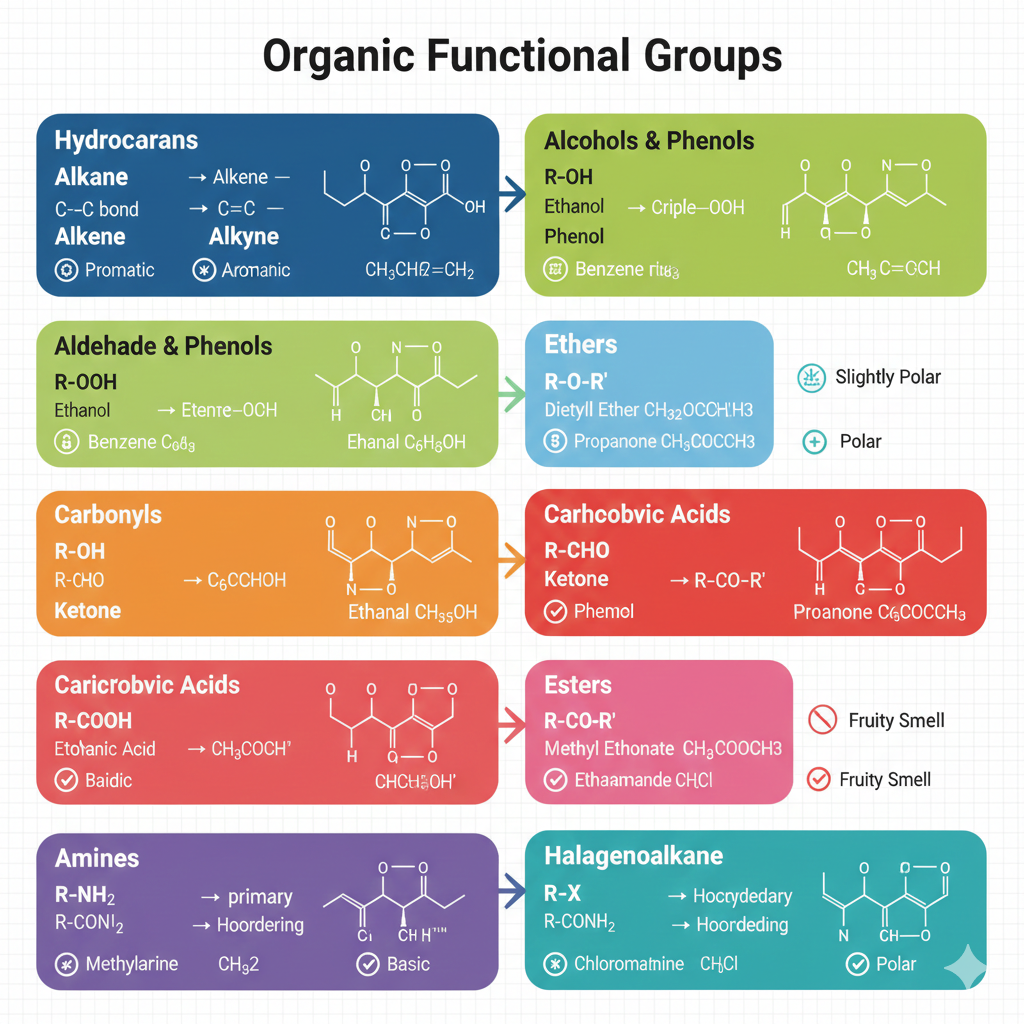
Think about it. Did you know that nearly everything you use, wear or eat is made from molecules that have carbon in them? The sugar in your tea, and the plastic in your pen, belong to the enormous family of organic compounds. The secret to their reactions and properties lies in a functional group which is a small part of the molecule.
Predicting the behavioral patterns of organic compounds requires an understanding of functional groups. Let's explore them.
A functional group is a set of atoms that is specific and within a molecule that defines the molecule's chemical characteristics and its ability to undergo chemical reactions. The rest of the molecule may consists of carbon and hydrogen, but the functional group has a specific characteristic in a particular way across different molecules.
Alcohols have the -OH grouping.
Carboxylic acids have the -COOH grouping.
These groups work like "chemical fingerprints" to aid in the identification and classification of organic compounds.
Functional groups are like the engine of a car. The engine determines how fast or slow a car would move, and in the same way, a functional group determines how fast or slow a reaction is.
With the help of functional groups, organic compounds have been classified into different categories. The classification is as follows.
Compounds consisting of carbon and hydrogen.
Have an oxygen atom in between two carbons (R–O–R). Example: Dimethyl ether (CH₃OCH₃). Properties: Relatively inert, polar, lower boiling points than alcohols.
Contain the C=O group (carbonyl group).
Contain –COOH. Example: Acetic acid (CH₃COOH). Properties: Weakly acidic, forms hydrogen bonds, soluble in water. Reactions: Neutralization, esterification.
Contain –COO– linking carbon chains. Example: Ethyl acetate (CH₃COOCH₂CH₃). Properties: Fruity scent, applications in perfume and flavoring. Reactions: Hydrolyzed to alcohol and acid.
General Structure: Contain -NH₂ (primary), -NHR (secondary), or -NR₂ (tertiary). Example: Methylamine (CH₃NH₂). Properties: Bases, react with acid to form salts. Uses: Pharmaceuticals, dye making.
General Structure: Contain -CONH₂. Example: Acetamide (CH₃CONH₂). Properties: Polar, high boiling points, stable. Reactions: Hydrolyzed to acids or amines.
Contain halogens (F, Cl, Br, I) attached to carbon. Example: Chloroethane (C₂H₅Cl). Properties: Varying polarity and reactivity. Reactions: Nucleophilic substitution and elimination.
| Functional Group | General Formula | Example | Key Properties |
|---|---|---|---|
| Alkane | CnH2n+2 | Methane | Saturated, low reactivity |
| Alkene | CnH2n | Ethene | Unsaturated, addition reactions |
| Alkyne | CnH2n–2 | Ethyne | Highly reactive, addition reactions |
| Alcohol | –OH | Ethanol | Polar, hydrogen bonding |
| Phenol | –OH (aromatic) | Phenol | Weakly acidic |
| Ether | R–O–R | Dimethyl ether | Relatively inert |
| Aldehyde | –CHO | Formaldehyde | Oxidizable |
| Ketone | –C=O | Acetone | Moderate reactivity |
| Carboxylic acid | –COOH | Acetic acid | Weakly acidic |
| Ester | –COO– | Ethyl acetate | Fruity smell, hydrolyzable |
| Amine | –NH₂, –NHR, –NR₂ | Methylamine | Basic, forms salts |
| Amide | –CONH₂ | Acetamide | Stable, polar |
| Haloalkane | –X (Cl, Br, I) | Chloroethane | React via substitution |
Think of them as DNA for chemicals. Identifying a functional group on a particular compound, you can mentally chart almost everything, from its activity and odor to its function.
An example includes;
The ability to identify functional groups enables chemists to quickly and systematically type, foresee, and modify molecules, a system that is crucial for organic synthesis and industrial chemistry.
In the most basic sense, functional groups are the most essential elements of organic chemistry. They offer a universal system to categorize organic compounds. Identifying a functional group enables you to forecast chemical reactions and physical properties and also enables you to navigate the extensive organic compounds library.
Every chemical group has a history – from hydrocarbons to halogenated compounds. Understanding these stories enables you to traverse the world of molecules with assertiveness.