

On this page:
Introduction What is Entropy? Everyday Examples of Entropy Influence of Factors on Entropy Spontaneous Processes What are Exothermic and Endothermic Reactions What is Gibbs Free energy? The Universe Entropy Standard Molar Entropy Temperature and Spontaneity Entropy and Chemical Reactions Summary Key Equations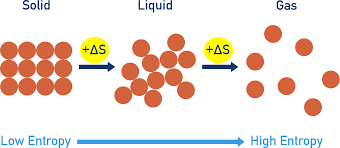
Chemistry is the science of reactions. There are some reactions that happen easily and quickly, like melting ice. Other reactions are unlikely and will not happen spontaneously, like freezing water. In this lesson we will learn about spontaneity and entropy and how they help scientists understand why some processes happen and why others do not.
Entropy is the measurement of the disorder of a system. It is a measure of how randomly the components of a system are arranged.
For example,
Essentially, energy and matter can be arranged in a high entropy state when they are spread out, and energy and matter are arranged in a low entropy state when they are compact.
Meaning of entropy is also the number of ways in which the constituents of the system could be arranged.
Several factors affect entropy, including the:
Entropy increases when there is freedom of movement:
Gases > Liquids >
Solids
Entropy increases when the temperature increases due to the increased speed of molecules. This causes more arrangements.
Entropy increases when there are more particles.
Entropy increases when there are complex molecules. More molecules lead to increased movement, which leads to increased vibrations and rotations.
For Example: In 1 mole of O₂ gas, the entropy is less when compared to 1 mole of C₆H₆ due to the increased way of movement in the gas.
For a spontaneous process, no outside assistance is needed.
Examples:
For a system, the energy changes and the entropy changes determine that spontaneity.
A key insight is that reactions can release energy but that alone, does not make a reaction spontaneous. There must be a factor that increases disorder.
G is the Gibbs Free Energy that chemists use. Gibbs Free Energy is the combination of enthalpy and entropy, and is expressed with the following formula:
ΔG = ΔH - TΔS
Where:
Result: There are three key concepts that can be used to analyze spontaneity and ΔG:
ΔG < 0
ΔG > 0
ΔG = 0
Example: ice at a temperature of 298 K:
Example: freezing water at a temperature of 298 K:
Every spontaneous reaction will increase the disorder in the universe (system + surroundings).
If a system's disorder decreases, the surroundings can avail space enough to gain entropy so that disorder is highly increased.
Example:
Each substance has a standard molar entropy (S°) recorded at 298 K and 1 atm.
Units: J mol⁻¹ K⁻¹
Trends:
This helps in calculating the entropy changes in the reactions:
ΔS°reaction = Σ S°products − Σ S°reactants
When ΔH and ΔS are of opposite signs, temperature will affect spontaneity.
Example:
Why this matters:
If you look around you, every reaction is guided by these principles, ice melts, gases expand, perfumes spread, fuel burns, and energy flows. This is the result of the delicate balance of entropy, enthalpy and temperature. Chemistry helps us quantify this balance in order to help us understand why nature behaves the way it does.
ΔS°reaction = Σ S°products − Σ S°reactants
ΔG = ΔH − TΔS