

On this page:
Introduction What is a fuel? Chemical Energy and Bond Breaking Enthalpy of Combustion Measuring Energy: Calorimetry Comparing Fuels Hydrogen as a Fuel Energy Efficiency Renewable vs Non-Renewable Fuels Safety and Environmental Considerations Energy from Fuels: Key Takeaways Why this matters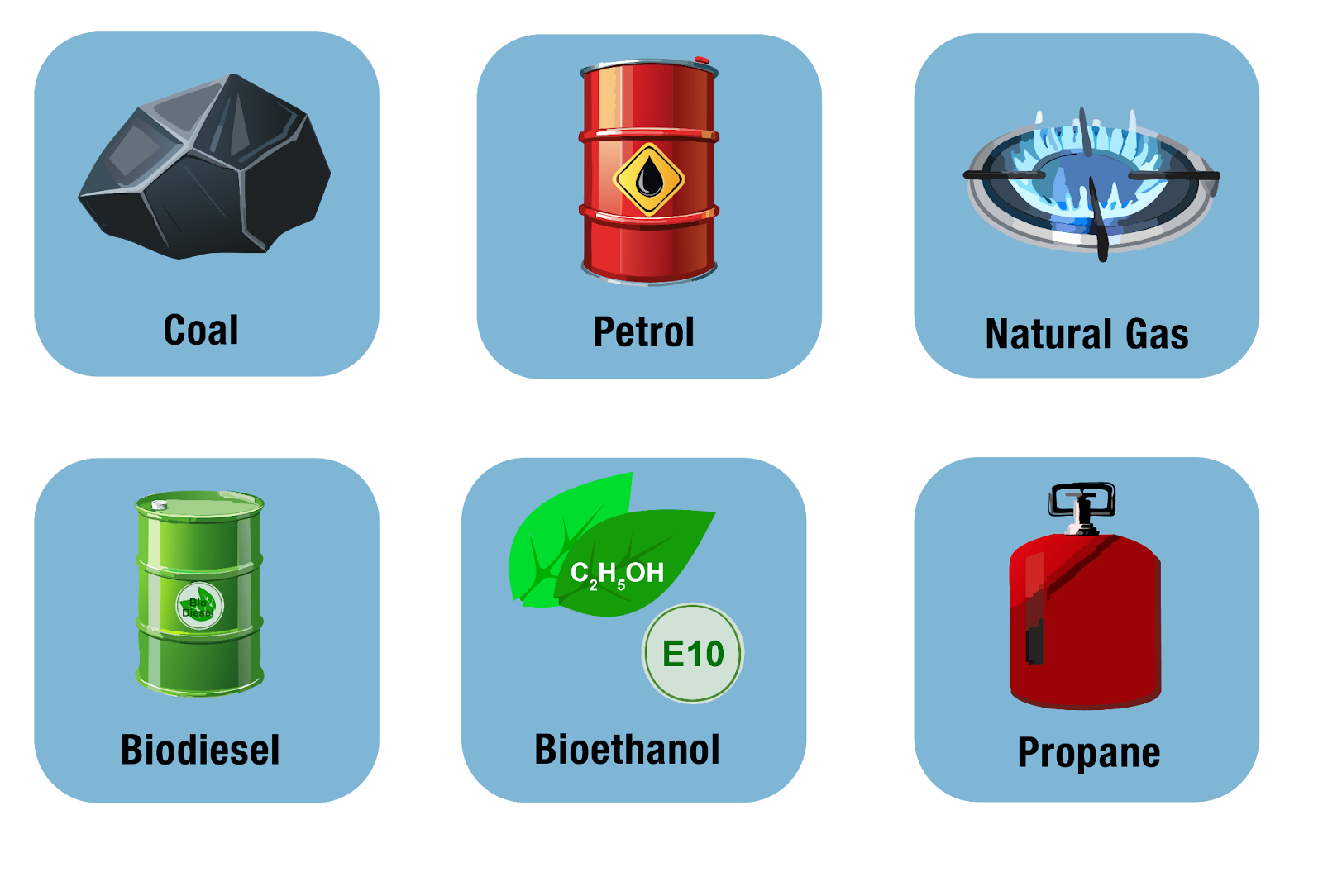
Have you ever thought about how petrol allows cars to drive, or how the energy in wood helps us keep warm? The answer to these is the energy that is stored in these fuels. All fuels release energy as the chemical bonds in the fuel break, and then new bonds are formed. This is essential to understand for chemistry, for the future, and how these apply in real life.
In this lesson, we will look at how scientists have developed methods to measure the energy stored in different fuels, and look at the chemical principles that explain how and why energy is released.
A fuel is a substance that has the ability to release energy that is stored in the chemical bonds of the substance in the form of light or heat when it is burned.
Some examples of fuels are: petrol, ethanol, methane, coal, and hydrogen.
Fuels can also be classified as renewable (like ethanol and biodiesel) or non-renewable (like coal and petrol).
The energy that is released is due to exothermic reactions and, more specifically, combustion.
Interesting fact: not all fuels release the same energy – more energy is produced when a mole of methane undergoes combustion than when a mole of ethanol does.
Changes in energy with fuels depend on how bonds are formed or broken. Here's how:
The net energy change determines whether the reaction gives heat or takes heat.
Example: Combustion of methane:
In this reaction, bonds in methane and oxygen are broken. This requires energy and becomes an endothermic reaction. Then bonds in carbon dioxide and water are formed, which releases energy and becomes an exothermic reaction.
Net effect: An exothermic reaction.
Enthalpy of combustion (ΔHc) is the energy released when 1 mole of a substance burns completely in oxygen.
Example:
Key Points
The method used by scientists to find the energy from a fuel is called calorimetry. This method includes 3 simple steps.
q = m × c × ΔT
q = energy absorbed by the water (J)
m = mass of water (g)
c = specific heat capacity of water (4.18 J/g°C)
ΔT = temperature rise (°C)
Example: 100 g of water heated from 20° to 40° by burning some ethanol:
To then find the energy burnt per mole of fuel, we calculate how much fuel we burnt.
Not all fuels are equal; scientists have found ways to measure and compare them by the energy contained in either one gram or one mole of the fuel.
Gasoline and diesel are made of long hydrocarbon chains.
Ethanol and methanol are made of alcohols.
Wood and hydrogen are made of lighter molecules.
Factors that affect the energy output:
Hydrogen is gaining popularity; it is considered a clean fuel.
Combustion Reaction:
Energy Released = 286 kJ/mol of H₂
Advantages: Water is the only by-product.
Challenges: Storage + Safety due to flammability
Fuels give off energy, but not in full. Efficiency depends on:
Example: Cars using petrol → only 25–30% of the energy actually moves the car, the rest is lost as heat.
Examples: coal, petrol, natural gas.
Pros: High energy density, availability.
Cons: Polluting, finite resources
Examples: bioethanol, biodiesel, wood pellets
Pros: Sustainable, less CO₂ net release
Cons: Lower energy output, Land use for crops
IMPORTANT: Chemistry helps to optimize the renewable fuels by increasing energy output and reducing waste.
Chemists study alternative fuels (like biofuels and hydrogen) and cleaner combustion reactions to save the Earth.
We apply chemistry to everyday life, from heating homes to powering cars, and burning fuels intelligently is essential to developing sustainable alternatives.
Real-life applications:
The energy of fuels is chemistry in action and turns the invisible bonds in the fuel into heat, light, and movement.