

On this page:
Introduction Types of Energy Changes Bond Energies and Reaction Enthalpy Hess's Law: Energy Cycles Energy cycles using bond enthalpies Calorimetry: Measuring Energy Changes Energy Cycles in Ionic Reactions Factors Affecting Energy Changes Summary Key TakeawayHave you ever thought about why some reactions give off heat while others take in heat? Why do we need energy to break bonds and lose energy when we make bonds? Chemical reactions involve energy changes, and each reaction can be understood in terms of an energy cycle.
In chemistry, energy is measured in kilojoules per mole (kJ/mol). Energy is involved in:
Every chemical reaction is a balance of these two energy changes.
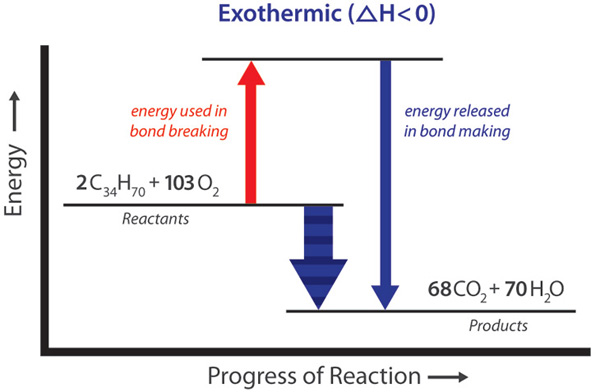
Key idea: The net energy change indicates if the reaction is exothermic or endothermic.
Chemical reactions include the breaking and formation of bonds.
The overall change in enthalpy (ΔH) of a reaction is given by:
ΔH = energy released from bond formation - energy absorbed from bond breaking
Example: Combustion of methane
Remember:
Hess's Law becomes handy when the direct measurement of energy changes is difficult.
The total enthalpy change of a reaction is the same regardless of the route taken.
Hess's Law states energy is conserved in chemical reactions, allowing the use of energy cycles to calculate ΔH indirectly.
Example:
Direct measurement of the formation of CO₂ from C and O₂ may be challenging.
Alternative path:
Hess's law allows us to calculate ΔH for reactions that cannot be measured with a calorimeter.
Enthalpy is a state function → depends only on the initial and final states, not the path.
Bond enthalpy tables give average bond energies, which can be used to estimate the enthalpy of a reaction.
Steps to use bond enthalpies:
ΔH ≈ sum of bonds broken − sum of bonds formed
Example: Formation of H₂O.
Bullet points:
Energy changes can also be measured experimentally using calorimetry.
Calorimeter: A calorimeter measures the amount of heat involved in a chemical reaction.
Types of Calorimeters:
Basic Principle
q = mcΔT
q = heat absorbed/released (J)
m = mass of solution (g)
c = specific heat capacity (J/g·°C)
ΔT = temperature change (°C)
Heat gained by water = heat released by reaction
The sign of ΔH tells us if the reaction is exothermic (ΔH < 0) or endothermic (ΔH > 0)
Experimental ΔH will always be < theoretical ΔH
Lattice enthalpy and hydration enthalpy are also important in ionic reactions.
Lattice Enthalpy (ΔHₗₐₜₜᵢcₑ) When gaseous ions turn into solid ions, energy is released, and is associated with the formation of an ionic lattice. Lattice enthalpy is highly exothermic, which is one of the reasons why ionic compounds are very stable.
Hydration Enthalpy (ΔHₕyₒₐₜᵢₒₙ) When ions dissolve in water, energy is released. Energy released is exothermic and depends on the size and charge of the ions.
Born-Haber Cycle: Lattice, and other energy changes of ionic compounds can be used to calculate the enthalpy of formation of an ionic compound. The Born-Haber cycle includes:
The net ΔH can be calculated using Hess's Law.
Energy cycles explain the stability of ionic salts and why some salts are more stable/soluble.
Energetic cycles in chemistry consist of bond energy, enthalpy of reaction, and calorimetry. From this, we can predict if a reaction is exothermic or endothermic and calculate the enthalpy changes using Hess's Law. Enthalpy of lattice and hydration helps to understand compound stability, while energy changes and the making and breaking of bonds are interrelated.
Energy pathways are formed by every chemical reaction, and understanding these pathways allows us to harness and manage energy efficiently.