

On this page:
Introduction Subshells Inside Energy Levels Orbitals and Electron Capacity Rules of Electron Configuration Diagramming Electron Configuration Valence Electrons Stability and Noble Gas Configuration Summary of Orbital Filling Order Why Electron Configuration is Important in DP Chemistry Visualizing Electron Configuration Key Takeaways Structure of the Atom and Energy Levels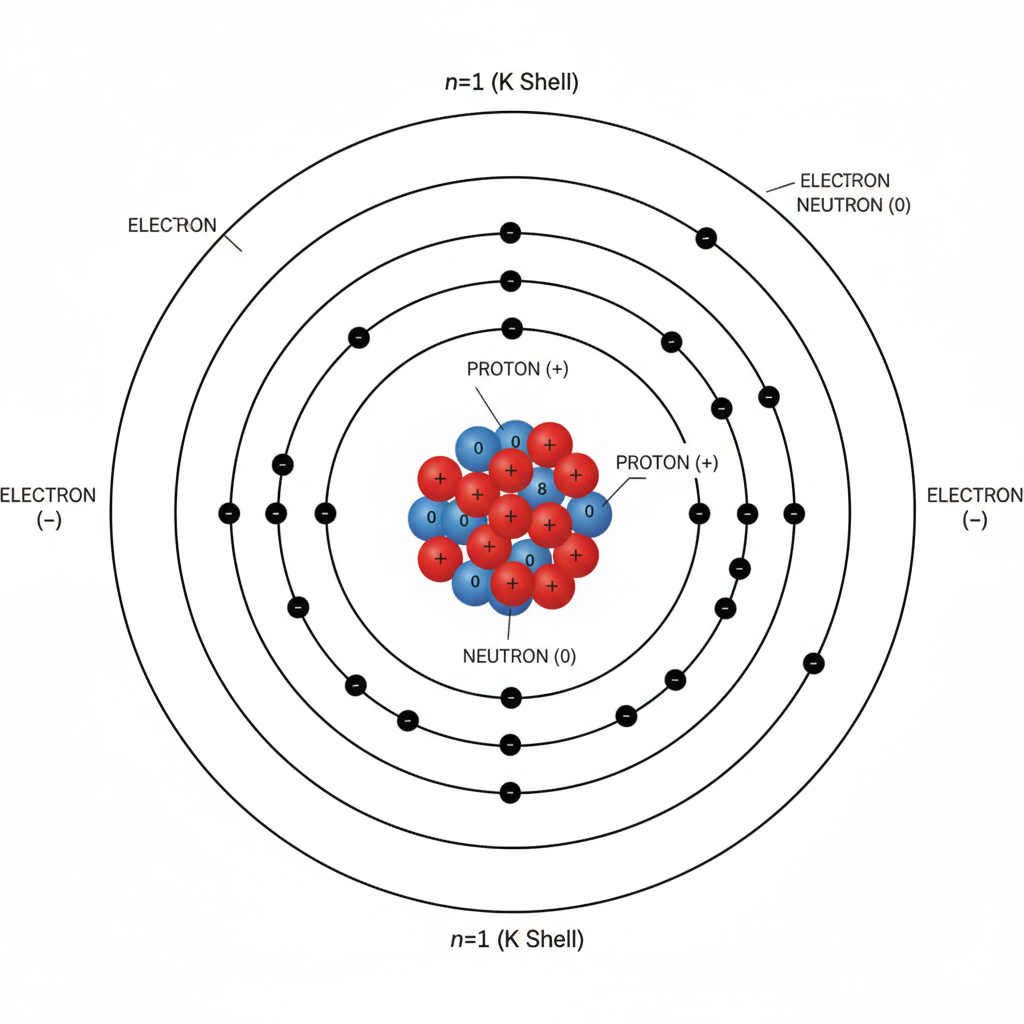
All atoms have an intricately organized structure, and quantum mechanics explains how their nucleus dictates the arrangement of electrons and directly determines their chemical behavior, bonding, and stability.
Electron configuration methods illustrate how electrons are distributed across various energy levels, subshells, and orbitals. Proficiency in electron configuration is vital in DP Chemistry, as it is foundational in understanding the periodic table, atomic structure, and molecular structure.
All atoms are made up of three types of subatomic particles.
Electrons are found in energy levels, or "shells," that are quantized and represented by the principal quantum number n. Every shell has a maximum number of electrons it can hold:
| Shell | n | Max Electrons |
|---|---|---|
| K | 1 | 2 |
| L | 2 | 8 |
| M | 3 | 18 |
| N | 4 | 32 |
Electrons will fill the lowest energy shells first to keep the total energy of the atom as low as possible. This is known as the Aufbau principle, and it is how an atom's stability is determined.
Every shell has subshells that are defined by their angular momentum quantum number (l):
| Subshell | Symbol | Max Electrons |
|---|---|---|
| s | 0 | 2 |
| p | 1 | 6 |
| d | 2 | 10 |
| f | 3 | 14 |
Take the second shell (n=2) for instance, it has: 2s → 2 electrons 2p → 6 electrons Total = 8 electrons
Subshells define the energy and spatial distribution of the electrons, and this is what helps us determine the chemical nature of an element.
Subshells are made up of orbitals, which are the regions of space where we are most likely to find electrons. Each orbital can accommodate a maximum of 2 electrons, and this is where we find the difference in spins. This is known as the Pauli Exclusion Principle:
| Subshell | Number of Orbitals | Max Electrons |
|---|---|---|
| s | 1 | 2 |
| p | 3 | 6 |
| d | 5 | 10 |
| f | 7 | 14 |
This explains the electron capacities of subshells: s = 2 electrons, p = 6 electrons, d = 10 electrons, f = 14 electrons.
Electrons fill orbitals from lowest to highest energy:
1s → 2s → 2p → 3s → 3p → 4s → 3d → 4p…
This order is what maximizes atomic stability.
This was proposed by Wolfgang Pauli. He states that an orbital can hold a maximum of 2 electrons, and that their spins must be opposite. This explains why orbitals are only able to hold 2 electrons, and why stability is reliant on spin orientation.
Friedrich Hund proposed that when considering orbitals of equal energy (degenerate orbitals), electrons will first occupy all orbitals singly and will only pair up after all orbitals have one electron. This will reduce the repulsion between electrons and increase the stability of the atom.
This method only depicts the number of electrons in each shell.
Example: Sodium (Z = 11) → 2, 8, 1.
This method depicts the distribution of electrons at the orbital level.
Example: Sodium (Z = 11) → 1s² 2s² 2p⁶ 3s¹.
This method shows all the quantum details, such as energy level, subshell, and number of electrons in each orbital.
Valence electrons reside in the outermost shell of the atom, and dictate:
Examples:
Valence electrons and their configuration hold the key to understanding how elements will behave in regard to ionic and covalent bonding.
Atoms tend to reach the electron configuration of the nearest noble gas as these configurations are associated with stability; considered to have full outer shells:
Helium: 1s²
Neon: 1s² 2s² 2p⁶
Argon: 1s² 2s² 2p⁶ 3s² 3p⁶
Other elements will gain, lose, or share electrons to achieve this stable configuration, forming ions or covalent bonds.
When filling orbitals, electrons fill in order of increasing energy:
1s → 2s → 2p → 3s → 3p → 4s → 3d → 4p → 5s → 4d…
This order is used to explain exceptions found in the configurations of electrons (such as in the transition metals), where 4s will fill before 3d, but as ions are formed, 3d may be empty first.
To understand the chemistry of any substance in the DP Chemistry, an understanding of the electron configuration of the substance is essential, as it explains the:
Example:
This results in the formation of the ionic compound NaCl.
Understanding electron configuration will help predict the chemical reactions and the bonds that will be formed, and understand the properties of the substance. Therefore, it is of utmost importance in solving the DP Chemistry and understanding the periodicity of the elements.
Arrows represent electron spin (↑↓) in orbitals:
Example: Oxygen (Z=8)
Each arrow = 1 electron
Hund's Rule: Orbitals filled singly first and then paired.
Electron configuration explains group trends, reactivity, and atomic size.