

On this page:
Introduction Why counting particles is the hardest task What Is a Mole? Grasping the Size of a Mole Molar Mass: Mass of One Mole Calculating Molar Mass Using a Periodic Table Relation between mass and moles Calculating Number of Particles What are a Mole, Particle, Atom, Molecule, and Formula Unit? The Mole Connects Mass and Particles Why the mole is important in chemistry The mole as an SI base unit From the Laboratory to Life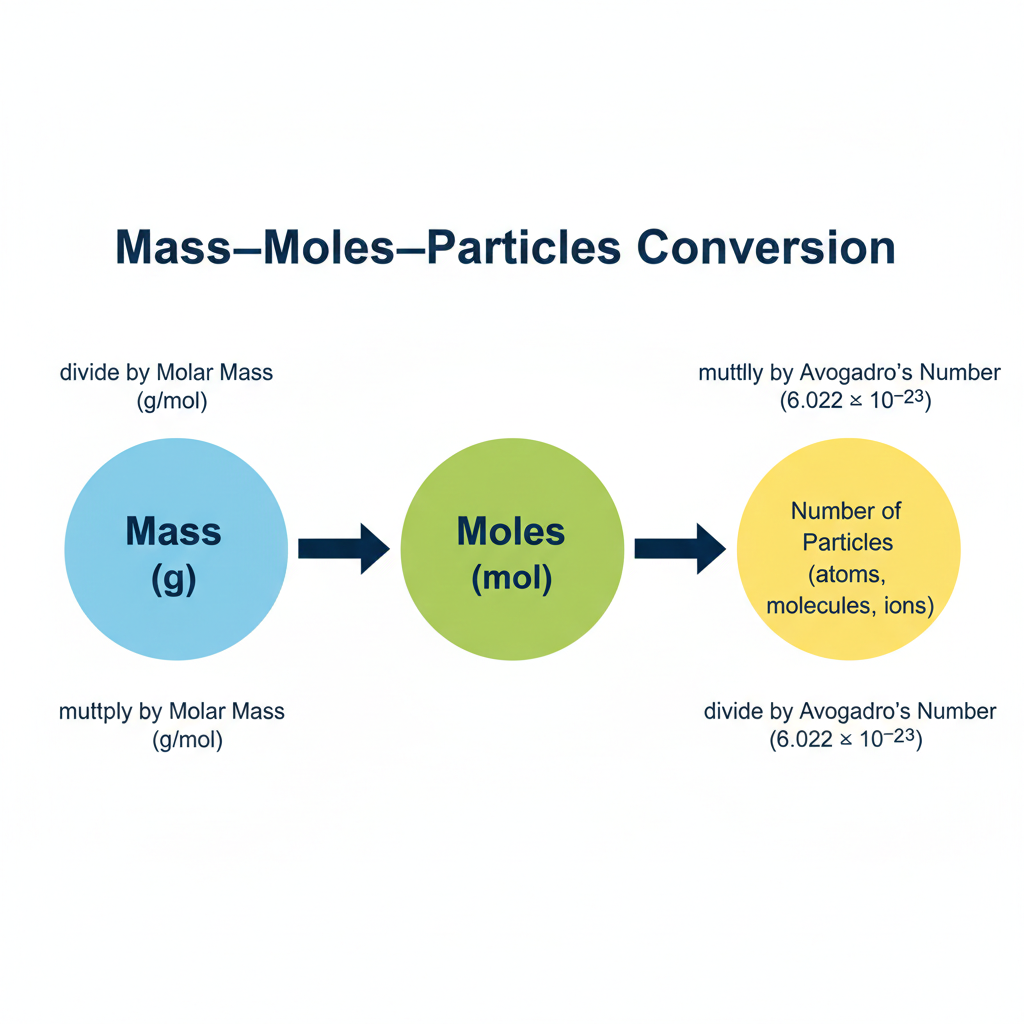
Imagine a crystal of sodium chloride. It may look insignificant, but it actually contains an extraordinarily large number of particles – many more than can be counted, but each of those particles can be seen. When studying and quantifying matter, scientists need a counting system to convert the macroscopic mass of a sample to the microscopic particles it is made of. This system is supplied by the mole.
The mole gives chemists the ability to convert what can be measured in the laboratory (e.g., the grams of a sample) to the number of atoms, molecules, or ions present in that sample.
Here is an example of the usual method of counting.
Now, in chemistry, the counting unit is the mole, which is a value that allows an extreme counting of particles.
A mole (mol) is the SI unit for the amount of substance, representing a fixed number of particles:
(1 mole = Avogadro number) atoms, molecules, ions, or formula units.
Example:
Chemists can deal with small numbers of particles through the mole concept.
Even a small sample of matter contains a huge number of particles, illustrating the great need for a chemist to apply the mole.
Molar Mass (M) is defined as the mass of 1 mole of a substance and expressed in grams per mole (g/mol).
Examples:
With the help of molar mass, we can carry out conversions between mass measured in grams and the number of moles.
For elements, the molar mass is approximately the same as the relative atomic mass that you'll find on the periodic table.
For compounds, you'll need to add the atomic masses of each of the constituent atoms.
Water (H₂O)
M = 2(1 g/mol) + 16 g/mol = 18 g/mol
This means that 1 mole of water weighs 18 g.
Chemists use the formula below:
n = m / M
where n = number of moles, m = mass in grams, M = molar mass in g/mol
Once the number of moles is known, the number of particles can be calculated using Avogadro's constant:
N = n × Nₐ
Where:
N = number of particles (atoms, molecules, or ions)
n = amount of substance (mol)
Nₐ = Avogadro's constant = 6.022 × 10²³ mol⁻¹
This method allows chemists to:
The relationship is given by the equation:
N = n × Nₐ
This shows the relationship between the macroscopic and microscopic worlds.
The full relationship can be summarized as:
Mass (g) ⇄ Moles (mol) ⇄ Number of particles (atoms / molecules / ions)
The term "particle" encompasses the following:
| Term | Definition |
|---|---|
| Atom | a single constituent unit of an element |
| Molecule | a group of atoms bonded together |
| Ion | a particle with a net electric charge |
| Formula Unit | the simplest ratio of constituents (ions) in an ionic compound |
Example
The mole measures the amount of microscopic particles regardless of the type of units.
The mole provides a link between measurable mass and the unseen world of atoms and molecules. By understanding the mole, one can:
Without the mole, we wouldn't be able to do quantitative chemistry.
The mole is needed for:
Examples include:
The mole is also one of the seven SI base units that measure the amount of substance and is represented by the symbol mol, just like meter (length), kilogram (mass), and second (time). This gives a fundamental framework of chemistry that is quantitative.
Chemists, in practical terms, do the following:
This enables precise calculations and, from a grain of salt to the air we breathe, connects macroscopic measurements to the reality of atomic measurements.