

On this page:
Introduction What is Water? The Structure of Water What is a Hydrogen Bond? Important Properties of Water Cohesion Adhesion High Specific Heat Capacity High Latent Heat of Vaporization Density Anomaly of Water Water as a Solvent Metabolic Reactions Involving Water Water and Osmosis Water and pH Buffers in Aqueous Systems Transport Role of Water Transparency of Water Water and Climate Regulation Summary of Core Concepts Final Understanding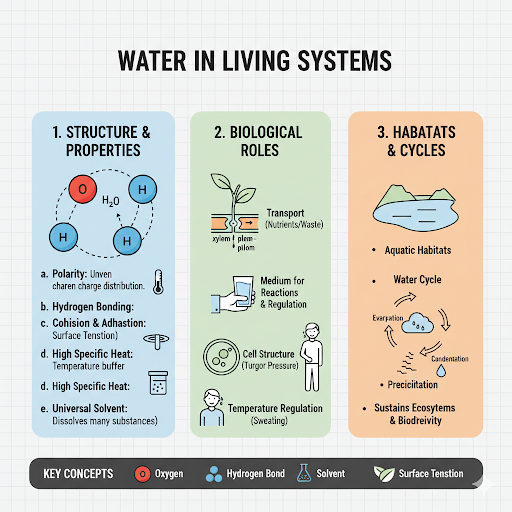
Take a moment and observe the things around you. You see how the plants are bending and growing toward the sunlight? You see how the blood flows in the body? You see how the cells are continuously growing and dividing? How do you see the enzymes, nutrients, and even the waste?
All of this is possible because of Water.
Water is the most critical biological molecule on the planet and for every living organism. In IB DP Biology, water is examined as a liquid as well as a molecule, and how the structure explains its properties that support life.
Before you understand life, you must understand water.
Water is a molecule consisting of:
Which means its chemical formula is H₂O
But water is special because of:
All of these characteristics of water justify its numerous biological functions.
Water has a bent shape. The oxygen atom forms covalent bonds with the other two hydrogen atoms.
However:
This imbalance makes water a polar molecule.
Polarity causes:
A hydrogen bond is:
They're individually weak.
But, altogether, they are strong.
The unique properties of water result from hydrogen bonds.
Water demonstrates a number of properties that are beneficial to living organisms.
Water's various properties are beneficial to living organisms in various ways.
Cohesion is the attraction of similar molecules.
Because of hydrogen bonding, water molecules stick together.
This results in:
Biological importance:
The attraction of different substances is called adhesion.
Water adheres to:
Biological importance:
Specific heat capacity is the energy required to raise the temperature of a unit mass of a given substance by 1 degree Celsius.
Water has a high specific heat capacity, which means:
The reason for this is that energy is used to break the hydrogen bonds before the molecules speed up.
Biological significance of this property includes:
The latent heat of vaporization is the heat required to change a unit of substance from liquid to gas.
Water has a high latent heat of vaporization, meaning a large amount of heat is needed to evaporate water.
The reason for this is that a lot of hydrogen bonds must be broken.
The biological significance includes:
Most substances become denser in the solid state than in the liquid state. Water is different. Ice is less dense than liquid water.
The reason for this is that the hydrogen bonds in water form a fixed lattice whereby the molecules become spaced further apart.
The result of this is that ice floats.
The biological significance of this property includes:
Water is known as the universal solvent.
This shows the types of compounds that can be dissolved by water:
How dissolving (hydration) works:
The importance of water for life:
Water is a direct participant in chemical reactions.
Hydrolysis is a chemical reaction that involves the breaking of a bond in a molecule using water.
E.g. Proteins are broken down into amino acids. Polysaccharides are broken down into monosaccharides.
Water is required to break the bonds.
Hydrolysis is vital for digestion and catabolism.
Condensation (or Dehydration Synthesis) Reactions
Water is removed, and small molecules are joined together.
E.g. Amino acids are joined to form proteins, and monosaccharides are joined to form disaccharides. Water is produced as a by-product.
Consequently, water is both a reactant and a product in metabolism.
Osmosis is defined as the process of movement of water through a semipermeable membrane.
Water will move from an area of high water potential to an area of low water potential.
Water potential can be influenced by:
The value of osmosis in a biological system:
The cell can be damaged if the water osmotic balance is disturbed: Cells may burst (lysis) or Cells may shrink (crenation).
Osmosis is a process for maintaining homeostasis.
Water partially dissociates to form [H⁺] and [OH⁻] ions. This means that water is amphoteric, meaning that it can function as either an acid or a base. In pure water, there are equal amounts of [H⁺] and [OH⁻] ions; there are equal amounts of acid and base, producing a [pH = 7] solution. All biological systems require a stable pH because pH that is too high or too low can cause denaturation of proteins, alter enzyme activity, and disrupt metabolism. Water is essential for maintaining acid-base balance.
Buffers are able to resist changes in pH. An example of a biological buffer is the bicarbonate buffer found in the blood. Buffers can either combine with excess H⁺ ions to neutralize them or can donate H⁺ ions when they are needed. Water allows for the ions in a buffer system to move easily, thus making the buffer system much more effective. The ability to maintain a stable pH is essential for cellular life.
Water is the most important transport medium in living organisms. In plants, water transport helps in the uptake of minerals from the soil, the transport of sugars in the phloem, and the maintenance of cell turgidity. In animals, water is an essential component of blood plasma, and helps in the transport of nutrients and hormones, whilst also aiding in the excretion of wastes as urine. Nearly all transport systems are reliant on water.
Water is a transparent medium. This causes many positive effects for biological systems, as it allows for light to penetrate in aquatic systems, thus enabling underwater photosynthesis and supporting life in the ecosystems that are found there. The transparency of water is essential for the survival of life in lakes and oceans.
Large bodies of water can absorb heat during the day and release it during the night. This moderation of temperature in large water bodies helps to moderate the temperature in coastal areas, stabilize the climate on a global scale, and supports life in large quantities. Water is essential in regulating the temperature of the Earth.
Biologically, water is important due to:
Water is far more than a chemical formula.
Water is:
Its simple structure creates complex biological effects. Without hydrogen bonding, life would not function.
Water is the foundation of cellular activity, organism survival, and global ecosystems.