

On this page:
Introduction What is Water Potential? Components of Water Potential Solute Potential (Ψs) Pressure Potential (Ψp) Overall Water Potential Osmosis Cells in Different States Plasmolysis in the Lab Water in Xylem & Phloem Aquaporins Environmental Stresses Water Potential in Animal Cells Summary Real-life Examples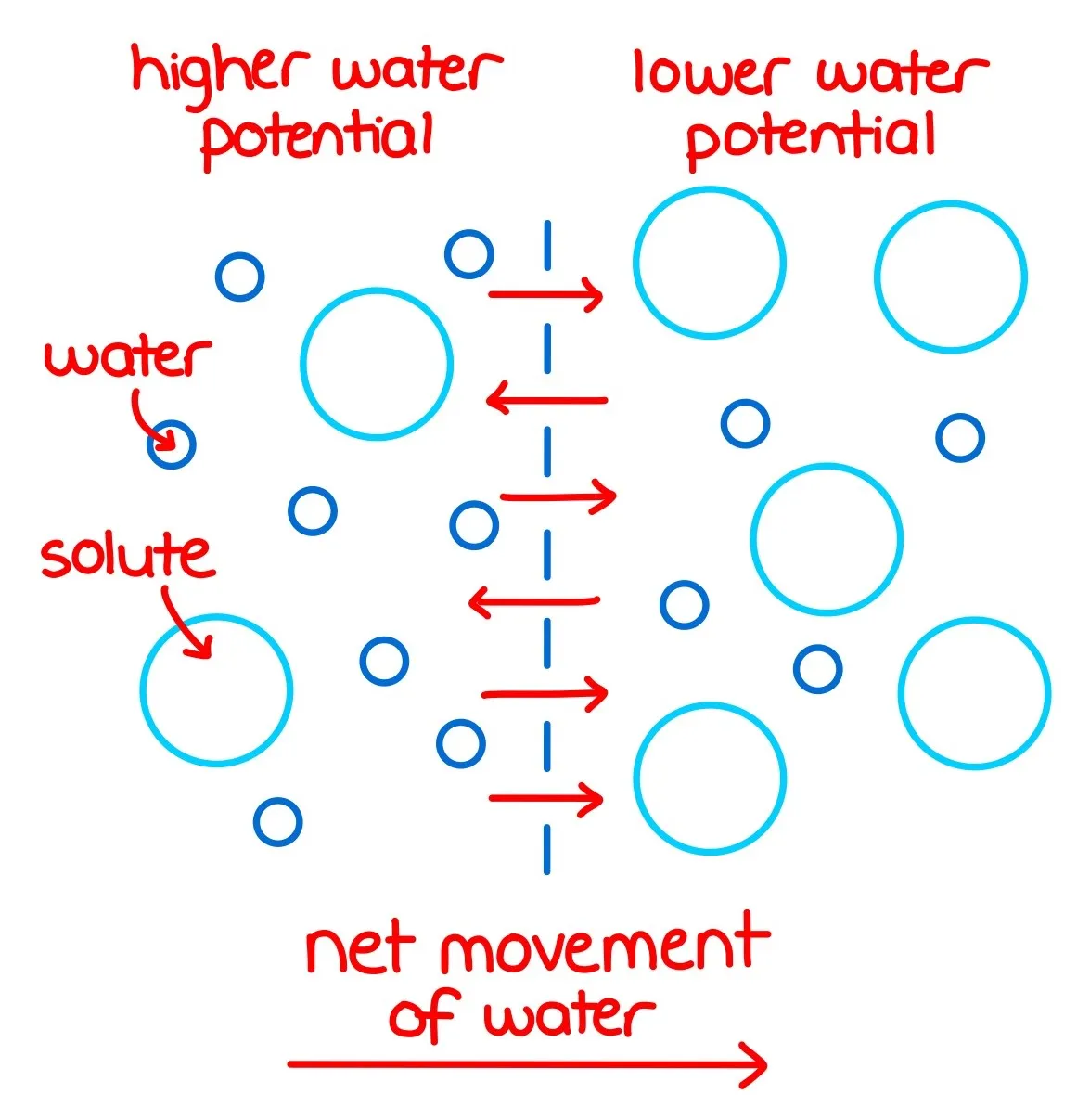
Life as we know it depends on water. Every one of the cells in your body is composed of water, and the flow of water and its movement between cells, tissues, and the environment is crucial to survival. But what about the movement of water in plants and animals?
The answer lies in water potential, which is a metric of how water moves in all conditions. Water potential is fundamental in understanding osmosis, plasmolysis, turgor pressure, and how cells maintain their equilibrium. So let's break it down step-by-step.
Water potential is denoted using the Greek letter psi (Ψ), which refers to the potential energy of water (per unit volume) in comparison to pure water at a specified temperature and pressure. Water potential dictates which direction water will flow.
Key Principles:
Water potential has two key components: solute potential and pressure potential.
Also called osmotic potential; measures the effect of solute molecules on water potential.
Physical pressure exerted by cell walls or the environment on water.
Solute potential, or osmotic potential, measures the effect of solute molecules on water potential.
Formula:
Ψs = -iCRT
Where:
A 0.2 M sucrose solution at 25°C has a solute potential of about -0.5 MPa. This means it will draw water from areas with higher water potential.
The cell wall, or other parts of the environment, can exert some physical pressure, and this is pressure potential.
A turgid plant cell may have Ψp ≈ +0.5 MPa. This positive pressure contributes to the overall water potential of the plant cell.
Overall water potential is calculated by the combination of solute potential and pressure potential.
Water Movement Rules:
A plant cell with water potential Ψ = -0.4 MPa is composed of Ψs = -0.8 MPa and Ψp = +0.4 MPa.
If the surrounding solution has Ψ = -0.2 MPa, then water will move out of the cell (from -0.2 to -0.4 MPa).
Osmosis is the movement of water through a semipermeable membrane. It occurs when the water potential on one side of the membrane is different from that on the other side.
Cell becomes firm and supports the plant when water enters the cell, increasing the turgor pressure (Ψp) in the cell.
A cell becomes soft when the water potential is equal inside and outside the cell, thus no net movement of water.
When the water potential decreases due to loss of water, the membrane pulls away from the cell wall, and the cell shrinks.
These states are important in plant physiology for the support and growth of the plant, and for the opening of the stomata.
This can be observed by placing plant tissue (e.g., elodea leaves) in different concentrations of sucrose solution.
Concentrated Sugar Solution:
Distilled Water:
This experiment illustrates water potential gradients and osmosis.
Water potential differences drive the movement of water in the xylem and phloem of the plant.
All cells need to manage the flow of water that moves in and out of the cell membranes. This includes special proteins in the membranes called aquaporins that manage the flow of water.
Aquaporins allow:
Plant Adaptive Responses:
Animal cells lack a rigid cell wall like the one found in plant cells, and this makes the pressure potential negligible. This means that water movement is caused mostly by the concentration of solutes.
Water will flow into a cell. This may cause a cell to burst (lysis).
Water moves equally in both directions; the cell maintains its shape.
Water will move out of a cell, causing it to shrink (crenation).
This is very important in medical practices. For example, an IV (intravenous) fluid has to have an isotonic concentration in order to prevent red blood cells from losing water (crenating).
Plants that have wilted show low water potential. Upon watering, the plants will restore their turgor pressure.
Salted or sugared foods reduce the water potential of the food, inhibiting the growth of microorganisms.
IV fluids have to be in the same range of water potential as blood. Isotonic IV solutions are used to avoid damaging cells.
Water potential is responsible for the movement of water in a transpiring plant. Water is drawn from the leaves down to the roots.
Water potential explains how life is supported, how nutrients flow, and how structural support is achieved. This is why it is one of the most important concepts in biology.