

On this page:
Introduction Are viruses alive? Viral Composition Genetic Material Protein Coats (Capsids) Viral Shapes Host Specificity Viral Replication Lytic Cycle Lysogenic Cycle Retroviruses and Reverse Transcription Viral Infections Transmission of Viruses The Immune Response to Viruses Vaccines and Viral Control Viruses and Their Rapid Evolution Viruses and Cancer Viruses in Science & Medicine Bacteriophages Why Studying Viruses is Vital for Biology ConclusionEvery time the news speaks about a pandemic or vaccines are discussed, what do people point fingers at?
The answer is often viruses.
Viruses are extremely small infectious agents. They do not belong in the cell category. They are unable to grow, respire, or reproduce on their own. But, they are able to infect an organism that is living and able to carry out a disease. In biology, viruses are used to understand some aspects of genetics, immunity, evolution, and biotechnology.
To further understand viruses, we need to answer one fundamental question.
Are viruses alive?
This is a very interesting debate in the field of biology.
Viruses show some features that are characteristics of life:
But they also have a great lack of some key features of a living organism:
For this reason, viruses are often regarded as non-living infectious particles. They exist on the borderline of either being alive or not.
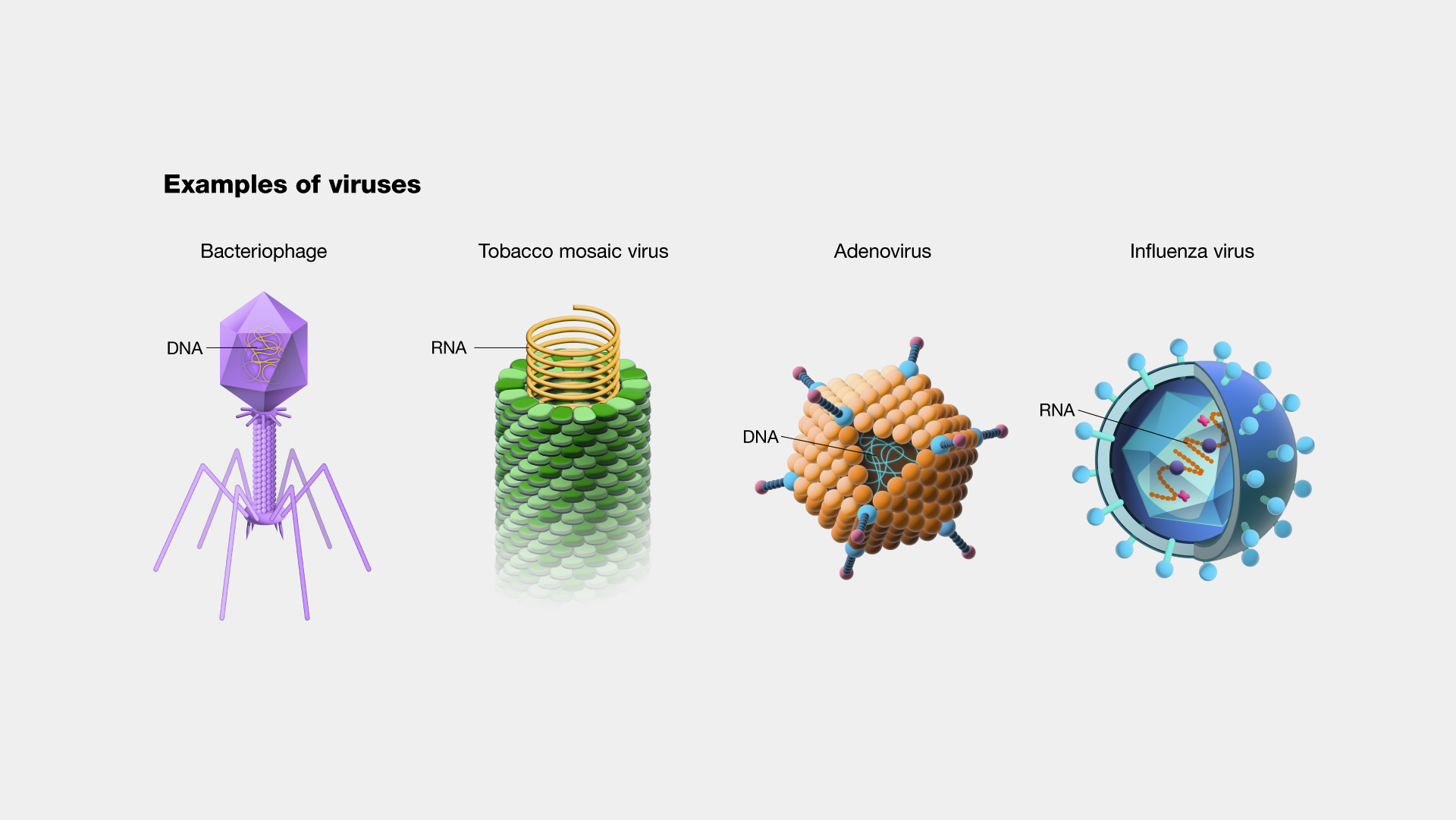
Viruses, being acellular, exhibit minimal structural complexity. Two major components comprise their structure:
Viruses contain either DNA or RNA as their genetic material, never both. In established cells as a unit of life, DNA is always present as genetic material. Viral genomes can be made up of:
Genetic material is encased in a defensive layer called a capsid. Capsids are made of units called capsomeres. Some viruses possess another covering called an envelope. The envelope is a sheet of the host cell membrane interspersed with viral proteins. The viral proteins aid the relevant virus in anchoring onto new host cells.
In very simplistic terms, a virus is made up of:
Genetic material + capsid + (sometimes) an envelope
Each virus targets distinct cells in a process known as host specificity.
A virus can only infect a cell that has the correct receptor proteins on the surface of that cell. The virus binds to the receptor proteins on the cell surface, like a lock and key.
For instance, some viruses infect only:
This host specificity explains the reason for tissue and species-specific viruses.
In the lytic cycle, the virus:
This cycle quickly destroys the host cell.
In the lysogenic cycle, the viral DNA integrates into the DNA of the host cell, where it becomes part of the host genome.
The host cell replicates as it normally would, but in addition to replicating its own DNA, it also replicates the viral DNA.
An integrated provirus deals with animal cells as a prophage deals with bacterial cells. Given the right conditions, the viral DNA can be activated once more and move to the lytic stage.
These two processes are pivotal for characterizing viral infections as well as gene control.
Unlike other viruses, a few have RNA in place of the more common DNA. A further classification of these viruses are the retroviruses, whereby instead of the conventional DNA polymerase, they use reverse transcriptase.
This enzyme reverse transcribes viral RNA into DNA, which then becomes part of the infected cell's DNA.
An example of such a virus is the human immunodeficiency virus (HIV) that infects and eliminates the immune cells of the victim.
This is a pivotal process of IB Biology as it associates viruses with gene activation, a precise area of genetic engineering.
Viruses can spread in the following ways:
Understanding the ways in which viruses spread can help control the spread of viruses.
When a virus is in the body, the immune system has to work.
First Line of Defence
Barriers like skin and mucus help to stop entry.
Innate Immune Response
Once the virus cells interfere, the cells release a special type of protein, and that protein is called interferon. They help protect other cells that surround the cell from being infected.
Adaptive Immune Response
Adaptive immunity has cytotoxic T cells that harm infected cells that show proteins of the virus. Antibodies are produced by the B cells in the body to fight against viruses, and they fight by adhering to viral proteins.
Once an infection occurs in the body, memory cells remain within the body, and if the virus comes back again, then the body's immunity will be much faster and stronger. This is the basis of the principles of vaccinations.
To prepare the immune system, vaccines safely show the body a type of viral antigen, which can be any of the following:
Vaccines will help the body without being infected to make memory cells.
Therefore, a vaccinated person's body will react to the real virus more rapidly, and severe disease will be avoided.
Vaccines have saved countless lives and drastically improved the well-being of communities.
Some viruses can cause cancer in the affected individual. This means that some viruses are oncogenic and can oncogenically transform a person by:
Some types of the Human Papillomavirus (HPV) cause cervical cancer. The HPV vaccine has been shown to significantly lower the incidence of cervical cancer. This explains the link that is established between the viruses and the regulation of genes.
Although most viruses are harmful, scientists have also used viruses to their advantage.
Gene Therapy
By modifying the viral genome so that it does not cause disease, scientists are able to use certain viruses to deliver therapeutic genes to cells in a living organism.
In molecular biology, viruses are considered vectors for inserting DNA into other cells.
Viruses are invaluable to the scientific community because they aid researchers in the study of:
Since viruses rely on other cells for survival, they are also a great way to learn about cell biology.
Bacteriophages are a type of virus that infects bacteria. Phage therapy is a potential treatment for bacterial infections that are resistant to antibiotics. Because bacteriophages only infect unwanted bacteria, while leaving the other cells in the body unharmed, they could serve as an effective substitute for antibiotics.
In Biology, students study the following topics to learn about viruses:
It is important to study viruses to understand the decomposition of biological systems. Viruses are powerful tools that can manipulate the biological world and alter ecology. They are simple biological systems that consist of a genome and a protein coat, where the virus is unable to grow on its own and must incorporate itself into other living cells.
Viruses can propagate by using two processes that are called lytic or lysogenic processes, and in some cases can bring about the manipulation of transcription in a process called reverse transcription, which can result in the obstruction of a functioning biological system or regulation of a biological system in an immune system response, or ultimately the virus can undergo rapid changes to adapt itself to the surrounding systems.
Viruses are also useful for biotechnology and medical research.
While they are not alive, viruses help shape and influence life on this planet, and they also help us learn about the fields of genetics, evolution, immunology, and global health.
In the Biology program, viruses are not just seen as small infectious agents; they are seen as essential for learning how biology operates at the molecular level.