Transport systems in biology - circulatory system and plant vascular system

Welcome to MindMentor!

Transport biology icon

DP Biology

Transport

Transport systems in biology

All living things need the transport of materials. Every cell in your body needs nutrients, water, gases, and ions. Also, every cell needs to get rid of wastes, like carbon dioxide and urea. Transport is the act of moving materials within an organism.

Transport in biology occurs in two main ways. Transport can happen at the cell level (cellular transport) and then at the level of the organism (systemic transport).

Cellular Transport

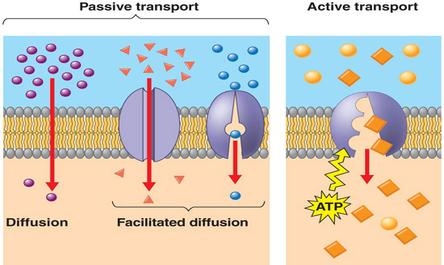
Cells can interact with the external environment by exchanging things through their membranes. This can happen either by passive transport or active transport.

Passive Transport

Passive transport is not active. This means it does not use energy. Matter naturally moves from an area of high concentration to an area of low concentration.

Diffusion

Diffusion is the natural and spontaneous movement of molecules from a high concentration area to a low concentration area until an equilibrium state has been reached.

Example: During capillary diffusion, oxygen moves into the cell from the capillaries, and carbon dioxide moves out.

Here is how transport and diffusion work:

  • Temperature: Higher temperatures mean faster movements of the molecules.
  • Concentration gradient: The greater the concentration gradient, the greater the rate of diffusion.
  • Surface area: The greater the surface area, the greater the diffusion.
  • Membrane thickness: The thinner the membrane, the quicker the diffusion.

Osmosis

Osmosis is the diffusion of water molecules through semipermeable membranes from a region of lower solute concentration to a region of higher solute concentration.

For example, the absorption of water by the roots of the plants.

Water potential: Water always moves from higher water potential to lower water potential.

Facilitated Diffusion

Some molecules, such as ions and glucose, cannot diffuse freely through membranes. Therefore, they use facilitated diffusion, which employs carrier proteins or channel proteins to shift substances to the other side of a membrane along the concentration gradient.

For example, the transport of glucose into the cells.

Active Transport

Active transport is the transport of substances with the use of energy in the form of ATP to move substances through a membrane against a concentration gradient.

For example, in the nerve cells, the sodium-potassium pump moves K⁺ in and Na⁺ out.

Importance of Active Transport:

  • It enables the absorption of minerals from the soil in the plants and the absorption of nutrients in the gut of the animals.

Transport in Animals

Animals have advanced specific circulatory systems to transport materials over long distances.

Open vs Closed Circulatory Systems

Open Circulatory System

This system is present in some mollusks and insects.

Here, blood is not contained in vessels; it flows through open spaces, called sinuses.

Constrain: Less efficient and slower in larger organisms.

Closed Circulatory Systems

These are seen in vertebrates, including the human species.

Blood remains within defined structures known as vessels: arteries, veins, and capillaries.

Benefit: Blood transport is quicker, with higher pressure and a more effective transport of oxygen and nutrients.

The Circulatory System of Humans

The human circulatory system is the combination of the heart, blood, and a network of blood vessels.

The Heart

  • It has 4 chambers: 2 atria and 2 ventricles.
  • The right side pumps blood that lacks oxygen to the lungs (this is known as pulmonary circulation).
  • The left side pumps blood containing oxygen to the entire body (this is known as systemic circulation).
  • Some valves ensure blood flows in a single direction only.

Blood Vessels

Arteries
Carry blood away from the heart; have thick and muscular walls to endure the high pressures associated with blood.
Veins
Carry blood back to the heart; have valves that prevent the blood from flowing backwards.
Capillaries
Are the smallest blood vessels; they have walls that are 1 cell thick to promote the exchange of gases, nutrients, and wastes.

Blood

It is made up of plasma as well as red blood cells (RBCs), white blood cells (WBCs), and platelets.

  • RBCs carry oxygen as a result of a protein called hemoglobin.
  • WBCs are the major defense proteins associated with infection.
  • Platelets are the major proteins associated with blood clotting.
  • Plasma serves as the transport medium of nutrients, hormones, and waste products.

Transport in Plants

For transport, plants have the specialized vascular tissues called xylem and phloem.

Xylem

It is the tissue that is responsible for the transport of water and minerals from the roots to the leaves.

It is composed of tracheids and vessel elements.

Here are some of the mechanisms behind the movement of water in plants:

Transpiration Pull

As water evaporates out of the leaves of the plants, more water is drawn up.

Cohesion & Adhesion

As water moves up the plants xylem, it clings to itself, and the walls of the xylem.

Root Pressure

Due to the osmotic pressure in the roots, water can be pushed up.

Phloem

Phloem is responsible for the movement of organic nutrients, mainly in the form of sucrose, from the sources to the sinks.

Sources are the parts of the plants producing sugar, usually the leaves, and sinks are where the sugar is utilized, i.e roots and fruits.

Phloem is differentiated into sieve tube elements and companion/sieve cells.

Mechanism of Translocation:

  • The movement of sugars in the phloem is explained in the pressure flow hypothesis.
  • 'Translocation' is the movement of sugars across the phloem, and is explained by the difference in turgor pressure.

Considerations for Effective Transport

Animals

  • The largest terrestrial animals utilize the double circulatory system to ensure that every cell in the body receives oxygen.
  • Gill respiration is the single circulatory system of fish.
  • The large capillary networks in the organs of animals aid in ensuring that the surfaces available for exchange are maximized.

Plants

  • The root hairs ensure that the plants can absorb more water and minerals.
  • The xylem has cells that are lignified, ensuring that the column of water is continuous and that the xylem has continuous support.
  • The companion/sieve cells provide ATP for the active loading of sugars and are also part of the phloem.

Factors Transport Considerations

The efficiency of the transport is influenced by:

Surface area to volume ratio
The cells or organisms having a larger surface area with respect to volume transport the materials more quickly, and to a larger extent.
Concentration Gradients
In relation to the rate of diffusion and osmosis, steeper gradients increase the rate.
Temperature
The higher the temperature, the more kinetic energy available for diffusion and movement.
Pressure
In animals, blood pressure is responsible for the movement of blood flow. In plants, turgor pressure and the process of transpiration are responsible for the movement of fluids.
Membrane Permeability
Selectively permeable membranes are able to control what goes into and out of cells.

Bulk Transport

When diffusion is not enough, organisms have to use mechanisms of bulk transportation to move things over long distances.

  • In animals, Blood flow moves O2, nutrients, and waste, and is therefore a very efficient means of transport.
  • In plants, the movement of water, along with dissolved minerals and sugars, is also an efficient means of transport.

Bulk transport is essential for survival for larger organisms, especially when diffusion is too slow.

Summary

Transport is one of the most important functions of life, and as such, it occurs on several levels:

  • Cellular Transport: Diffusion, osmosis, facilitated diffusion, active transport.
  • Transport in Animals: Open and closed circulatory systems, composition of blood, functioning of the heart, and blood vessels.
  • Transport in Plants: Xylem and phloem, along with the mechanisms of water and sugar movement.
  • The efficiency of transport depends on many factors, including surface area, concentration gradients, pressure, temperature, and a number of structural adaptations.
  • If transport is not efficient, cells cannot get rid of wastes and cannot obtain nutrients. This leads to the death of tissues and eventually of the organism itself.
  • It is through the understanding of transport that we learn of the survival, growth, and adaptation of organisms to their surroundings.
```