

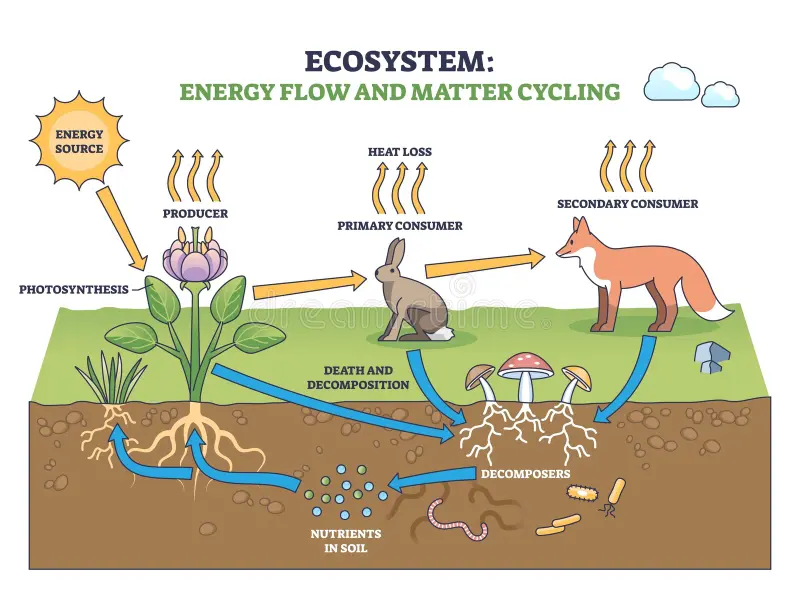
All around you, animals move, rivers flow, and plants grow; and your heart beats every second. All of these things require energy. But where does all this energy come from? How does all this matter move from the air into plants, from plants into animals, and then back into the environment?
Biology depends on energy and matter. Every single one of the countless processes that make up something alive depends on the continuous transfer and transformation of energy and matter. This process of how energy is transferred and how matter is transformed is one of the most important things to learn about in Biology.
Energy is the ability to bring about change or to do work. Living organisms use energy to grow, move, reproduce, and do active transport. Living organisms must also use energy to maintain their internal balance.
Matter is something that has mass, and it also occupies some amount of space. In biology, matter is the atoms and molecules that make up everything, from air to water to glucose, and also to big molecules like proteins and even DNA molecules.
In ecosystems:
This difference is the foundation of ecological understanding.
In living systems, the transformation and transfer of energy is governed by the thermodynamic laws.
Energy cannot be created or destroyed. It can only change from one form to another.
For instance: During photosynthesis, chemical energy from sunlight is transformed.
Energy transformations cannot be 100% efficient. Some energy is always transformed into heat and lost.
This is why energy diminishes as it moves through the food chains.
Most ecosystems use sunlight as the main source of energy. The process through which light energy is transformed into chemical energy is called photosynthesis.
Photosynthesis is a chemical reaction that is performed in the chloroplasts, and it can be summarized as:
These reactions happen in the membranes of the thylakoids. Chlorophyll absorbs light energy. Water undergoes photolysis, and oxygen is released. Then, ATP and NADPH are produced.
These reactions happen in the stroma. CO₂ is fixed and then, with the help of ATP and NADPH, is converted into glucose.
Photosynthesis transforms inorganic carbon into organic molecules, which is the way matter enters the biological world.
Cells release the energy stored in glucose through a process that occurs in the mitochondria.
ATP (Adenosine triphosphate): It is the cell's energy currency. It captures and stores energy and releases it when it is needed.
A food chain illustrates how energy is transferred from one food organism to another food organism.
At every trophic level, the loss of energy is 90%. It is lost in heat, movement, or waste.
Energy Pyramids:
Primary productivity is the measure of how quickly producers convert energy from the sun into chemical energy.
Certain factors, such as light intensity, temperature, and nutrient availability, limit productivity.
Matter is recycled infinitely in ecosystems, unlike energy. These cycles are called biogeochemical cycles.
Without carbon, life is impossible. It is what makes organic molecules.
Nucleic acids and proteins require nitrogen. However, most living beings cannot directly utilize atmospheric nitrogen gas (N₂).
The atmosphere, land, and oceans continuously cycle water.
Phosphorus is an essential part of ATP, DNA, and phospholipids.
This separation is critical to the science of ecology.
Human actions significantly influence these natural systems:
The disruption of these systems can lead to an increase in the temperature of the Earth, eutrophication, and the loss of species.
It helps explain:
The flow of energy and the cycling of matter integrate molecular biology, cell biology, ecology, and environmental science. From the production of ATP in the mitochondria to the cycling of carbon on a global scale, the same concepts are applied.
Sunlight is essential for life on Earth since photosynthesis would not take place without it. If there were no nutrient cycles, key elements would be lost for an extended period of time. The interrelationship of biosphere elements and life forms is made possible through the understanding of the flows of energy and cycling of matter.
Energy flows unidirectionally through ecosystems, entering as sunlight and exiting as heat, governed by the laws of thermodynamics. Matter, however, cycles endlessly through biogeochemical loops (Carbon, Nitrogen, Water, Phosphorus). Photosynthesis and cellular respiration act as the bridge between these two processes. Understanding these dynamics is crucial for comprehending ecosystem stability, the limits of food chains, and the profound impact of human activities on our planet's future.