

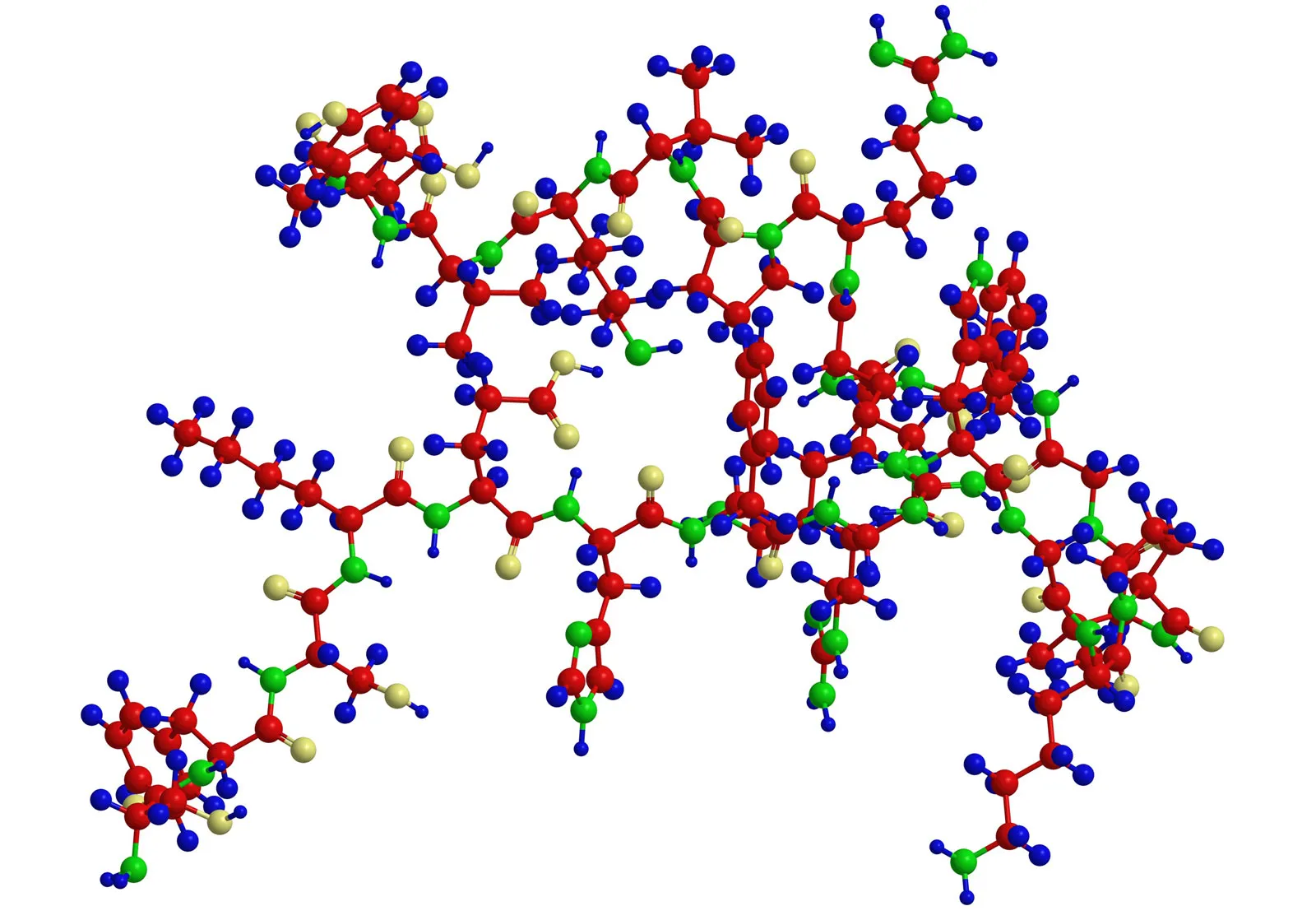
Proteins are very important molecules in all living things. There are different types and functions that a protein can perform.
For example, proteins can: build the structure of the cell, break down molecules, and make the reactions happen faster. Each protein is made of smaller units called amino acids. These terms will take a closer in-depth look at some of the proteins that are important to the function of each cell.
Proteins are the macromolecules of the cell. Proteins and other macromolecules of the cell are formed from a series of smaller units that are called monomers.
Each of the cell's proteins is made of long chains of monomers called amino acids.
When a long chain of these monomers is formed, that is referred to as a polypeptide.
Each protein is built according to a set of instructions that is found in the DNA of the cell. That is why the proteins that are made in each cell are made just for that cell.
Amino acids play the role of the structural components of proteins.
There are three parts to an amino acid:
While the amino and carboxyl groups are constant, the R group differs with each amino acid, which gives each amino acid distinct chemical properties.
Of the twenty amino acids, some are basic, some are polar, some are non-polar, some are acidic, and others are basic.
Amino acids are joined together through a chemical bond called a peptide bond. Typically, a peptide bond forms when the carboxyl group of one amino acid interacts with the amine group of another amino acid, and a molecule of water is released. This is identified as a condensation reaction.
A polypeptide chain that has folded to achieve the desired conformation is a functional protein.
A protein has a total of four structural levels, and each of these levels contributes to the overall shape and function of the protein.
The primary structure of the protein is composed of the total number of amino acids arranged in a chain that forms a polypeptide. This sequence is dictated by the organism's DNA.
For instance: A single amino acid substitution in the hemoglobin of an individual is responsible for the occurrence of sickle cell anemia.
The secondary structure of a protein is its folding of polypeptide chains into alpha helices and beta-pleated sheets.
The secondary structure is stabilized by hydrogen bonds formed between the backbone (protein backbone) atoms.
Example: An alpha helix structure in keratin and beta sheets in silk fibroin.
The tertiary structure is the 3D folding of a polypeptide chain.
The tertiary structure is stabilized by:
Example: Myoglobin has a compact globular structure.
This occurs when more than one polypeptide chain assembles to form a functional protein.
The quaternary structure is stabilized by the same bonds as the tertiary structure.
Example: Hemoglobin has 4 subunits.
Proteins are highly versatile molecules with multiple functions.
These provide the support and structure to the cells and tissues.
Example: Collagen (connective tissue) and keratin (hair and nails).
These are biological catalysts that speed up chemical reactions and are not consumed in the process.
Example: Amylase is an enzyme that breaks down starch into glucose.
Enzymes are highly specific to the substrates they act upon (due to the 'active site' on the enzyme).
These proteins facilitate the transport of molecules across membranes and throughout the blood.
Example: Hemoglobin (carries oxygen) and channel proteins (allow and facilitate the movement of specific ions).
These are chemical messengers that control and regulate physiological activity.
Example: Insulin is a protein that regulates the level of glucose (sugar) present in the blood.
These are proteins that protect the body from foreign particles or substances.
Example: Antibodies are specific proteins that attach (bind) to antigens to neutralize pathogens.
Proteins that serve to store nutrients and energy in the body.
Example: Ferritin is an example of a storage protein that stores iron.
Denaturation refers to the loss of structure and hence function of a protein. Denaturation involves the loss of secondary, tertiary, and quaternary structure, but primary structure remains unchanged.
Denaturation can occur due to:
Example: Cooking an egg is an example of denaturation. Clear egg white is transformed into white because of denatured ovalbumin.
Enzymes are a type of globular protein that catalyze biochemical reactions. The function of enzymes is determined by their shape.
Key Concepts:
Protein synthesis can be divided into two main steps: transcription and translation.
Nucleotides in a DNA strand create a specific protein sequence by determining a specific order of amino acids, which then creates a defined protein function and structure.