Protein Synthesis
All cells require proteins. Proteins compose enzymes, hormones, structures, transporters, and more. But how does a cell construct a protein based on instructions from a cell's DNA? This process is called protein synthesis.
The stages of protein synthesis include transcription and translation. In IB Biology, it is vital to understand how protein synthesis provides insight into cell functionality, as well as the role of genes in defining the phenotypic expression of organisms.
DNA and RNA
When considering protein synthesis, three types of molecules come to mind:
DNA (Deoxyribonucleic Acid)
DNA has the instruction sets, or genes, that tell the cell how to construct a specific type of protein. DNA has the structure of a double helix and is found in the nucleus of the cell.
RNA (Ribonucleic Acid)
RNA acts as a bridge between DNA and protein. Three types of RNA are involved in the complex process of protein synthesis:
- mRNA (messenger RNA): Carries the genetic code from the nucleus to the ribosomes.
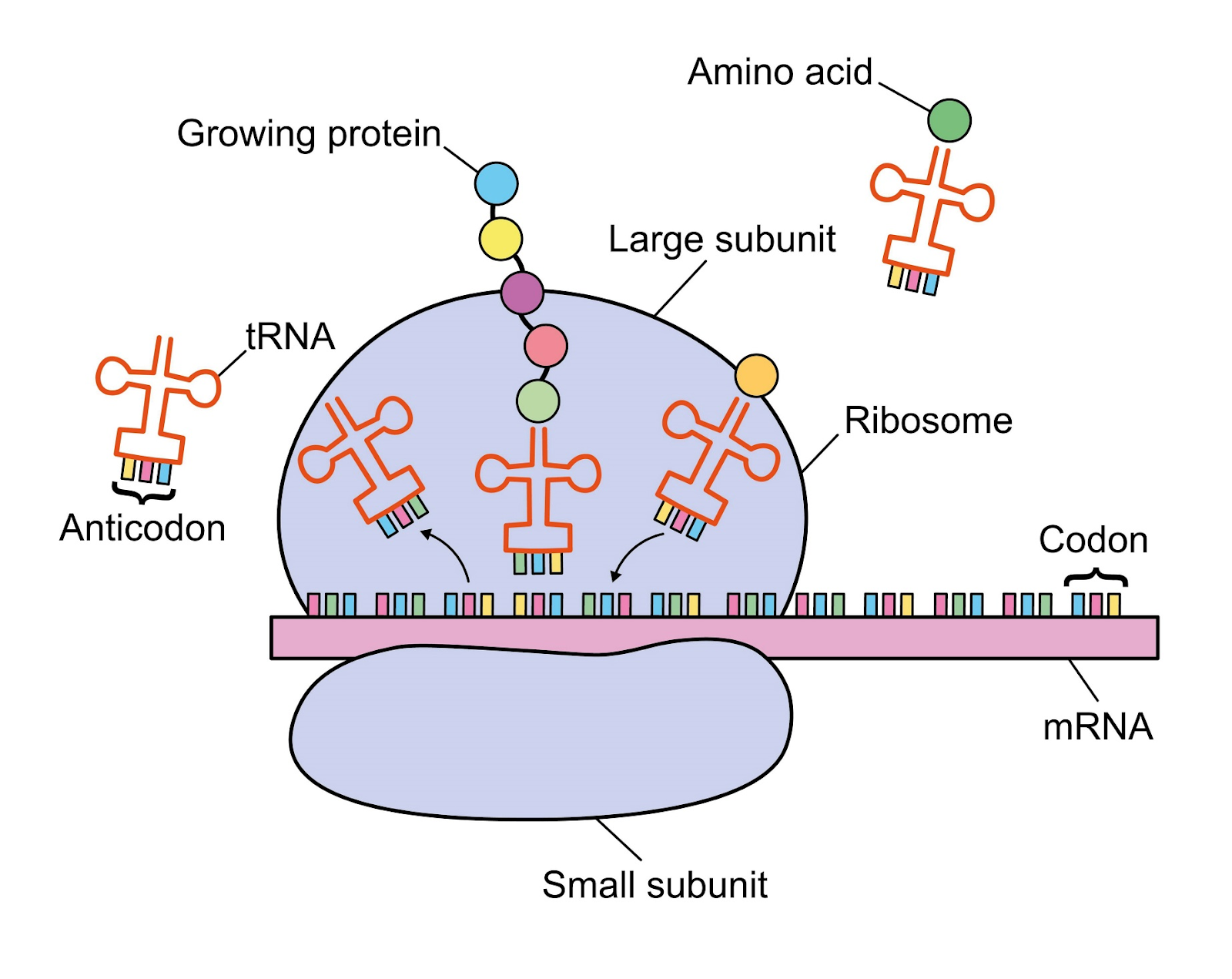
- tRNA (transfer RNA): Brings the amino acids to the ribosome and matches the amino acid to the corresponding codon of the mRNA.
- rRNA (ribosomal RNA): Part of a ribosome and plays an important role in the formation of peptide bonds between amino acids.
DNA differs from RNA in the following ways:
- While DNA is a double helix, RNA is a single helix.
- DNA has the sugar deoxyribose, and RNA has the sugar ribose.
- DNA has the nitrogenous base thymine (T) while RNA has the nitrogenous base uracil (U).
Stage 1 - Transcription
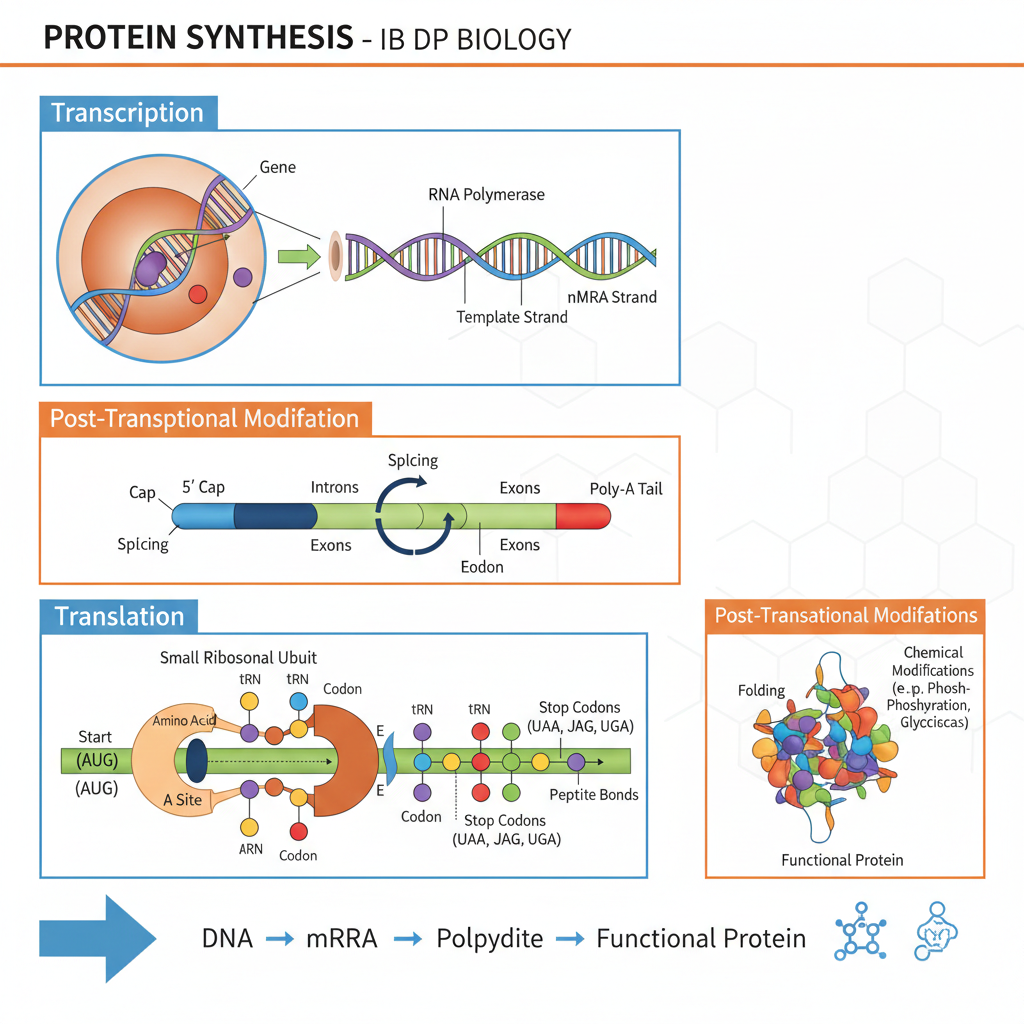
Transcription is the first stage of the protein synthesis pathway. Transcription consists of copying a gene from DNA and converting it into mRNA. This process occurs in the nucleus of the cell.
Step 1 — Initiation
- The enzyme known as RNA polymerase attaches to the promoter region on a DNA strand.
- Next, RNA polymerase unwinds the DNA strands to have access to the coding strand.
Step 2 — Elongation
- The RNA polymerase constructs the RNA transcript in a 3' to 5' direction and continuously moves in the same direction along the DNA template strand.
- The construction of the mRNA strand, however, occurs in the opposite direction, meaning a 5' to 3' direction.
- According to the base-pairing rules: in DNA, A pairs with T; in RNA, A pairs with U. C pairs with G and vice versa.
Step 3 — Termination
- Transcription continues until the RNA polymerase reaches a terminator region on the DNA.
- After the mRNA separates from DNA, the DNA strands come back together.
Post-Transcriptional Edits (Eukaryotic Cells):
- A 5' cap, which is a protective cap, is added to the beginning of mRNA and assists the ribosome in the attachment process.
- A poly-A tail is added to the 3' end to increase stability.
- A splice of coding sections called Exons is done, while a break is made to the non-coding sections called Introns.
Transcription takes place in a eukaryotic cell nucleus, and a mature strand of mRNA is the final product that is transported to a ribosome in the cytoplasm.
Stage 2: Translation
Building proteins from codons in mRNA is called translation. Translation happens in the cytoplasm at the ribosome.
Step 1 - Initiation:
- The mRNA strand binds to a small subunit of the ribosome.
- The translation process begins at the start codon (AUG) on the mRNA.
- A tRNA molecule that carries the amino acid methionine binds to the start codon through the tRNA's anticodon.
- The large subunit of the ribosome binds to the small ribosomal subunit to finish forming the ribosome.
Step 2 - Elongation:
- Amino acids are brought to the ribosome by tRNA.
- Each tRNA carries an anticodon that is complementary to the codon on the mRNA.
- Moving from 5' to 3' end on the mRNA, the ribosome matches tRNA anticodons to mRNA codons.
- A polypeptide chain is formed by peptide bonds that link together a specific sequence of amino acids.
The ribosome contains three sites:
- A site (aminoacyl site): Receives a new tRNA.
- P site (peptidyl site): Contains the polypeptide chain that is being synthesized.
- E site (exit site): Where tRNA is released from the ribosome.
Step 3 - Termination:
- Translation continues until a stop codon (UAA, UAG, UGA) is reached.
- There are no matching tRNAs for stop codons. Therefore, release factors cause the ribosome to separate from the completed polypeptide.
The Genetic Code
The instructions for the correct order of the assembly of amino acids lie in the sequence of nucleotides in the mRNA.
Key points:
- The code is triple: Three nucleotides (aka codons) are the minimum needed to code for an amino acid.
- The code is degenerate: Multiple codons may code for the same amino acid.
- The codons are universal: The same codons are used for almost all organisms.
- Start codon: AUG (methionine).
- Stop codons: UAA, UAG, and UGA.
Translation: Prokaryotes vs Eukaryotes
Prokaryotes
- Can do transcription and translation at the same time.
- No nucleus means mRNA can be translated immediately as it is transcribed.
Eukaryotes
- Transcription occurs in the nucleus.
- Translation occurs in the cytoplasm.
- mRNA must be processed before leaving the nucleus.
Post-Translational Modifications
A polypeptide must undergo multiple changes before it can function as an active protein.
- Chaperone proteins help proteins fold into their correct three-dimensional structure.
- Some proteins must undergo cleavage to become active.
- To control a protein's activity, stability, or location, a variety of chemical modifications may occur:
- Phosphorylation: Adding a phosphate group to a molecule.
- Glycosylation: Adds a carbohydrate to a molecule.
- Lipidation: Addition of a lipid.
Ribosomes – Protein Factories
Translation is the process of making proteins. Ribosomes are the ones that do this because they have proteins and rRNA.
Structure of Ribosomes
- Ribosomes are in the cytoplasm or the rough endoplasmic reticulum.
- Ribosomes are made of a small subunit and a large subunit.
Function of Ribosomes
- Ribosomes help to position the mRNA and tRNA.
- Ribosomes catalyze the peptide bond formation to attach two amino acids.
Summary of Protein Synthesis
- The genetic information is in the DNA in the nucleus.
- Transcription is the process that uses the DNA of a gene to make a strand of mRNA and is complementary to the DNA.
- Then this mRNA strand leaves the nucleus and attaches to a ribosome.
- mRNA has codes called codons that are translated to determine the sequence of amino acids.
- To build polypeptide chains, ribosomes build peptide bonds.
- Proteins then undergo various modifications to assist the protein's folding and activation.
- Each protein performs a particular function in the cell.
The Role of Protein Synthesis in the Cell
The creation and growth of cells depend on protein synthesis. It is through protein synthesis that the cell can form enzymes, structural proteins, and regulatory proteins.
When things go wrong:
- Alterations in protein synthesis lead to diseases and can be attributed to changes in DNA. One example is sickle cell anemia, which is the consequence of a single-base substitution.
- Mistakes during the transcription and translation processes lead to the synthesis of nonfunctional proteins.
The understanding of the various processes involved in protein synthesis is important in biotechnology, medicine, and genetic engineering.
Glossary of Important Terms
| Term |
Meaning |
| DNA | Deoxyribonucleic acid stores the genetic code |
| RNA | Ribonucleic acid, messenger and translator of the genetic code |
| mRNA | Messenger RNA carries gene information to the ribosome |
| tRNA | Transfer RNA carries amino acids to the ribosome |
| rRNA | Ribosomal RNA forms ribosomes and catalyzes peptide bonds |
| Transcription | Copying DNA into mRNA |
| Translation | Synthesizing protein from mRNA |
| Codon | A sequence of three nucleotides on mRNA coding for an amino acid |
| Anticodon | Three nucleotides on tRNA are complementary to a codon |
| Ribosome | Site of protein synthesis |
| Polypeptide | Chain of amino acids |
Conclusion
The process of protein synthesis explains how genes develop into proteins and how the genetic code controls cellular processes. It is a detailed process that involves DNA, RNA, ribosomes, and different enzymes.
Understanding protein synthesis means understanding an integral part of the development, growth, and overall health of an organism.