

On this page:
Introduction What Is a Population? Population Changes Limiting Factors Reproductive Strategies Community Competition Ecological Niche Predation Symbiotic Relationships Energy Flow in Communities Ecological Pyramids Succession Biodiversity Impact of Humans on Ecosystems Conclusion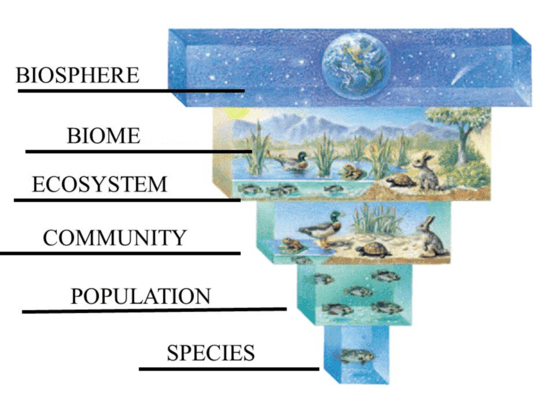
Look around you. In a park, you see trees, birds, insects, grass, and maybe a pond with fish. Are these living things alone?
No. They are all part of a complex web.
In Biology, we do not study organisms in isolation. We study organisms in relation to their environment and the other organisms around them. That is the case in ecology. Populations and communities are a crucial part of the study of how life on Earth is structured and organized.
Some elementary concepts in ecology must be understood in order to understand this topic.
A population is a group of organisms of the same species and potential interbreeding members. Population biology is the study of how and why population size increases or decreases.
Each population has a set of defining characteristics:
These characteristics assist scientists in the prediction of further changes in the population.
We see changes in population size as a result of (1) birth, (2) death, and (3) immigration and emigration.
Population size increases as the resources needed to sustain the population are abundant. This results in a J-shaped curve. In real ecosystems, the resources are limited (e.g., food, water, and space). The population size continues to grow until the resources become limited. This results in an S-shaped curve.
Exponential growth when resources are abundant
Logistic growth with limited resources
The largest number of organisms of a specific area is called the carrying capacity of an area, which depends on the resources and conditions of the surrounding environment. Consider the reindeer population on St. Matthew Island. The population of the reindeer on the island began to grow rapidly because of the environment's abundant resources. However, the population later crashed because the environment could not sustain that many reindeer.
Population control is necessary because it prevents a population from exceeding the limit of the environment. This is called a limiting factor and can be several things that can be grouped as:
The effect of an independent density-limiting factor is felt within a population at all levels. The population is affected no matter how many individuals it contains. Some of the realities that can restrict the population of an area, regardless of how many people there are, are: unfavourable weather conditions, natural disasters, and extreme drought conditions.
Example: The volcanic activity of Mount St. Helens affected the population of an area regardless of the density of the population.
Factors that become more intense as population density increases, such as competition for resources, disease, and predation.
The strategies of survival and reproduction of a species are called the reproductive strategies of that specific species.
There are two different types of reproductive strategies:
This is a reproductive strategy that aims to reproduce as many individuals as possible within the shortest time possible. There is no parental investment provided to the young. The young are likely to die at a young age.
Examples: species of insects, and the small rodents.
This is a reproductive strategy that aims to reproduce as few individuals as possible within a long period of time. However, a great parental investment is provided to the young. The population of a species is likely to remain near the carrying capacity.
Examples: elephants and humans.
Different species of organisms are adapted to different conditions found in their environment. The adaptations that they have demonstrate which environment is ideal.
A specific area can have several organisms, all of which belong to different species. All of the organisms in the area can be said to make up a community.
The different species that form a community undergo different types of interspecific relations. The community's species relations influence the survival rate of the species, their reproduction, and their spatial distribution in the ecosystem.
Important interaction types include:
Let's make sense of these.
Competition is an interaction occurring when organisms utilize one of the available resources. This can be:
The competitive exclusion principle states that two species cannot occupy the same niche in the same habitat for an extended period of time. One will outcompete the other.
An ecological niche describes the role of a species within its ecosystem. It includes:
Two species cannot occupy the same niche in the same ecosystem.
Example: Different species of finches in the Galápagos Islands developed different shapes of beaks to specialize in eating certain types of food and, as a result, reduce competition among themselves.
Predation is when one of the involved organisms, the predator, kills and eats the other, which is the prey.
Predator-prey interactions exhibit cyclic population changes. An increase in the population of prey is followed by an increase in the population of the predators. When there are too many predators, the population of prey will decrease. After prey populations decrease, the predator populations will also decrease.
Example: The predator-prey relationship between wolves and moose on Isle Royale.
Predation is important as it helps control population size and maintain the balance of ecosystems.
The definition of symbiosis is a close and long-term interaction of two species.
Both species benefit.
Example: bees and flowering plants.
One species benefits while the other is harmed.
Example: tapeworms in mammals.
One species benefits while the other is generally unaffected.
Example: birds nesting in trees.
These types of relationships increase the complexity of local communities.
A flow of energy is the main thing every local community depends on.
For most complex ecosystems (including the one you live in), the main energy source is the sun. Creators (also known as autotrophs) convert solar energy through a process known as photosynthesis and convert it into chemical energy.
Although energy only flows one way, matter is recycled.
A flow of energy through a local community is usually illustrated as a food chain, and more complex ones as a food web.
Every local food chain is a community, and every community is a food web.
Through a process known as cellular respiration, energy is lost as heat at every trophic level. The main reason why food chains are so small is that empirical studies show only 10% of energy from one food chain level is transferred to the next.
Every trophic level is represented in ecological pyramids.
Because energy decreases across all levels, the pyramid of energy is always upright.
Shows the total mass of living organisms at every level.
Shows the total number of individuals at each trophic level.
The goals of this drawing are to illustrate the concept of energy flow in an ecosystem and to visualize the concept of ecological succession.
Ecological communities are not stagnant, and they can undergo significant changes through a process of succession.
Happens in inhospitable environments where, for example, a volcanic eruption has taken place and where there is no soil or pre-existing ecosystem to start the process. The first organisms to arrive in inhospitable areas are called pioneer species (in this case, lichens). With time, later organisms (more complex plants and trees) arrive.
Example: The eruption of Krakatoa in 1883 was an example of a primary succession event.
Happens in areas where a community existed before, but was affected by a disturbance (e.g., a forest fire). Here, recovery is faster because soil has already been created by the previous community.
The result of succession is a community of organisms that is in a relative state of equilibrium. This is called a climax community.
Biodiversity is defined as the variation and the total number of different organisms that can be found in a certain area.
Biodiversity can be decomposed into 3 different sub-categories:
Ecosystems that exhibit higher biodiversity are more stable. When an ecosystem is made of different organisms, and multiple species are doing the same thing, that ecosystem is more resistant to disturbances.
Examples: Coral reefs and tropical rainforests.
The activities of mankind have a direct impact on organisms and communities in ecosystems.
Examples of that are:
Example: The bleaching of corals on the Great Barrier Reef occurs due to high sea temperatures.
Conservation biology focuses on fighting concern for individual species and entire ecosystems with the following techniques:
Examples of these include the work of pollinators, climate control, nutrient recycling, and much more.
In Biology, populations and communities are the building blocks of ecology. A population is made up of the same species living together. A community involves all the interacting populations in a particular area. The size and structure of populations and communities change as a result of a number of births and deaths, interactions, and environmental factors.
There is a flow of energy and a cycling of nutrients through the different trophic levels. Species in a community compete, cooperate, prey on, and adapt to one another. Communities undergo development through succession and are influenced by natural and anthropogenic activities.
These concepts are fundamental to explaining the different patterns and relationships in the natural world, and underscore the need for ecosystem conservation for the future.