

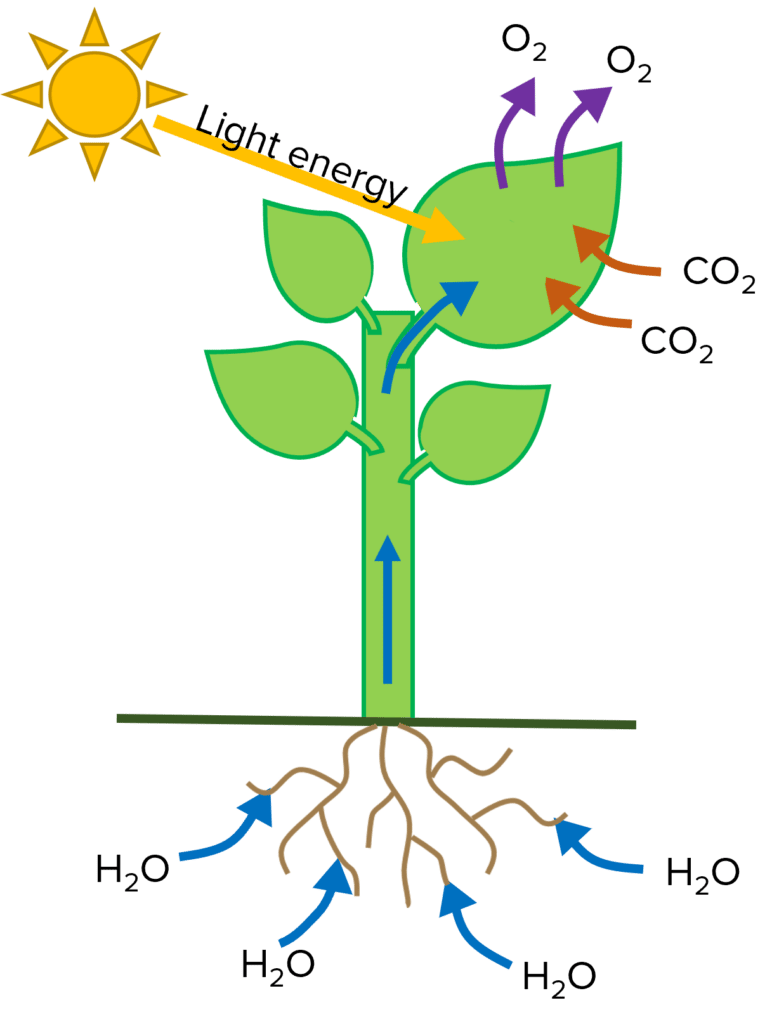
The extraordinary phenomenon happening in every greenery in your proximity, from microscopic grass to gigantic trees, is the synthesis of its own food.
How does a plant make food? How do the plant's very own natural resources, the sun and the soil, convert light energy into chemical energy?
The light energy is converted and stored in chemical energy in the form of glucose.
Photosynthesis is a significant topic in Biology because of the reason we learn in school, energy enters the biosphere and sustains all forms of life on earth.
The fossil fuels, the food chains, and the oxygen production all rely on photosynthesis.
Let's break it down.
Photosynthesis is the production of food through the conversion of sunlight energy into chemical energy, which is stored in the food. Photosynthesis occurs in plants, algae, and some bacteria.
Here's the equation for photosynthesis:
Carbon dioxide + Water → Glucose + Oxygen
In chemical equations, that's:
6CO₂ + 6H₂O → C₆H₁₂O₆ + 6O₂
The process of photosynthesis occurs in the chloroplasts of plant cells. Generally, photosynthesis can be separated into two steps:
Both of these steps are connected and intertwined.
Photosynthesis in plants occurs in chloroplasts. Chloroplasts are only found in the mesophyll cells of leaves.
Chloroplasts have:
The thylakoid membrane encloses and contains chlorophyll (which is the pigment that captures light energy) and also contains other light-capturing pigments that are called photosynthetic pigments.
The stroma contains the enzymes required for the Calvin cycle.
The structure of chloroplasts shows that the function of chloroplasts is to absorb light and convert it into chemical energy (which is their primary function).
One of the main pigments is chlorophyll (which is considered to be the primary photosynthetic pigment). Chlorophyll can be further divided into main groups, including chlorophyll a and chlorophyll b, and other accessory pigments (which mainly include carotenoids).
These pigments can absorb and trap light, but at different wavelengths.
Chlorophyll can absorb red and blue light but reflects green light. This is the main reason why we associate the color green with plants.
In the IB Biology curriculum, emphasis is placed on the absorption spectrum and the action spectrum.
The relationship between the two is strong/both have great relevance.
The light-dependent reactions take place inside the thylakoid membranes. They require light to form ATP and NADPH.
These reactions use 2 photosystems:
Every photosystem has a light-harvesting complex that has a bunch of chlorophyll molecules.
When light strikes Photosystem II, the chlorophyll gets some of its electrons excited, causing them to exit the chlorophyll and join an electron transport chain.
However, to replace the lost electrons, chlorophyll uses the process known as photolysis of water.
2H₂O → 4H⁺ + 4e⁻ + O₂
The reaction provides:
The thylakoid membrane has an embedded electron transport chain through which electrons move. As the electrons travel within the chain, some of the stored energy is released so it can be used to move more protons into the thylakoid lumen.
The proton gradient drives the large concentration of protons that is present within the thylakoid lumen back into the stroma through a process known as ATP synthase.
This process is called chemiosmosis.
As protons travel through ATP synthase, some of the protons turn ADP and an inorganic phosphate into ATP.
This process is known as photophosphorylation.
Excited electrons reach Photosystem I and get re-excited by light. These electrons then get transferred to NADP⁺ and form NADPH.
At the end of light-dependent reactions, we have ATP, NADPH, and Oxygen.
ATP and NADPH are energy carriers used for the next stage.
The Calvin Cycle takes place in the stroma of the chloroplast. It does not require light directly but does depend on the ATP and NADPH produced in the light reactions.
The Calvin Cycle consists of three main stages:
The key enzyme in this cycle is RuBisCO (Ribulose bisphosphate carboxylase oxygenase) and is one of the most abundant enzymes on Earth.
Carbon Dioxide combines with a 5-carbon molecule (RuBP) Ribulose bisphosphate.
This forms an unstable 6-carbon compound that quickly splits into two molecules of a 3-carbon compound known as Glycerate-3-Phosphate (GP).
ATP and NADPH are used during the Reduction stage to convert G3P into Triose Phosphate (TP).
Some molecules of TP leave the cycle to form glucose and other carbohydrates.
The other TP molecules are used in the Regeneration stage to regenerate RuBP. This is done with the use of ATP.
For 3 molecules of CO₂ fixed, 1 molecule of TP leaves the cycle. 2 TP molecules yield 1 glucose molecule.
This cycle must continue uninterrupted for glucose to be produced.
Several environmental elements play a role in the rate of photosynthesis.
The three main limiting factors are:
This is the reason why, with only one factor, increasing a singular component stops increasing within photosynthesis.
When RuBisCO, instead of a carbon dioxide molecule, binds with an oxygen molecule, photorespiration occurs.
Photorespiration is a waste of energy as glucose is not produced; thus, it is a negative process for the economy of photosynthesis.
Photorespiration is more common at higher temperatures, with lower concentrations of carbon dioxide.
Some plants have developed adaptations to photorespiration.
C3 plants are the most common of the 3 types of plants. They directly use the Calvin cycle, and their first stable product is a 3-carbon compound.
Maize and other C4 plants capture carbon dioxide in mesophyll cells in the form of a 4-carbon compound. This compound then goes to the bundle sheath cells, where the Calvin cycle takes place.
This process increases the efficiency of the plant's metabolism in a hot climate by decreasing photorespiration.
CAM plants, cacti, for instance, keep their stomata closed during the day. Thus, to carry out photosynthesis, they store the carbon dioxide they need, and they use it during the daylight.
This process also reduces water loss.
The role of light and chlorophyll in photosynthesis is well documented.
All other experiments are aimed at the same understanding of the mechanisms involved in photosynthesis.
Life on Earth would not be possible without the process of photosynthesis, which is fundamental to:
From the processes occurring in the thylakoid to the carbon cycle on the planet, photosynthesis integrates cell biology and ecology.
In Biology, the way you understand the process of photosynthesis is the way you understand the flow of energy in living systems and the way you understand the role of structure in function at all levels.