

On this page:
Introduction Early Earth Conditions Chemical Evolution Miller-Urey Experiment Creating Polymers from Organic Molecules Protocells The RNA World Hypothesis Prokaryotic Cells Great Oxygenation Event The Beginning of Eukaryotic Cells Endosymbiotic Theory Features of Primitive Cells Spontaneous Generation Vs. Biogenesis Why We Study the Origin of Cells Summary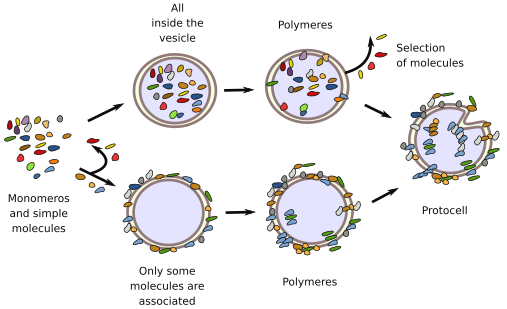
Look around you. Every plant, every animal, and every microorganism is made of cells. Your skin, your blood, and even your brain are made of tiny living units called cells. But have you ever asked yourself, where did the first ever cell come from?
There was a time when there were no cells on Earth. Cells were absent, and life did not exist. This makes understanding how the first cell was formed one of the major achievements in biology because it is overwhelmingly apparent that cells are the basic unit of life.
In biology, the origin of cells is where chemistry, geology, and biology unite. It is the origin of life and explains how, without the help of living organisms, the first life system emerged from a collection of non-living chemicals.
In studying the first cells, a basic understanding of the young Earth is needed. Earth is around 4.6 billion years old and formed from dust and gas. At that time:
During the planet's early years, the atmosphere was likely composed of simple molecules such as methane, ammonia, hydrogen, and water vapor. These molecules, from simple, contain the elements found in living cells: carbon, hydrogen, nitrogen, and oxygen.
The combination of heat from the volcanoes, energy from the storms, and the ultraviolet light from the sun would likely result in the components of living cells reacting. This theory is called chemical evolution.
The combination of simple inorganic materials to form complex organic structures was first demonstrated by Stanley Miller and Harold Urey in 1953. These two men created early-earth-like conditions.
In the Miller-Urey experiment, they used a closed environment, providing methane, ammonia, hydrogen, and water vapor, and used electricity to simulate lightning.
Just a few days later, they discovered the formation of amino acids in the closed environment.
Amino acids are the building blocks of proteins and the first organic molecules. The Miller-Urey experiment demonstrated that early Earth conditions were not a barrier to the formation of life.
This discovery greatly supported the theory that life can be formed from materials that are not alive.
To create complex biological molecules like proteins and nucleic acids, nucleotides and amino acids must first join together.
Scientists believe that small molecules may have combined due to the clay surfaces or hot ocean vents, which could help concentrate the molecules and spark the chemical reactions that are needed to combine small molecules.
Initially, only simple molecules formed, and since molecules alone are not considered alive, more complex systems are needed that have organization, reproduction, and metabolism.
This brings us to another important term: protocells.
Although protocells are not fully alive, they do exhibit some characteristics of living systems.
Cells have membranes, which create a barrier between the exterior of the cell and the interior.
When specific types of lipids are placed in aqueous environments, they spontaneously assemble into structures termed vesicles, which have a bilayer organization like modern cell membranes.
When organic matter is encapsulated within a vesicle, a distinct environment is created that facilitates a greater efficiency of chemical reactions.
Protocells are fascinating. They could:
While protocells are not true cells, they were an important step toward life.
One of the biggest mysteries of biology is: which came first: DNA or proteins?
But, DNA is the instruction manual for proteins, and is therefore required for the process of DNA replication. Proteins cannot be made without DNA.
So, what came first?
The RNA World Hypothesis is supported by many.
While DNA and proteins may be the end goal for more complex life, it's theorized that early life relied solely on RNA.
In this theory:
This allowed cells to function more complexly and efficiently.
The first true cells were simple cells that lacked a nucleus and are referred to as prokaryotic cells.
Bacteria and archaea are more modern examples.
An early and significant group of bacteria was the cyanobacteria. These bacteria were photosynthetic and produced oxygen as a waste product.
Oxygen built up in the atmosphere over many millions of years. This was called the Great Oxygenation Event.
The rise of oxygen changed the world in several ways:
Prokaryotic cells are basic and are missing:
Eukaryotic cells are more advanced, as seen in plants and animals. These cells have:
What is the process by which eukaryotic cells are made?
The best answer to this, most people agree, is the Endosymbiotic Theory.
Lynn Margulis was a strong supporter of this theory.
The Endosymbiotic Theory suggests that the mitochondria and chloroplasts were free-living bacteria.
In this scenario:
The following points help explain this theory:
The theory of endosymbiosis explains the origin of complex cells from simple cellular structures.
The first true cells of life would have been:
Initially, primitive cells would have been small and simple, but over time, through the process of natural selection, primitive cells evolved and diversified to the present-day wonderful array of living organisms.
People in the past believed, among other things, in spontaneous generation, which is the current belief that cells are generated from non-living components. For example, people believed that maggots developed from rotten meat. Such theories were disputed by other modern scientists, including Louis Pasteur, who established the principle of biogenesis. Biogenesis is the theory that cells arise from other pre-existing cells.
The above principle does not conflict with the first statement that the first cells are believed to have formed in very different and unique conditions that do not exist today.
There are several reasons why we study the origin of cells. It helps us learn about:
The transition from chemistry to biology
This process took billions of years and included the transition from simple molecules to protocells, from RNA to DNA, and from prokaryotic to eukaryotic cells.
The origin of cells began with the Earth's early chemical evolution, which then created cells.
It's a big reminder that life did not just appear out of thin air, but as a result of a combination of chemical, energetic, and evolutionary processes.
All life on Earth ultimately descended from those first, very simple cells that formed billions of years ago. The origin of cells study shows us how life developed step by step instead of a sudden birth.