

On this page:
Introduction What Are Organelles? Importance of Compartmentalization Prokaryotic vs Eukaryotic Cells Membrane-Bound Organelles Non-Membrane-Bound Organelles Cell Membrane & Transport Prokaryotes vs Eukaryotes Conclusion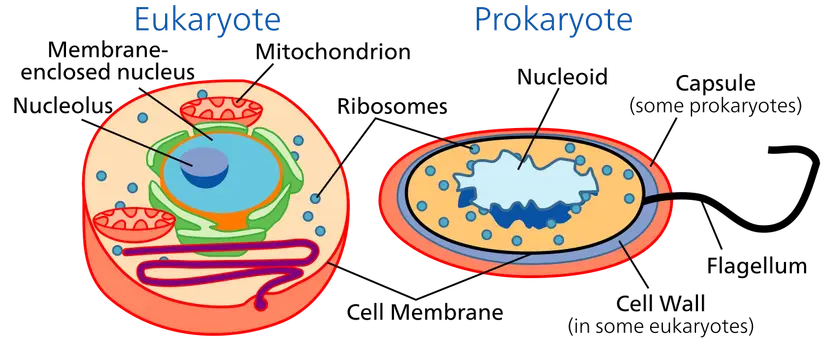
Everything that surrounds you, including the smallest microbe and the tallest tree, is made up of cells. Cells are the fundamental units of life, and within cells, there are specialized structures, called organelles, that perform specific functions that keep the cell alive and well.
Compartmentalization, the presence of organelles with specific structures and functions, is a characteristic of eukaryotic cells. Compartmentalization is one of the reasons that cells are able to perform different chemical reactions, even incompatible ones, and increases efficiency.
An organelle is a specialized subunit of a cell that has a specific function. Organelles can be so-called membrane-bound organelles and non-membrane-bound organelles.
Organelles that are surrounded by a membrane, specifically, a lipid bilayer.
Examples: Nucleus, mitochondria, endoplasmic reticulum, Golgi apparatus, lysosomes, and chloroplasts.
Organelles that do not have a membrane surrounding them. These organelles are often structural or synthetic in nature.
Examples: Ribosomes, elements of the cytoskeleton, and centrioles.
Compartmentalization enhances efficiency and specialization:
Before we can learn about organelles, we need to learn about the types of cells.
The cellular structure of prokaryotes (e.g., archaea and bacteria) is characterized by:
Examples of eukaryotes are fungi, animals, plants, and protists. These cells are more complex/larger than prokaryotes due to the following features:
The nucleus serves as the cell's control hub. It keeps the DNA that contains the information for protein synthesis and cell division.
Structure: Double membrane with pores
Function:
Mitochondria produce ATP energy through aerobic respiration.
Structure: Double membrane, the inner membrane forms folds called cristae.
Function:
The ER is a membrane system that forms a network of tubules and vesicles that play a role in the synthesis of proteins and lipids.
Function:
The Golgi Apparatus is the packaging and transporting center of the cell.
Structure: A set of flattened membrane-bound sacs called cisternae
Function:
Lysosomes are membrane-bound organelles that contain hydrolytic enzymes and are involved in intracellular digestion.
Function:
Chloroplasts are the sites of photosynthesis in plant cells.
Structure: Double membrane with internal stacks of thylakoids (grana)
Function:
Vacuoles are storage organelles, especially prominent in plant cells.
Function:
Ribosomes are the protein factories of the cell.
Structure: Comprised of rRNA and proteins; found free in the cytoplasm or bound to rough ER
Function:
The cytoskeleton provides structure, support, and movement.
Components:
Centrioles are implicated in cell division.
The cell membrane (or plasma membrane) is a bilayer of lipids with plasma proteins and other membrane proteins. It regulates the flow of materials into and out of the cell.
Compartmentalization depends on the membranes, which provide unique microenvironments for different cellular contexts.
In a part of a cell, membrane transport, for example, uses:
| Feature | Prokaryotes | Eukaryotes |
|---|---|---|
| Nucleus | No | Yes |
| Membrane-Bound Organelles | No | Yes |
| Ribosomes | 70S | 80S |
| DNA | Circular | Linear |
| Cell Size | Small (1-10 microns) | Large (10-100 microns) |
Eukaryotes and Prokaryotes compartmentalize their cells to compartmentalize their cells' functions and as a result, compartmentalization improves safety, efficiency, and specialization. Although there are many different types of organelles, all eukaryotes contain the same basic set:
By means of their cellular membranes, eukaryotic cells can compartmentalize their internal structures in order to create the right conditions for the appropriate types of cellular reactions. In contrast, simpler Prokaryotic cells do not have membrane-bound organelles.
In order to perform many different biochemical processes within the cell, compartmentalization is used so that the reactions can occur simultaneously without any interference.
Compartmentalization and the different types of organelles are essential to maintain life, allow growth and reproduction of cells, and enable cells to respond to their environment. Compartmentalization is the reason for the efficiency and high level of order, which is fundamental to all living organisms, and the relationship between the structures and the functions of the organelles is a reflection of that order.