

On this page:
Introduction What are Nucleic Acids? The Basic Unit: Nucleotide DNA (Deoxyribonucleic Acid) Structure of DNA Antiparallel Direction DNA as the Genetic Material DNA Replication Stages of DNA Replication RNA (Ribonucleic Acid) Transcription RNA Processing (Eukaryotes) Translation The Genetic Code Mutations DNA Packaging Chargaff's Rules Importance of Nucleic Acids Conclusion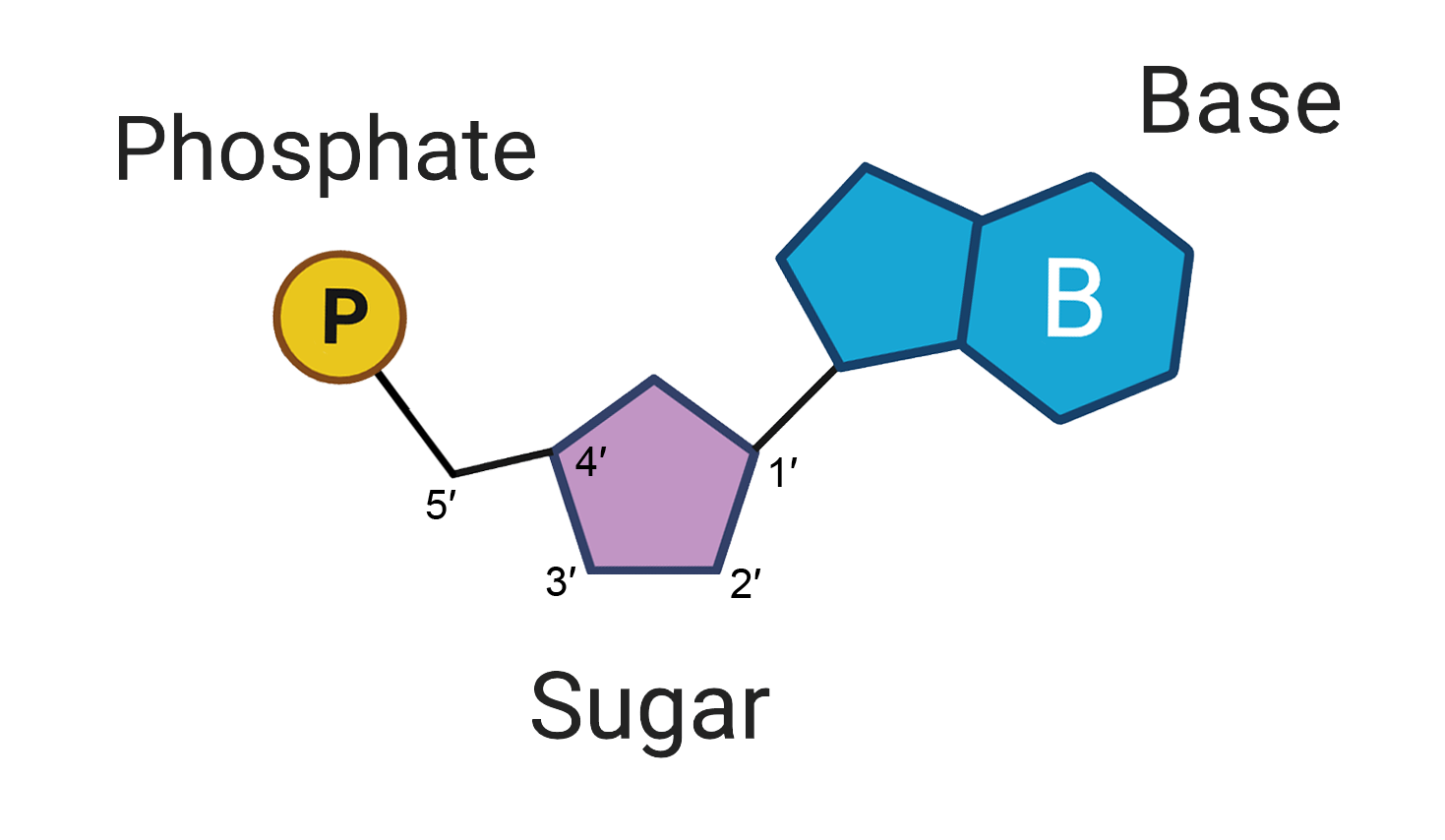
If I asked you about the information, such as the color of your eyes, your height, your blood type, and even how your body builds proteins. Where is all this information stored? Is it written somewhere inside you? Yes. It is stored in molecules called nucleic acids.
In biology, nothing happens without information. Cells know how to construct, when to divide, and how to respond to the external environment. Nucleic acids are the molecules that keep and carry this information. They are the blueprints of life.
The two principal forms of nucleic acids are:
In unison, they manage to control the structure and function of all the living organisms.
Nucleic acids are large macromolecules composed of smaller, repeating units known as nucleotides. They fall under the four major biopolymers:
Unlike carbohydrates and lipids, which mainly provide energy, nucleic acids are responsible for the storage of genetic information.
Nucleic acids are formed by a basic unit called a nucleotide. Every nucleotide has three components:
For nucleic acids, there are two types of sugar:
Nucleotides can have one of two different types of nitrogen bases:
Purines (which have a double ring structure):
Pyrimidines (which have a single ring structure):
Nucleotides are joined together by a specific covalent bond called a phosphodiester bond, making a long structure called polynucleotide.
DNA is the molecule that contains genetic information for the majority of living organisms. The structure of the DNA molecule was established in 1953 by scientists James Watson and Francis Crick using the information (data) of a scientist called Rosalind Franklin. Watson and Crick called DNA a double helix structure.
Consists of two polynucleotide strands. Important features are:
This specific pairing of bases is called complementary base pairing.
Because of this specific pairing, knowing one strand means you can predict the other strand.
One strand runs 5' → 3'.
The other runs 3' → 5'.
The numbers represent the carbon atoms in the sugar molecule. This directionality is particularly important in DNA replication and in the synthesis of proteins.
DNA transports genes.
There are sequences of DNA in the genes that code for specific proteins.
Proteins are responsible for the manifestation of the various traits, such as:
DNA → RNA → Protein
This progression is referred to as the central dogma of molecular biology.
A cell must duplicate its DNA before it can undergo division. This procedure is termed replication.
The replication takes place during the S-phase of the interphase within the cell cycle.
DNA replication is characterized as semi-conservative.
This suggests that every novel DNA molecule comprises:
This was the model validated in 1958 by Matthew Meselson and Franklin Stahl.
The process of replication is essential, and it ensures the following:
If replication is not accurate, there is the potential for mutations.
RNA is different from DNA in 3 main ways:
RNA is essential in the process of protein synthesis, which occurs in three types of RNA:
Transcription is the process by which information is transferred from DNA to mRNA, and it occurs in the nucleus in eukaryotes.
Steps of transcription include:
As a result of these pairs, an mRNA strand is created.
Modified mRNA exits the eukaryotic nucleus, leaving the chromosomal DNA behind, and moves into the cytoplasm.
In eukaryotes, mRNA requires the following modifications:
Translated mRNA is now ready.
Translation means to build a protein. This occurs in the cytoplasm on the structures called ribosomes.
In translation, the following occurs:
The final product is a functional protein.
The genetic code consists of 3 bases.
The bases in mRNA code for amino acids.
Every 3 bases equals 1 codon.
For example, AUG is a start codon that means to include Methionine in the protein.
The number and types of codons:
The genetic code is:
Mutations are an alteration of the DNA sequence.
Types of mutations:
Types of mutations include:
Mutations can be:
In the context of evolution, mutations are very important because they provide the genetic diversity needed for evolution to occur.
DNA must be compacted to fit inside the nucleus because it is very long.
In eukaryotes: DNA is wrapped around protein (histones) to form nucleosomes. These nucleosomes coil to form chromatin (which is further coiled to form a chromosome during cell division). Each chromosome is made of 1 very long DNA molecule.
Prokaryotes:
Eukaryotes: DNA is linear, found in the nucleus, and has histones associated with it.
In addition, prokaryotes may have plasmids (small circular DNA).
Erwin Chargaff determined:
This is Chargaff's rule, which supports base pairing.
Nucleic acids are important because they:
As a result of this, life cannot exist without DNA and RNA.
Molecules of inheritance are nucleic acids. DNA keeps the instructions. RNA helps translate the instructions into proteins. Cells maintain life and information through successive generations by replication, transcription, and translation.
Understanding nucleic acids enables understanding of genetics, biotechnology, medicine, evolutionary biology, and even forensics.
The entire complexity of an organism, from one fertilized cell to the whole organism, begins with the order of the nucleotides in the DNA.