

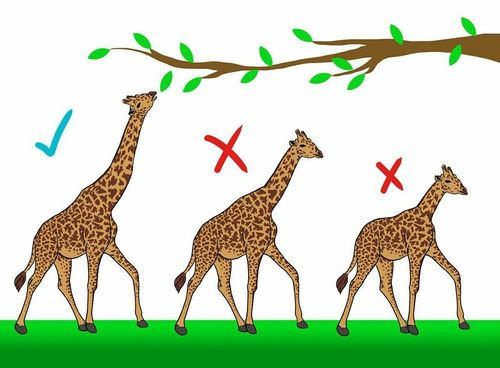
Why do you think giraffes have long necks? Why do some bacteria survive even after exposure to antibiotics but others die? Natural selection answers all of the questions above.
Natural selection is the process whereby organisms with more conformed and conducive adaptation to the environment survive and reproduce more than the rest, and in the course of time results in the adaptation becoming common in the ecology. Charles Darwin was the first person to discuss natural selection in his book called On the Origin of Species.
In simple words: The environment 'selects' who survives. It is called 'survival of the fittest' (where 'fitness' means the organism is capable of reproducing and passing on successful genes).
Changes in a population allow for natural selection to happen. Variation allows enough distinctions in individuals of the same species for natural selection to do its work.
Variation in sequences of DNA. Some rabbits have the DNA for thicker fur than others.
Differences in observable traits like the color of the eyes, shape of the beak, or height of the individuals.
Variation can occur in the following ways:
Without variation, there is no natural selection.
Changes to a population can occur through adaptations. When a population undergoes an adaptation, individuals have the same traits that increase the chance of survival and reproduction in their environment.
This refers to the physical features of an organism, for example the spines of a cactus and the flippers of a whale.
This is primarily concerned with actions that help an organism survive, like the migration of birds and the pack hunting of wolves.
Refers to changes that occur within the organism, for example the production of insulin, or venom.
Changes in populations can occur through different forms of physical, behavioral, or physiological adaptations. Adaptations bring about new changes to the population that occur through natural selection.
Natural selection works according to selective pressures, or factors in the environment that favor certain traits.
Examples of Selective Pressures:
Selective pressures create differential survival — some individuals survive longer and reproduce more than others.
There are primarily three types of natural selection:
One extreme trait is favored.
Example: A population of moths — darker-colored moths may survive better than lighter-colored moths due to better camouflage on soot-covered trees.
Average traits are favored.
Example: Human birth weight — very small or very large babies have lower survival rates.
Both extremes are favored.
Example: In a fish population, very small or very large fish survive; medium-sized ones are eaten more by predators.
These factors help explain how environmental conditions affect the ability of a population to adapt over time.
Natural selection is a multi-step process:
Key Points:
Natural selection has many different forms of evidence:
Over a long period of time, the gradual changes of the horse's evolution have been shown (from small forested horses to grazing horses).
Humans and whales are said to have a 'common ancestor' because they have homologous structures (like arms or front flippers).
The earlier stages in embryo development are seen to be similar and close, suggesting a close relationship of the species.
The evidence of evolution and the use of common DNA are said to use common systems.
One of the better forms of modern-time natural selection is the changing of bacteria to be able to survive with antibiotics.
Speciation is the creation of new species, as a result of new populations being formed and becoming confined in a way that the populations can no longer interbreed. Natural selection can result in the new populations becoming confined.
Types of Isolation:
Natural selection is a process that develops different traits in different populations over time, and can result in the creation of new distinct species.
The Industrial Revolution resulted in a higher survival rate for dark moths because they were better camouflaged on soot-covered trees.
The rapid reproduction of bacteria is a result of the bacteria having a mutation that caused them to be resistant to the new antibiotic.
The different beak sizes and shapes of the finches are a result of the different types of food that are available on the Galapagos Islands.
The open grasslands of the world are home to the fastest land animal, the cheetah, whose speed has evolved to give it a significant advantage in hunting.
These examples show the role of natural selection in real-life situations and how it influences species.
Natural selection answers these questions:
Natural selection is a major aspect in understanding evolutionary medicine, conservation biology, and ecology.
In summary, natural selection is about survival of the fittest.
Natural selection is characterized by:
Natural selection is utilized for a purpose in evolution that reigns supreme over all other revisions to the changing of life.