

On this page:
Introduction Structure of the Cell Membrane Phospholipid Bilayer Membrane Proteins Cholesterol Carbohydrates Functions of the Cell Membrane Membrane Transport Passive Transport Active Transport Bulk Transport Membrane Potential Factors Affecting Transport Real-life examples Conclusion Summary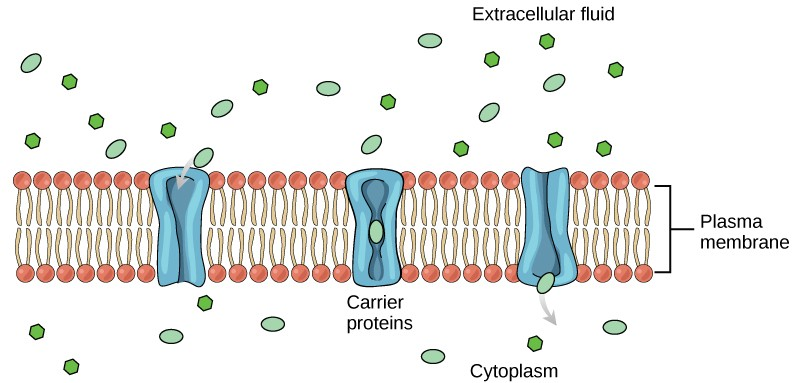
All living cells have a cell membrane. It can be thought of as the cell's "skin". In membranes, barriers are not the only things present. They are also responsible for controlling the nutrition and waste movement in and out of the cell. In addition, the membranes allow the cell to communicate with other cells. Membrane functions are important for the cell to maintain homeostasis, which is a stable internal environment.
Membranes consist of a variety of proteins and lipids, with a strong emphasis on the fluid-mosaic model proposed by Singer and Nicolson in 1972. The emphasis is on how the membranes are not solid structures, but rather flexible.
The membrane itself is a bilayer of phospholipids.
Every phospholipid is composed of hydrophilic (water-loving) head and hydrophobic (water-fearing) tails.
In an aqueous environment, phospholipids spontaneously form a bilayer. The "hydrophilic" (water-loving) heads will face the water on the exterior, and the "hydrophobic" (water-fearing) tails will face inward (the "water separating" region of the bilayer).
This bilayer is semi-permeable, meaning it will allow some substances to pass through, while blocking the passage of certain other substances.
Membrane proteins can be classified as:
Cholesterol molecules, distributed in the bilayer, serve to:
The sugar chain components of glycoproteins and glycolipids form a glycalyx on the cell surface and are involved in cell recognition, cell adhesion, protection, and signal reception.
In terms of energy use and concentration gradients, substances can either use passive or active transport to travel through membranes.
No energy is required for passive transport to occur. High-to-low concentration transport is called down the concentration gradient.
This is when molecules travel to an area of low concentration in order to achieve equilibrium, so movement of molecules occurs in the presence of no protein.
Carbon dioxide always exits the cell while oxygen is continuously entering.
Diffusion is affected by a concentration gradient; a steeper gradient increases the rate of diffusion, while an increase in temperature increases molecular movement.
A larger surface area allows for an increase in the rate of diffusion, and a shorter distance also increases the rate of diffusion.
When certain molecules are unable to cross the lipid bilayer (like glucose and ions), they must use certain proteins designated as channels or carriers.
Still, no energy is required in this process, and movement always occurs down through the concentration gradient.
Glucose uptake, as an example, occurs in the liver cells through the use of GLUT transporters.
The diffusion of water across a membrane that is semi-permeable to water is what is called osmosis.
From areas of low solute concentration, which are abundant in water, will flow to areas with a high solute concentration, which are low in water.
Active transport occurs when a cell moves a substance in the opposite direction of a gradient and requires energy, such as ATP.
Carrier proteins that transport substances by changing their shape through a process called conformational change are called pump proteins.
To transport very large molecules, cells use vesicle-mediated transport.
Endocytosis is how cells take in large amounts of substances by engulfing them.
Types include:
Exocytosis is the process by which large molecules are removed from the cell by vesicles.
Examples include when neurons release neurotransmitters or when the pancreas secretes insulin.
An electrical potential is maintained by cells as a result of the unequal distribution of ions, such as sodium, potassium, and chloride, on each side of the membrane, along with the presence of selective ion channels.
This difference is critical for:
Dynamic and selectively permeable, the cell membrane manages the cell's interactions with its environment.
The cell membrane is composed of a fluid mosaic of phospholipids, proteins, carbohydrates, and cholesterol. This construction allows it to perform various jobs, such as transport, signaling, recognition, and giving structural support to the cell.
Substances can cross the membrane by either active transport, which uses cellular energy (ATP), or passive transport (cellular energy is not required; the process uses energy from the cellular environment). This passive transport can take the forms of diffusion, facilitated diffusion, or osmosis.
Larger molecules can cross the membrane by a process called bulk transport, which is a type of endocytosis and exocytosis. For cell health, membrane potential and selective transport processes must function.
To fully understand biology, especially the biology of cells, it is essential to understand the cell membrane, and especially the mechanisms of transport across the membrane, from the uptake of nutrients and the signaling of hormones, to the impulses transmitted by nerves.