Homeostasis
Your body is a machine; a machine that works no matter the temperature, the amount of food you eat, or the amount of exercise you do. The smooth operation of the machine is called homeostasis.
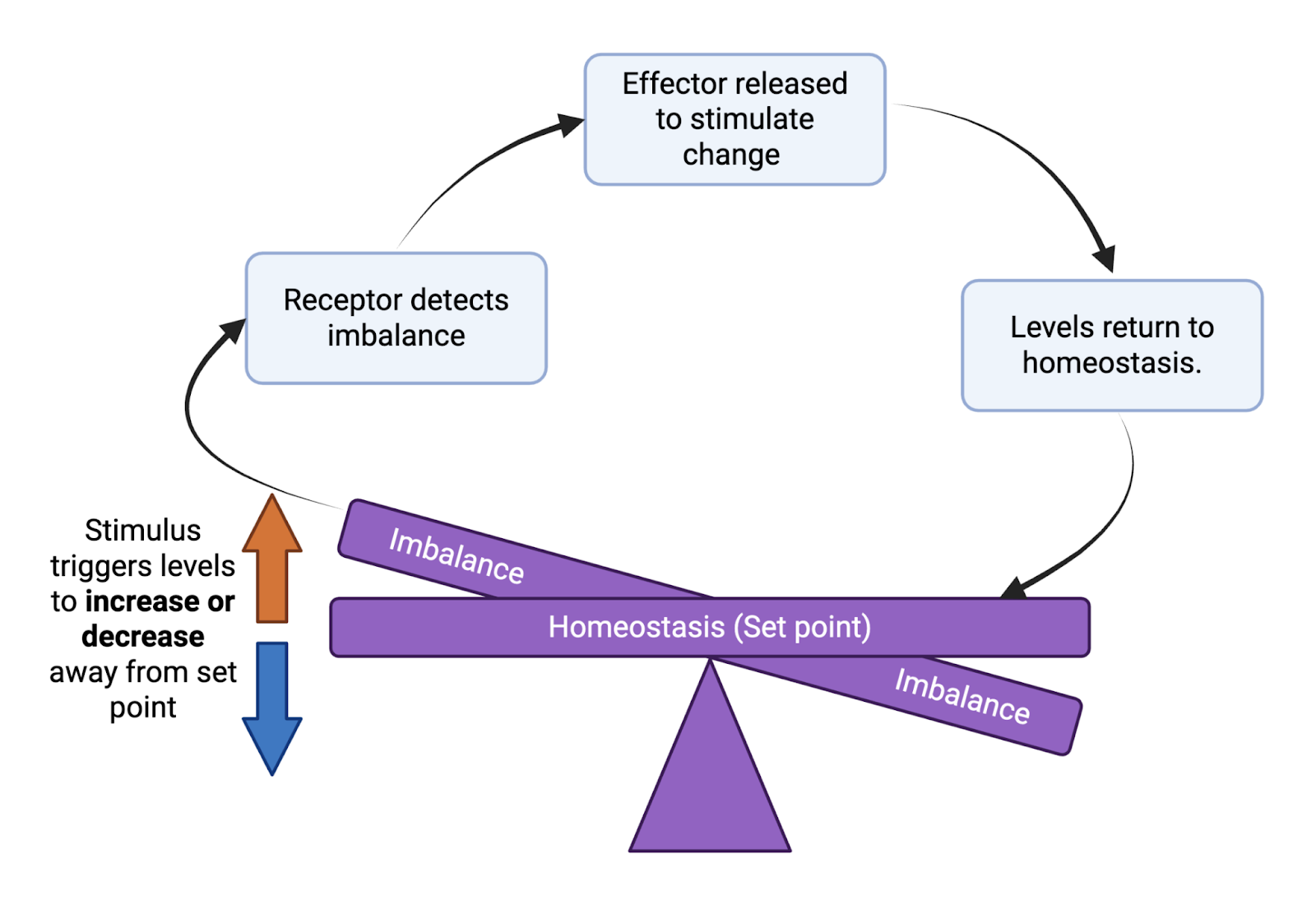
Homeostasis refers to the process by which a living organism keeps a stable internal environment regardless of the external environment. It is important because cells can only function properly in the right conditions.
What is Homeostasis?
Homeostasis is derived from Greek, where homeo means 'similar' and stasis means 'standing still'. So homeostasis means 'staying the same'.
For instance:
- Irrespective of how cold the outside environment is to you, your body temperature will still be around 37°C.
- After you eat, your blood glucose levels will still be around 90 mg/100 mL of blood.
This balance is maintained using feedback mechanisms, which detect changes and trigger responses to correct them.
Elements of Homeostasis
Three components are key for homeostasis to occur:
Receptors
These detect changes within and outside the body. An example is the thermoreceptors in the skin.
Control Center
Typically, the brain or endocrine glands. The control center receives the data and determines what action to take. The hypothalamus serves as the control center for temperature control.
Effectors
These can be muscles or glands, and they perform what action is necessary. An example is sweating, which cools the body.
Control Mechanisms
There are two types of control mechanisms:
- Negative Feedback: Reverses the change made to any controlled variable. This is the most common mechanism employed by the body.
- Positive Feedback: Makes a change greater instead of reversing it. It happens less often and usually occurs in processes that need a definite end.
Negative Feedback
Example: Regulation of Body Temperature
- When body temperature goes above 37°C, the change is detected by the hypothalamus.
- Sweat is released by the sweat glands.
- Blood vessels dilate (vasodilation), cooling the body by bringing the temperature down to normal.
Example: Regulation of Blood Glucose
- After a meal, there is a rise in blood glucose levels.
- In response, the pancreas secretes insulin, which causes body cells to take up glucose, and blood glucose levels drop.
- When levels of glucose drop too low, the pancreas releases the hormone glucagon, which stimulates the liver to release glucose.
Positive Feedback
Positive feedback makes a change greater instead of reversing it. It happens less often than negative feedback and usually occurs in processes that need a definite end.
Blood Clotting:
- When a vessel is damaged, platelets stick to the wound.
- They release chemicals that attract even more platelets to the wound.
- This cascade continues until the clot is formed.
Labor:
- Uterine contractions push the baby towards the cervix.
- This activates a stretch receptor that makes the body release more oxytocin.
- Oxytocin increases the contractions even more until the baby is born.
Thermoregulation
Being able to regulate body temperature is important when it comes to enzyme function. Enzymes have a narrow temperature range in which they operate.
Cooling Mechanisms
- Sweating: Sweat evaporates and takes heat with it.
- Vasodilation: Blood vessels widen to release heat; more blood is sent to the skin.
Warming Mechanisms
- Shivering: The body moves rapidly to create more heat.
- Vasoconstriction: Blood vessels constrict to trap heat.
- Thyroxine: This hormone increases the metabolic rate, which creates heat.
Ectotherms vs Endotherms:
- Ectotherms: Reptiles and similar organisms regulate their body temperature with the environment.
- Endotherms: Humans and other mammals generate their own heat internally.
Regulation of Blood Glucose
Blood glucose must be kept at a constant level in order to ensure that the body has a constant energy supply. This is especially important for the brain, as it requires a large amount of energy.
Insulin
- Lowers blood glucose when glucose is taken up by cells.
- Stimulates storage of glucose as glycogen in the liver.
Glucagon
- Increases blood glucose levels.
- Stimulates the conversion (breakdown) of glycogen to glucose in the liver.
Example of Negative Feedback:
- Increased blood glucose levels after the consumption of food.
- Release of insulin from the pancreas.
- Absorption of glucose from blood; glycogen storage in the liver.
- Return of blood glucose levels to normal.
Diabetes Mellitus: Occurs due to the disruption of this process. In this condition, the production or response of insulin is impaired, resulting in elevated blood glucose levels.
Osmoregulation
Osmoregulation refers to the regulation of the concentration of water and the dissolved solutes in the body. If the concentration of solutes is too high, the cells will shrink. If the concentration of solutes is too low, the cells will swell.
Involved Organs:
- Kidneys: Involved in blood filtration and urine production through reabsorption of water and ions.
- Hypothalamus: Responsible for the detection of water levels in the blood.
- Pituitary gland: Produces and releases the water-conserving hormone (ADH).
Mechanism
- Decreased water levels: Increased production of antidiuretic hormone (ADH) → increases permeability of kidney tubules to water → body retains more water → decreased urine output.
- Elevated water levels: Decreased production of ADH → decreased water retention → increased urine output.
Regulation of Ions and pH of the Blood
Certain ions are essential for the normal functioning of the cells: Na⁺, K⁺, Ca²⁺. This is equally important for the functioning of the cells.
Regulation of pH
- Blood pH is ideally kept between 7.35 and 7.45 for optimal functioning of the cells.
- Blood pH is regulated through several buffer systems (for example, bicarbonate).
- Increased breathing (hyperventilate): Low level of blood CO₂ → results in high pH (alkaline).
- Decreased breathing (hypoventilate): High level of blood CO₂ → results in low pH (acidic).
- Kidneys: Responsible for long-term regulation of blood pH. Increased excretion of H⁺ ions results in elevated blood pH (alkaline). Increased absorption of HCO₃⁻ also results in elevated blood pH.
Hormonal Control and Homeostasis
Hormones travel in the blood and regulate homeostasis. Here are a few examples:
- Insulin and Glucagon: Regulation of blood glucose
- ADH: Water balance
- Aldosterone: Regulation of sodium and potassium
- Thyroxine: Regulation of metabolic rate and temperature
Hormonal control often works with negative feedback to maintain homeostasis.
Homeostasis in Response to Exercise
Homeostasis is challenged during exercise. There is a greater energy demand and an increase in body temperature and CO₂ production.
Body Responses:
- Increased level of oxygen is achieved by an increase in heart rate and stroke volume.
- An increase in breathing rate occurs to remove CO₂.
- Increased blood flow occurs due to vasodilation of the muscles.
- Heat is dissipated by sweating.
All of these changes are temporary. Once the body rests, everything returns to normal.
Disorders of Homeostasis
Homeostasis can fail due to disease or environmental factors. Here are some examples:
Diabetes Mellitus
Failure of blood glucose regulation
Dehydration
Disruption of water balance
Hypothermia/Hyperthermia
Failure of temperature regulation
Electrolyte Imbalance
Abnormal sodium or potassium levels
For survival, it's crucial to maintain homeostasis.
Summary
Homeostasis keeps everything inside your body stable so that cells can function at their best. It includes:
- Sensors (receptors) that detect changes
- Control centers like your brain or glands
- Effectors that reverse or amplify changes
Homeostasis includes both positive and negative feedback, temperature control, blood sugar levels, pH levels, and hormones. Feedback control explains the body's response to the external and internal challenges and explains life processes.