

On this page:
Introduction What is Gene Expression? What is DNA made of? Transcribing Genes Processing in Eukaryotes Translation Control of Gene Expression Control in Prokaryotes - Operons Eukaryotic Gene Regulation Epigenetics Mutations & Gene Expression Summary Table Significance of Gene Expression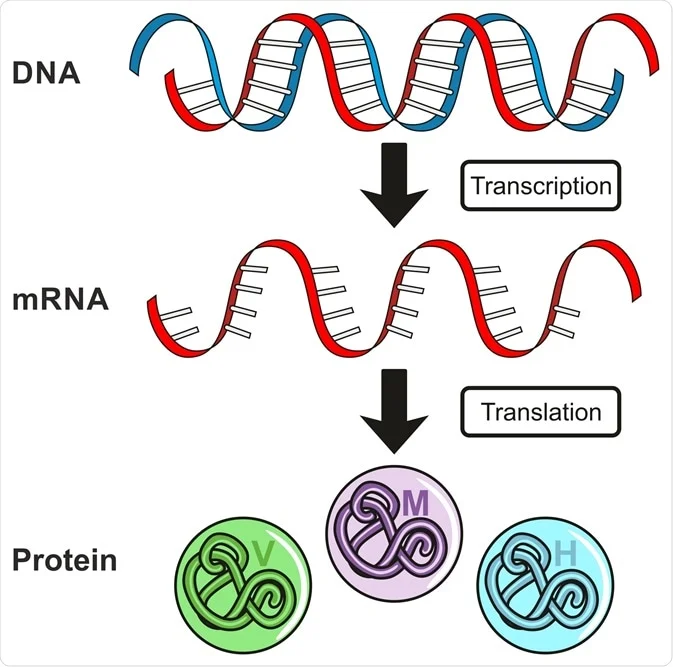
All of the cells in your body have the same DNA, but they look and behave differently. Why do certain cells, for example, liver cells, "know" to make liver proteins and muscle proteins? The answer is gene expression. Gene expression is the process of creating a protein, known as a functional product. The importance of gene expression in biology is that it shows us how traits are developed in organisms, how they react/respond to their surroundings, and how diseases are developed.
Gene expression is when the DNA sequence of a gene is turned into a functional product. Though it's usually a protein, sometimes it can be an RNA molecule like tRNA or rRNA.
There are two main stages of gene expression:
Each cell regulates which genes are to be expressed when. This is how specialization and adaptation take place.
We should review some fundamental principles of DNA before continuing. DNA is made of:
While DNA houses all the information the cells need, at a given point in time, only a certain segment of DNA (or some genes) is active or in use.
Transcribing a gene is the first step in gene expression and is the process of copying a specific gene into a messenger RNA (mRNA) molecule.
The transcription step involves three actions:
This is where the process starts. RNA polymerase (the enzyme responsible for synthesizing RNA) attaches to a DNA sequence called the promoter that is located close to the beginning of the gene. This is the cue that transcription is starting.
In this step, the DNA is unwound by the RNA polymerase, and a complementary strand of RNA is synthesized by the enzyme. Unlike DNA, RNA has uracil (U) rather than thymine (T).
The RNA polymerase encounters a specific sequence called a terminator sequence, and transcription comes to an end. For eukaryotes, the end product of this transcription process is called pre-mRNA.
Before pre-mRNA can be called 'mature mRNA', some changes are made to it.
Prokaryotic organisms lack introns; therefore, their mRNA is ready to go as soon as transcription is completed.
Translation is the next step, where a protein is produced from the decoded mRNA.
The ribosome binds to mRNA at the start codon (AUG). The tRNA carrying the first amino acid (methionine) with the complementary anticodon is brought.
The ribosome is transcribed as it moves along the mRNA, and codons are read. tRNA molecules continue to bring the amino acids to the ribosome in the right order to create a polypeptide chain.
The ribosome reaches one of the three stop codons (UAA, UAG, UGA). The polypeptide chain is then released, and it folds to create a protein with a specific function.
Proteins then go on to do many important functions, including serving as enzymes, structural components, transport, signaling, and regulation.
Only some genes are active at a particular time. In order to reduce energy, cells control the expression of genes.
Prokaryotes have a mechanism known as operons, a set of genes with a single promoter.
The presence of operons means that bacteria can adapt to fluctuations in their surroundings.
Eukaryotes have evolved a more complex means to control Gene Regulation than prokaryotes.
Control of transcription factors (proteins) that 'switch the genes on' (active) or 'switch them off' (repressed) by attaching themselves to the DNA.
Control of the expression of a gene is influenced by certain mechanisms, or control structures, with which the DNA sequence is not altered.
Control of the DNA Sequence of a gene is altered, and affects the expression of that gene: sequence changes, such as a single base change, and this is called a point mutation.
Mutations in regulatory sequences (promoters, enhancers) can increase or decrease the expression of a gene. Coding sequence mutations can alter the structure and function of a protein.
Some mutations can be dangerous or neutral, and in rare cases can be advantageous, resulting in evolutionary changes.
| Stage | Key Players | Purpose | Location |
|---|---|---|---|
| Transcription | DNA, RNA polymerase, mRNA | Copy DNA into RNA | Nucleus (eukaryotes) |
| RNA processing | Pre-mRNA, spliceosome, enzymes | Make mature mRNA | Nucleus |
| Translation | mRNA, ribosome, tRNA, amino acids | Synthesize protein | Cytoplasm |
| Regulation | Promoters, enhancers, repressors, transcription factors | Control gene activity | Nucleus / Cytoplasm |
| Epigenetic changes | DNA methylation, histone modification | Modify gene accessibility | Nucleus |
Gene expression is important in biology because:
Manipulation of genes, treatment of diseases, and the exploration of the basics of life are all made possible by the understanding of gene expression.