

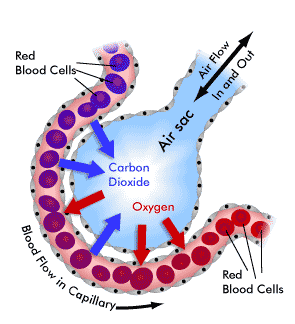
How do you think we intake oxygen and exhale carbon dioxide? Every living cell produces carbon dioxide as waste and requires oxygen for respiration. Gas exchange is the system in the human body by which oxygen is taken in and carbon dioxide is released. Without the system of gas exchange, life would not exist!
In this lesson, we will focus on all the mechanisms and adaptations in humans, plants, and animals that make gas exchange possible and efficient.
Gas exchange is the transfer of oxygen from the environment into the organism and carbon dioxide from the organism into the environment. This happens at the respiratory surface, which is typically thin and moist, providing a larger area for efficient diffusion.
The main principle is diffusion. It is the movement from high to low concentration of gases. In this case, oxygen will diffuse into the blood because it is low in concentration and will diffuse out of the blood because it is high in concentration in the surrounding air.
The size of the organism, its environment, and its metabolism will determine how different organisms will have different structures for gas exchange.
The main respiratory organ of humans is the lungs. The pathway of air is as follows:
Nose/Mouth → Trachea → Bronchi → Bronchioles → Alveoli
Alveoli are tiny sac-like structures that are modified for the exchange of gases. These modifications are:
Oxygen will diffuse into the blood and combine with hemoglobin, and carbon dioxide will diffuse into the alveoli to be exhaled.
Gill structures are used in fish because they live in water. Water enters through the mouth, passes over the gill filaments, and exits through the gill slits.
Gill adaptations include:
Insects use the tracheal system. They have spiracles that open up into tracheae that lead directly to the cells.
Adaptations:
Plants' gas exchange: O₂ and CO₂ diffuse through stomata in their leaves.
Adaptations:
Gas exchange occurs through two main processes: Diffusion and Ventilation.
Diffusion describes the natural gas movement. Gases always move from an area of high concentration to an area of low concentration.
Consider the following example:
Diffusion is affected by many factors:
In humans, the movement of air in and out of the lungs is called ventilation.
Ventilation involves:
Ventilation is important because it provides a constant supply of oxygen and removes carbon dioxide to maintain the concentration gradient for diffusion to occur.
In fish: Ventilation is done by the movement of the mouth and gills to allow water to flow continuously over the gills.
After diffusion, oxygen and carbon dioxide are transported in the blood:
In the tissues, where oxygen concentration is low, haemoglobin releases oxygen.
Bohr Effect: Because of the high CO₂ and low pH in the tissues, there is a reduced affinity of haemoglobin for oxygen, which facilitates the release of oxygen in the tissues.
All organisms have adaptations for gas exchange:
At high altitudes, getting enough oxygen becomes difficult due to the low partial pressure of oxygen. Therefore, the body accommodates to the new altitude by increasing red blood cell production and increasing the breathing rate.
The body demands more oxygen during physical exercise. So, the body adjusts to the new demands by increasing heart and breathing rates to deliver more oxygen to the muscles and exhale CO₂ produced faster.
For the aquatic animals, water has less oxygen than air, which means adaptations like Countercurrent flow and gills are needed. On the other hand, for the terrestrial animals, the air has more oxygen, which means structures like Tracheal systems and lungs are enough.
It is important to understand that the surviving cells require gas exchange to perform cellular respiration.
Summary of adaptations by organism:
Gas exchange works best when there is a good surface area, thin membranes, good moisture, optimal concentration gradients, and good ventilation.
The more we know about gas exchange, the more we know about the self-sustaining cycle of life in different habitats and how organisms are adapted to their environment.