Evolution and Speciation
Have you wondered why certain animals have long necks, why they have differently shaped beaks, or why humans and chimps are different? Evolution is a gradual process of change affecting all species.
This lesson aims to answer the following questions: What is evolution? How does evolution take place? How are new species formed?
What is Evolution?
Evolution refers to a change in the genetic composition of a species over time. This change happens over successive generations due to impacts from various external factors, and is a continuous process throughout the existence of the organism.
Think about this:
- The ancestors of today's horses were small forest-dwelling creatures. Over the course of millions of years, descendants of these ancestors would become the giant grassland horses.
- Humans and chimps share a common ancestor, but due to evolutionary pressure in their respective surroundings and a variety of genetic changes, their evolutionary journeys diverged.
Evidence of Evolution
One of the most important things to keep in mind when studying and explaining the process of evolution is the multiple ways the process can be documented.
- Fossil Evidence: The history of life on Earth is documented through fossils, providing documentary evidence for evolution. A famous example is Archaeopteryx– a transitional fossil that shows characteristics of both birds and reptiles.
- Anatomical Evidence: Structures that are similar in shape but serve different functions, like flippers of whales and arms of humans, are called homologous structures and express that the organisms demonstrate a common ancestor. Structures that serve the same function but are different in shape, like the wings of insects and the wings of birds, are called analogous structures and express convergent evolution.
- Embryo Development Evidence: Different vertebrates show likenesses while developing their embryos, indicating they might have come from the same ancestor.
- Genetics Evidence: Comparative studies of DNA and proteins provide evidence for evolutionary relationships among species. The greater the percentage of DNA they share, the more closely related they are. Humans and chimpanzees, for example, have 98-99% of their DNA.
- Evolutionary Location Evidence: The evolutionary history of living organisms on different land masses that have been isolated from each other is influenced by the movements of continents. For instance, living organisms found on isolated and continental land masses diverge and become evolutionarily different from each other.
Theories of Evolution
There are theories within the scope of evolution. Some of the more telling ones include Natural Selection, Type of Selection, Genetic Drift, and Gene Flow.
Natural Selection
Natural Selection means that there is a change within a species as a result of the activities going on around it. For a species to develop new traits, it must first survive and reproduce.
Important notes:
- Every population exhibits variations.
- Not every individual within a population is expected to survive.
- Traits that aid in adaptations are genetic and can be carried by new generations.
The Peppered Moth: This is a type of moth found in England. The moths before the Industrial Revolution were mostly light colored. The moths changed because of the Industrial Revolution and the building of coal factories. The pollution from the factories made the tree trunks darker. The light colored moths were preyed on and were able to reproduce more than the light colored moths. This is a good example of directional selection.
Types of Selection
Stabilizing Selection
Example: Birth weights of babies.
Directional Selection
Example: Change of color in the peppered moths.
Disruptive Selection
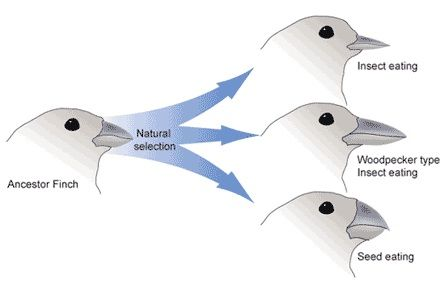
Example: Different beaks of finches that feed on different types of seeds.
Genetic Drift & Gene Flow
Genetic Drift
Evolution happens because of random changes that occur in a small population. The changes are not selective.
Example: Consider a stochastic storm that randomly, and without prejudice, affects a random assortment of birds. The genetic alleles of the surviving birds that remain alive will potentially become the dominant alleles of the next generation of birds.
Gene Flow (Migration)
The movement of an individual member of a population into a new and different population can have the potential of creating new and significant changes to the entire evolutionary process.
Mutation
Mutations affect random points on the DNA strand, creating new alternatives. The changes can be beneficial, neutral, or, in most cases, harmful to the organism. But some mutations can be advantageous in the sense of survival of the organism.
Speciation
Speciation is the process of a new species being born from a species that already exists. A species is defined as a group of living organisms that can interbreed and generate offspring that can also breed.
Speciation occurs mainly when a population is divided, and as a consequence, they face different selective pressures.
Three Types of Speciation
- Allopatric Speciation: This is the case when populations are isolated by physical and geographical barriers, such as a river, a mountain, or an ocean. A case is the beak shapes of Darwin's finches in the different islands of the Galapagos, because they had different types of food available.
- Sympatric Speciation: Sympatric speciation includes the possibility of speciation while there are absolutely no geographical barriers. More specifically, the population is in the same geographical location, but some of the populations become reproductively isolated due to genetic, behavioral, or environmental reasons. An example of this includes the various cichlid species found in the same lake in Africa that exhibit differences in mating preferences.
- Parapatric Speciation: Parapatric speciation is the opposite of sympatric speciation. In other words, this type of speciation occurs when populations are reproductively isolated, but they are still close enough to each other so that they can interbreed, although there is still some geographical barrier to interbreeding. An example can be seen in the populations of the same species of grass that are found in one of the soils that is contaminated, while in the other, the uncontaminated one, and over time, they evolve into different species.
Mechanisms of Reproductive Isolation
In the process of speciation to occur, there must be some form of reproductive isolation, other than the geographical barriers. This can occur through what are known as the prezygotic barriers or the postzygotic barriers.
Prezygotic Barriers
- Spatial Isolation: This occurs when breeding is done in different geographical locations.
- Temporal Isolation: This is when breeding occurs at different times.
- Behavioral Isolation: Different mating rituals.
- Mechanical Isolation: Different structures.
- Gametic Isolation: The sperm and egg do not fuse.
Postzygotic Barriers
- Hybrid Inviability: The fertilized egg does not develop correctly.
- Hybrid Sterility: The offspring are sterile; this is seen in mules, which are sterile hybrids of horses and donkeys.
- Hybrid Breakdown: The offspring may be able to reproduce, but they and their descendants will be weak or sterile.
Adaptive Radiation
When one organism develops more than one way of functioning and rapidly diversifies into a number of distinct organisms for one or more ecological roles.
Darwin's finches are an example of adaptive radiation, where the species developed different types of beaks to eat different foods: seeds, insects, or nectar.
Gradualism vs Punctuated Equilibrium
Gradualism
The changes happen over a long period of time and are documented in the fossils over millions of years.
Punctuated Equilibrium
These changes happen in a short and quick period of time, and the fossils show new species that are documented.
Evolution of Humans
Modern apes and humans are different species; however, both have a common ancestor.
Key milestones include:
- Australopithecus had a small brain, the first to walk upright, and eventually evolved to
- Homo Habilis, the first to use tools
- Homo Erectus, which had a bigger brain and was the first to use fire
- Modern Homo Sapiens have culture and language. DNA evidence suggests that early humans interbred with Neanderthals and Denisovans, explaining why we have their DNA.
Understanding speciation and the mechanisms through which it occurs offers insight into the multiple forms of life on earth and the processes that bring the continual emergence of new forms.
Summary
Some points on evolution and speciation include:
- Evolution involves changes in the heritable traits of a biological population over generations.
- The processes involved in evolution include natural selection, genetic drift, and mutations, as well as the movement of genes (gene flow).
- Speciation occurs when there are populations that become reproductively separated from each other.
- Evolution can occur through three models: adaptive radiation, gradualism, and punctuated equilibrium.
- The evolution of the human species illustrates the many changes that can occur within a species over millions of years as it adapts to new environments and new challenges. Evolutionary processes are fundamental to understanding the diversity of life on earth, the interrelationships among organisms, and the history of life on our planet.