

On this page:
Introduction What Is an Ecological Niche? Niche and Habitat Fundamental and Realized Niches Niche Overlap and Competition Competitive Exclusion Principle Resource Partitioning Niche and Adaptations Keystone Species Niches in the Real World Niche Dynamics and Environmental Change Summary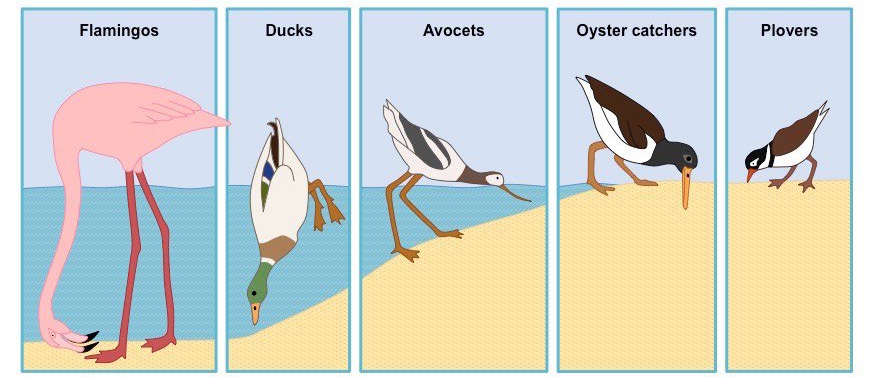
Imagine looking through a forest, a pond, or even your backyard. There are many different types of species living next to each other. Some climb trees while others dig into the dirt. Others swim about in the water. Have you ever thought about how they are able to live next to each other without one species dominating everything? The answer is ecological niches.
Ecological niches help to explain different ways in which different organisms interact with one another and with the environment. They help explain how species can live next to each other, compete, and how they further evolve in that particular ecosystem.
An ecological niche is how a particular species of an organism fits or fits into an environment.
Niche is not a space; it's a job. It's how a species survives, lives, and interacts with its biome.
Take, for example, a frog in a pond. Yes, that's its habitat, but it also does other things. It eats insects, and in addition to other activities like creating a home and breeding in it, it can be at risk of being captured by a bird. A frog has a niche that is not just its environment.
Desert, pond, forest.
A habitat contains several organisms, among which each has a different role and function in the ecosystem to avoid competition.
Role of the organisms and their way of life.
Rainforest inhabitants are divided into different roles. For example, the branches are home to the monkeys. The ground is where the jaguars are stationed. The epiphytic plants are also located on the branches.
The two types of niches can be explained with the following terms used by ecologists:
This niche has no competition. As a result, the species can realize its full potential regarding the temperature, light, water, salt, or other factors. From an ecologist's standpoint, think of it as the ideal career plan.
This involves limiting factors, be they competition, prey, or other factors. Competitive species tend to occupy the niche. It is the location where a species is found, and the resources it uses.
The two species of barnacles represent a classic example. They inhabit the same zone. One barnacle can extend her reach to the entire zone, but due to competition, she is confined to a zone. This has a resemblance to the concept of realized niche.
All factors considered, balance is critical, given that niches are drawn from the potential of species and the resources available.
When two species compete for the same resources, we say their niches overlap, and the result will be competition.
Competition between different species.
Example: Two species of birds compete for the same species of insects.
Competition between individuals of the same species.
Example: Two rabbits compete for the same type of food.
Two species cannot coexist in the same niche for a long time. One of the species will be outcompeted and go extinct or relocate elsewhere.
This was first noted by Gause (1934) in his research on Paramecium species.
Example: If two species of mice compete for the same species of food and habitat, one of the species will be outcompeted and go extinct or relocate to a different habitat.
This principle shows that the coexistence of different biological species is the result of small changes. By evolving slight behavioral changes, or changes in the way resources are utilized (resource partitioning), species can coexist without completely replacing each other.
Resource partitioning is the phenomenon where an ecosystem manages to balance the competition of different species or the resources that they depend on, and allows them to coexist in the same area.
To survive without fighting, organisms often split resources so as not compete. This method is called resource partitioning.
Consider the case of a species that lives in a desert ecosystem. The desert cacti are an organism that displays particular adaptations. It has a thick stem that is able to store water, and the spines protect the organism from herbivores that may eat it. The shallow roots enable the organism to absorb the rainwater quickly.
Such adaptations also help the organism to survive in the desert ecosystem and compete with different organisms within the same niche.
Different species can also be grouped based on the resources that they are competing for.
Niche width is classified as either narrow or broad.
Having a wide niche, and surviving in many different habitats.
Example: A raccoon can eat a variety of foods, from plant-based foods to insects, eggs, and even human food.
Having a narrow niche and are hyper-adapted to survive in extreme conditions or feast on a specific type of food.
Example: A specific species of insect that eats only one type of plant. Koalas only consume eucalyptus trees.
Importance: Generalist species' niche is able to adapt to competition, while specialist species are efficient in their niche but have lost vulnerability as the conditions change.
Some species have a fundamental role in nature, as they keep a certain structure in the ecosystem. These species have a large impact on other species in a niche. A keystone species provides support to the ecosystem as a whole.
Species that fit into many categories in a food web are known as? They show how a single niche impacts the entire system.
Niches are dynamic, not fixed, and they change because of:
Species that can't change their niche may adapt, migrate, or face extinction.