

On this page:
Introduction What Is DNA? Why DNA Replication Is Necessary Semi-Conservative Replication Direction of Replication Enzymes Involved in DNA Replication Leading and Lagging Strands Initiation of DNA Replication Elongation Termination Accuracy and Proofreading Replication in Prokaryotes and Eukaryotes Cell Cycle and DNA Replication Applications to Biotechnology and Medicine Important Ideas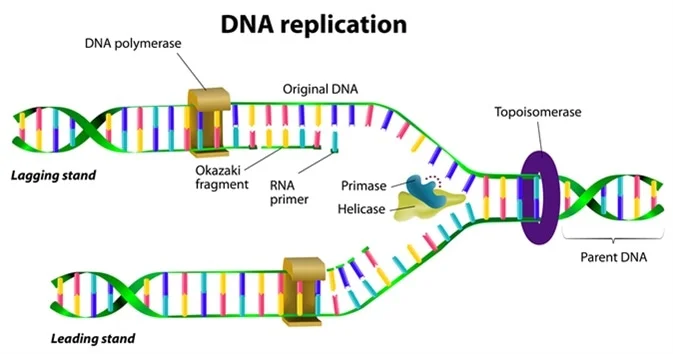
Look at your hands. Every muscle cell, skin cell, and neuron in your brain has DNA. But how is it that every new cell gets the same DNA information?
Your body is continuously dividing cells. When cells divide, DNA has to be copied, and it needs to be done correctly. If there is an error, a change occurs in a particular protein, and the whole organism could be impacted.
DNA replication is a biological mechanism that is used to make an identical copy of the cell's DNA before cellular division. It maintains the continuity of genetic information from cell generation to cell generation.
DNA is an acronym for Deoxyribonucleic Acid. It is a type of molecule that is found in almost all living organisms and contains genetic information.
In 1953, James Watson and Francis Crick proposed a model for DNA's structure as a double helix using data provided by Rosalind Franklin and Maurice Wilkins. DNA has a double helix structure, consisting of two strands that run antiparallel to each other. Each strand is made up of units called nucleotides.
Every nucleotide is made of three components:
There are four types of nitrogenous bases:
In this case, base pairing has a specific rule:
This is called complementary base pairing.
DNA replication takes place before cell division, specifically before the S phase of interphase, which forms part of the cell cycle.
When a cell divides by mitosis, it produces two daughter cells that are identical to the initial cell. If DNA is not copied accurately, the information contained in the genes would be lost.
In meiosis, it is through DNA replication that it is ensured that the gametes obtain the appropriate genetic material. If this cycle of replication were to cease, life would not be sustained.
DNA replication is characterized as semi-conservative.
This means each new DNA molecule has:
Matthew Meselson and Franklin Stahl experimented in 1958, which confirmed the semi-conservative model.
Their experiment showed that replication conserves an old strand after replication and forms a new strand.
This mechanism ensures both accuracy and continuity.
DNA strands are antiparallel. This means that one strand goes from 5' to 3' and the other goes from 3' to 5'.
DNA polymerase, the main enzyme that builds new DNA, only adds nucleotides in the 5' to 3' direction. This results in the two strands being replicated in different ways.
Many different enzymes replicate DNA, each with a different and specific role.
All these enzymes have unique and complex functions.
Because DNA Polymerase can only work in the 5' to 3' direction, the process of DNA replication is different for the two strands.
DNA polymerase continuously synthesizes new strands in the direction of the helicase and replication fork.
Designed to synthesize new strands of DNA in the opposite direction of the replication fork.
This creates small pieces of DNA, known as the Okazaki fragments, which are named after the scientist who first discovered them. Each Okazaki fragment requires a separate strand of RNA Primer, and, after the Strand of RNA Primer is removed, the fragment of DNA will then undergo ligation to join the strands of DNA, which is what makes the complex discontinuous synthesis process of DNA replication.
DNA replication begins at specific spots in the DNA sequence known as the origins of replication. In prokaryotic cells, there is usually one origin, and in eukaryotic cells, there are several origins.
Helicase is an enzyme that unwinds the DNA double helix, allowing for the formation of a replication bubble.
The next step is to add the proper nucleotides for the new complementary strand, which is done by the enzyme DNA polymerase.
On the leading strand, this process is continuous, whereas on the lagging strand, this process is discontinuous.
The next step is the formation of the hydrogen bonds that occur between the added bases, as well as the formation of the phosphodiester bond between nucleotides.
In order for replication of DNA to be terminated, the entire DNA molecule must be replicated. Telomerase is the enzyme responsible for extending telomeres, which are special structures found in eukaryotes that protect the ends of chromosomes from the loss of important DNA sequences.
The DNA replication process is remarkably accurate, with an error rate of approximately one mistake for every billion nucleotides.
This process is accurate for three reasons:
In the case that DNA polymerase adds the wrong nucleotide, it is able to remove and replace it with the correct one.
If errors are not corrected, they may be the basis of mutations, some of which are harmless, and others may eventually lead to diseases or cancer.
The process of DNA replication in prokaryotes is the simplest and fastest, as the circular DNA of prokaryotes, such as bacteria, is located in the cytoplasm.
Eukaryotic organisms have their DNA organized as linear chromosomes. DNA replication in eukaryotes is more complicated than in prokaryotes for the following reasons:
Despite the differences in the above factors, the basic mechanics of DNA replication are the same across the board.
This explains why DNA replication is a fundamental process, and it furthers the hypothesis that all organisms have come from a singular, primordial organism.
Replication of DNA happens during the S phase of the interphase of the cell cycle. The entire cell cycle is made up of four phases:
The cell has several checkpoints to confirm that no mistakes have been made during the replication of DNA.
When these cell checkpoints are activated, the cell cycle is halted. This ensures that the genetic information from the parent cell is not damaged when it is passed onto the daughter cells.
Processes that are based on the principles of DNA replication have been developed. One of these processes is called the Polymerase Chain Reaction, or PCR for short. Warehouses are used to duplicate and amplify results in the rapid growth of cells. This process is used in:
Most of the treatments offered for cancer are aimed at the cells that divide the fastest as a result of DNA replication.
Replication is NOT the mere copying of the DNA strands but also an active, ordered, and regulated series of processes that are controlled by enzymes, and that must occur for life to continue.
As cells divide, the nucleotides are copied. This must happen with great detail for the processes of growth, repair, and reproduction to occur. Evolution is also dependent on mechanisms that are precise.
DNA replication is one of the most essential processes in biology. It also serves as the origin of the foundation for the most basic concepts of genetics, inheritance, and molecular biology.