

On this page:
Introduction What Is Biodiversity? Why Is Biodiversity Important? Ecosystem Services Threats to Biodiversity Extinction & IUCN Red List Conservation Strategies Sustainable Development Indicator & Keystone Species How Is Biodiversity Measured? International Cooperation Conclusion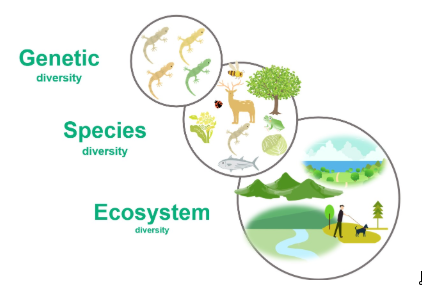
Open your eyes and watch the trees, birds, insects, microorganisms in the soil, crops in the fields, and even the bacteria in your body. There is life everywhere on Earth in unimaginable diversity.
But will this diversity stay forever?
No.
Species are disappearing at an unbelievable speed, not seen in many years. Forests are diminishing, coral reefs are dying, and many species of animals are endangered. Therefore, the conservation of biodiversity is one of the most pressing issues of modern biology.
Studying conservation of biodiversity in Biology, we learn the value of life, the impact of human activities on ecosystems, and the efforts that can be made to save the natural world.
Biodiversity is the variety of life in a particular location or on the Earth as a whole. It encompasses all living organisms and the ecosystems that they create.
Biodiversity can be understood at three levels:
Genetic diversity is the variation of genes between different individuals of the same species. Think of the differences between various breeds of rice or of different breeds of dogs. Having high genetic diversity within a population is important because it can help a population survive different challenges like a change in the environment or a new disease.
Shifting now to species diversity, this relates to the different species that can be found in an ecosystem, and the total number of individuals of each species. For example, a tropical rainforest has a higher species diversity compared to a desert.
And finally, in ecosystem diversity, this is the different ecosystems that are present in a given area. Think of the variety of ecosystems like grasslands, forests, wetlands, coral reefs, and deserts. Different ecosystems can support different types of communities of organisms.
All three levels of diversity come together to create the intricate web of life on Earth.
The importance of biodiversity can be understood through the delicate nature of life.
Ecological stability is one of the reasons. Life forms in an ecosystem rely on each other. Imagine producers, consumers, and decomposers in a food web. The loss of one species can create huge imbalances in an ecosystem.
Removing a top predator species from an ecosystem can allow its prey to multiply too much, and this will destroy vegetation and change the whole ecosystem.
Numerous medications are derived from microorganisms and plants. Pollinators like bees are essential for crops, and healthy marine ecosystems are necessary for fisheries.
Tourism, industry, and agriculture are all supported by biodiversity.
Many societies honor the environment for ethical and spiritual reasons. Some believe, regardless of their utility, that all species hold the right of existence.
Ecosystem services, or the benefits that nature provides to people, can be divided into four categories.
Biodiversity is the foundation of life, and when biodiversity declines, the services provided by ecosystems decline.
Human actions are the primary reasons for biodiversity loss. The main threats to biodiversity are:
Forests are destroyed for agriculture, urban development, and road construction. Wetlands are drained, and coral reefs are destroyed. The loss of habitats diminishes the living spaces and food sources of species.
As an example: Extensive deforestation in the Amazon Rainforest occurs due to cattle ranching and soybean agriculture.
Overfishing, overhunting, and illegal trade of wildlife mean that populations are being diminished more quickly than they can recover.
Organisms are harmed by industrial waste, plastics, pesticides, oil spills, and other pollutants. Water pollutants can lead to a process called eutrophication, which means a loss of oxygen and death for living aquatic organisms.
Due to global warming, temperature and rainfall patterns change. The Great Barrier Reef is one of the coral reefs that experiences coral bleaching because of increased heat in the water.
An invasive species is an organism from another ecosystem that has no natural predators in the ecosystem to which it is introduced. They can outcompete the organisms that are already living in that new ecosystem.
Extinction is the term used to describe the death of the last member of a species. In the history of life on Earth, natural extinction has always occurred, but the current rate of extinction is unprecedented because of human activity.
There have been 5 significant mass extinctions in the history of life on Earth. Scientists argue that we are currently living through the 6th mass extinction, which is a direct result of human activity.
The International Union for Conservation of Nature (IUCN) categorizes species that are threatened, which are called the IUCN Red List. The species that fall under IUCN Red List categories are:
Extinction in these categories assists scientists and governments in determining which species require immediate and focused interventions in terms of conservation.
There are different types of strategies that can be employed to protect and preserve biodiversity. The strategies can be divided into two major categories.
In situ conservation describes the protection of species naturally occurring in their habitats. National parks, wildlife reserves, and marine protected zones all demonstrate conservation of habitats, in this case, the habitats of endangered species.
For example: In Yellowstone National Park, large mammals like bison and wolves are protected. In situ conservation is complete because all of the species and the entire ecosystem and allow their interactions to evolve.
Ex situ conservation is the protection of species occurring outside their natural habitats. Examples of ex situ conservation are: zoos, botanical gardens, seed banks, and captive breeding programs.
Examples: The Millennium Seed Bank Partnership serves as a store of seeds from thousands of species. Captive breeding programs are also ex situ conservation.
Restoration Ecology describes the process of repairing the damage of ecosystems, which may involve restoring habitats, including:
These activities improve the ecosystem and the biodiversity.
The goal of conservation is not to restrict all human progress; on the contrary, it is to promote sustainable development. These developing future needs of current and future generations. The 1992 Earth Summit Convention on Biological Diversity illustrated this goal.
Sustainable practices include many things. Some examples include:
Perhaps the greatest challenge of environmental management systems globally is seeking balance between conservation and economic growth.
Indicator species include those that signal the environmental quality of their habitat with their presence or absence.
For instance: Amphibians are abundant and often the first organisms to disappear with increased habitat pollution and climate change.
Keystone species exert a disproportionately large influence on their ecosystem. Ecosystem collapse is a likely possibility when a keystone species is removed.
Example: Yellowstone National Park's wolf reintroduction program is a successful example of restoring ecological balance. Wolves controlled the deer population and allowed the recovery of the deer overgrown vegetation.
To assess biodiversity, scientists employ several methods, including:
Monitoring biodiversity is essential, in part, because it enables scientists to detect any changes and evaluate conservation strategies.
The loss of biodiversity is a result of many factors. It is a global issue and results in the necessity of international cooperation. For example, Animals migrate in and out of different countries. Climate change occurs on every continent.
Cooperation must occur internationally during the development of organizations, treaties, and research programs.
Global efforts include:
In Biology, the conservation of biodiversity intersects with ecology, evolution, genetics, and the anthropology of impacts.
Biodiversity loss has far-reaching consequences, with collateral damage to the planet and our collective future.
Understanding conservation allows students to think both rigorously and ethically about our culpability.
Biodiversity underwrites life on Earth and is the bedrock of our interdependent socio-economic systems. Human activities are endangering life on Earth with a rapidity and severity previously unseen.
The combination of in situ and ex situ conservation, restoration ecology, sustainable development, and international cooperation can preserve the planet's biodiversity.
Life on Earth is dependent on prudent choices, scientific understanding, and responsible stewardship.