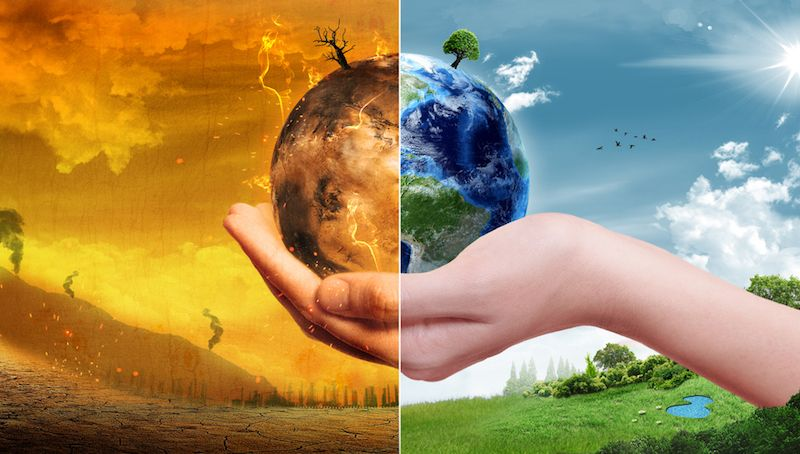
Climate Change
Take a look outside. Do you see the seasons changing more than last year? More extreme weather like heatwaves, or more storms and floods? Glaciers melting? Coral reefs dying? All of these examples are signs of climate change.
One of the reasons climate change is an important topic in biology is because of its relation to ecosystems, biodiversity, and the overall survival of species. Most of the time, climate change is affecting the entire planet. It can help us understand the global phenomena involving changes in the populations, habitats, and ecosystems.
What is Climate Change?
The term climate change is used to describe a long-term change in the weather of a certain area of the globe. Weather changes tend to be global or regional, so there can be weather changes related to global warming.
Weather vs. Climate:
- Weather: The short-term changes in the atmosphere, like rain or sunshine.
- Climate: Long-term and average weather over a period of years or decades.
Climate change is a long-term shift in what is "normal."
Causes of Climate Change
There are two types of change: natural and human.
Natural Causes
- Volcanoes: These eruptions push out massive amounts of CO₂ and ash and will warm or cool the atmosphere.
- Solar radiation: Captures and releases targeted energy, which will heat or cool the planet.
- Earth's shifting orbit: Due to rotation and orbital variations.
Human (Anthropogenic) Causes
- Burning fossil fuels: Coal, oil, and gas release CO₂.
- Deforestation: Cutting down CO₂-absorbing trees.
- Industry: Provides methane (CH₄), nitrous oxide (N₂O), and fluorinated gases.
- Farming: Livestock methane, fertilizer nitrous oxide.
The Greenhouse Effect
The greenhouse effect keeps the Earth from freezing. Without the greenhouse effect, the Earth would be too cold to survive.
How it Works:
- The Earth absorbs some heat from the sun, and that heat warms the surface of the Earth.
- Some captured heat is released to the atmosphere.
- Greenhouse gases, such as CO₂, CH₄, N₂O, and water vapor, trap some of this released heat.
Enhanced Greenhouse Effect: The additional effect caused by humans, such as burning fossil fuels and deforestation, that add to the greenhouse gases that trap heat and cause global warming.
Primary Greenhouse Gases
The four primary greenhouse gases are:
- Carbon Dioxide (CO₂): Released from burning fossil fuels and deforestation.
- Methane (CH₄): Released from livestock and landfills.
- Nitrous Oxide (N₂O): Released from the use of fertilizers.
- Water Vapor: Essential for life. It increases in the atmosphere when the air temperature rises.
Global Warming
Global warming is caused by climate change, driven by accumulated greenhouse gases. Since the beginning of the Industrial Revolution, the average temperature of the Earth's surface has increased by about 1.2°C.
While 1–2°C may not seem like a huge difference, it is a significant number when talking about climate systems and ecosystem stability.
Impacts on Ecosystems
Climate change affects species, populations, and habitats. Key impacts include:
1. Habitat Loss
- Melting ice caps and glaciers reduce polar habitats.
- Rising sea levels flood coastal areas.
- Coral reefs bleach due to warmer seas.
2. Changes in Species Distribution
- Species move toward cooler areas (higher altitudes or latitudes).
- Some species may not adapt quickly enough and face extinction.
3. Altered Food Webs
- Changes in the timing of flowering, migration, or breeding affect predator-prey relationships.
- Example: Early plant flowering may not match insect activity, affecting pollination.
4. Extreme Weather Events
- Heatwaves, droughts, floods, and storms can kill species, destroy habitats, and reduce biodiversity.
Feedback Mechanisms
Climate change can be amplified or reduced by feedback loops:
Positive Feedback (Amplifies Change)
- Melting ice: Less ice → less reflection of sunlight → more heat absorbed → more ice melts.
- Permafrost thawing: Releases methane → more warming → more permafrost melts.
Negative Feedback (Reduces Change)
- Increased plant growth: More CO₂ → faster photosynthesis → more CO₂ absorbed → reduces warming.
Positive feedback usually dominates in the current climate change, accelerating the problem.
Evidence for Climate Change
Scientists use multiple lines of evidence:
- Temperature records: Thermometer readings over 150+ years show rising temperatures.
- Ice cores: Contain trapped air bubbles showing past CO₂ levels.
- Sea level rise: Measured using satellites and tide gauges.
- Glacier retreat: Observed in mountains and polar regions.
- Species changes: Shifts in migration, breeding, and flowering times.
Effects on Human Societies
Climate change affects humans as well:
Health
Heatwaves, the spread of diseases like malaria, and poor air quality.
Food Security
Droughts, floods, and shifting climates reduce crop yields.
Water Resources
Glacial melt and altered rainfall patterns affect freshwater availability.
Economic & Migration
Damage from storms increases costs; rising seas and desertification may force relocation.
Mitigation of Climate Change
Mitigation involves reducing greenhouse gas emissions or enhancing sinks. Strategies include:
- Energy Transition: Using renewable energy like solar, wind, and hydro instead of fossil fuels.
- Afforestation and Reforestation: Planting trees to absorb CO₂.
- Carbon Capture and Storage (CCS): Capturing CO₂ from power plants and storing it underground.
- Sustainable Agriculture: Reducing fertilizer use, managing livestock emissions, and improving soil carbon storage.
- Waste Management: Reducing methane emissions from landfills.
Adaptation to Climate Change
Adaptation reduces vulnerability to climate change effects. Examples include:
- Agricultural adaptation: Growing drought-resistant crops or changing planting schedules.
- Water management: Building dams, rainwater harvesting, and efficient irrigation.
- Urban planning: Designing flood-resilient infrastructure.
- Biodiversity conservation: Protecting habitats, wildlife corridors, and captive breeding programs.
Role of International Agreements
To tackle climate change, the world must work together. Global collaboration is of the utmost importance.
Kyoto Protocol (1997)
The first legally binding international agreement that set targets for developed countries to reduce their emissions.
Paris Agreement
Countries agreed to limit the rise in global temperatures to 2°C, but preferred to aim for 1.5°C above pre-industrial levels.
Key Concepts Summary
- Global warming: The average temperature of the Earth has risen due to the Greenhouse effect.
- Greenhouse gases (GHGs): The gases that cause the atmosphere to trap heat.
- Climate feedback: The processes that enhance climate change (whether to make it more pronounced or to lessen it).
- Mitigation: In response to climate change, GHG emissions are reduced or prevented.
- Adaptation: The response to climate change that involves adjusting to its effects.
- Carbon footprint: The total GHG emissions for which an individual, organization, or product is responsible.
Conclusion
Out of the many dangers facing life on Earth, the greatest threat is the climate crisis and climate change. Mainly due to the rise of greenhouse gas emissions and the resulting anthropogenic greenhouse effect.
Impacts of climate change include:
- Melting of polar ice and rise in sea levels
- Extreme weather events
- Destruction of habitats and dynamically changing ecosystems
- Scarcity of food and water
- Climate feedback loops that trigger and further accelerate these impacts
The ongoing biodiversity, ecosystem, and human-centered systems crises require sustainable and adaptive responses from ecosystems, energy systems, and emissions in order to minimize the inevitable impacts of climate change.