

On this page:
Introduction What Is Classification? Taxonomy Binomial Nomenclature Hierarchical Classification Three Domains of Life Natural vs Artificial Phylogeny Cladistics Clades Cladograms Homologous vs Analogous Molecular Basis Polyphyletic & Paraphyletic Benefits Evolution as Foundation Conclusion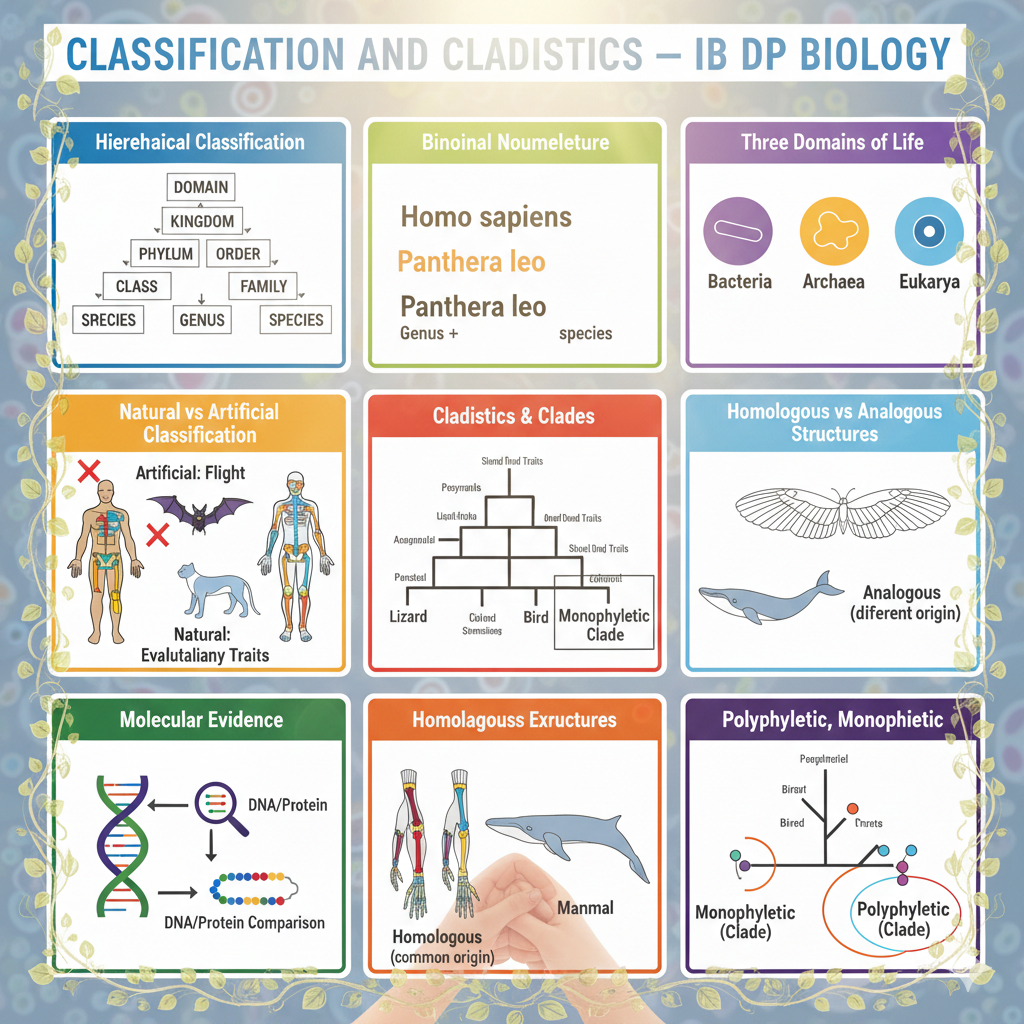
You see trees, animals, insects, fungi, and things we can't see with the naked eye. A cat and a mushroom don't look the same. Bacteria are definitely not the same as human beings. How do people like you and me and scientists do this staggering range of life? Can we simply divide groups randomly? Certainly not.
This is a simple question. There is a lot of confusion and organization in this question. The confusion must be resolved. The first step in the study of evolution is the study of classification. The organization of the study is the first step in the study of evolution. The study of classification is the foundation of evolutionary biology.
Classification is the act of grouping entities. The entities are classified based on similarities and differences.
When a scientist has to classify an entity, there are certain features that the scientist has to consider. These features are not limited to the following:
Classification helps us:
Taxonomy is the branch of biology that concerns the naming, describing, and classification of living things.
The current method of taxonomy is the work of 18th-century Swedish scientist Carl Linnaeus. He created a simple, structured method that is still used today.
Linnaeus categorized organisms based on the similarities of their physical traits. Modern science uses genetic data, but Linnaeus' method is still the foundation of classification.
Linnaeus' method of Binomial Nomenclature is one of the most important parts of Taxonomy.
Binomial means "two names".
Every species has a scientific name that consists of:
Genus + Species
For example:
Rules of Binomial Nomenclature:
Classification is organized in a hierarchical system, which means that living things are organized in levels and range from broad to specific.
The main taxonomic ranks are:
As we go lower in the hierarchy:
Humans are classified as the following:
At the level of species, organisms are quite alike and are able to interbreed and produce offspring that are also able to breed.
Contemporary systems of classification understand the division of three domains that take into account the structure of the cell and the molecular biology of organisms.
The three domains of life are a system of classification that is based on a vast majority of genetic analyses.
Organisms are classified based on simple classification based on available and observable features such as size, shape, and habitat.
Example: Organizing animals into one of the groups of 'flying' or 'non-flying.'
This system can be easily utilized, but it does not account for the evolutionary relationships between the organisms.
Natural classification takes into account a lot of different features, including:
Natural classification takes into consideration the evolutionary history and the common ancestry of organisms.
Phylogeny is the study of the evolutionary history of organisms, and it uses the concept of common ancestry to show how the different organisms relate to one another.
Current scientific practices and methodologies aim to reflect phylogeny, grouping closely related organisms together because they evolved from the same ancestor.
Cladistics is classified by the common ancestor.
Cladistics does not group organisms by general agreement. Organisms are classified by facts in evolution.
In history, there has been a common ancestor for a particular species; this ancestor is not found in previous lineages.
Cladistics emphasizes the pathways and patterns of splitting in evolution.
Clades consist of ancestor groupings and evolutionary descendants.
All clones are considered mono-groups.
For example, all mammals share a common ancestor whose descendants also possess hair, mammary glands, and middle ear bones. Hence, mammals are considered a monophyletic group.
If a population is found to exclude descendants, it does not form a true group.
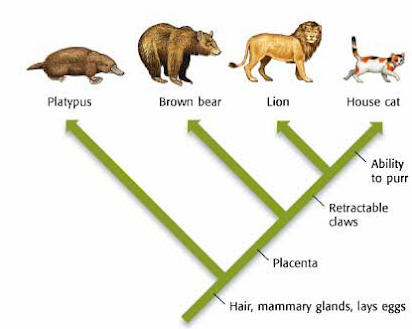
Cladograms are tree-like diagrams: they show the relationships among evolved organisms based on shared derived attributes.
In a closed area, you split the tree into 4 branches; each smaller branch of the larger is considered descended from the main.
Organisms in the closed area of the tree are separated in time from all organisms outside.
Some aspects may also be incorporated into the tree's design to exclude them. Only some organisms are related.
(Note: A few of the texts did not flow together properly. It is supposed to be clear that not all of them are true statements describing the subject being studied.)
In a cladogram, organisms that are closer together diverged from a common ancestor more recently.
In cladistics, structures are central to the science.
Are features that:
Example: The forelimbs of humans, whales, and bats are made of the same bones. This indicates a common ancestor.
Are features that:
Example: The wings of birds and the wings of insects. They have the same function but are the result of different evolutionary origins.
In cladistics, homologous features are used almost to the exclusion of features that are merely analogous.
In modern classification, molecular biology is of utmost importance.
Scientists look at:
The more similar the sequences, the more the organisms are related.
For instance, humans and chimps share a significant amount of DNA.
In some instances, molecular data have been used to reclassify organisms in ways that contradict classification based exclusively on morphology.
Not all groups are actual clades.
Cladistics seeks to eliminate paraphyletic and polyphyletic groups.
Classification involves more than just naming organisms. It enables scientists to:
Cladistics makes classification better by focusing on evolutionary history instead of grouping organisms based on superficial similarities.
For instance, in the past, whales were classified as fish because they have an aquatic habitat. However, Cladistic analysis has proven that they are mammals that share an ancestry with terrestrial mammals.
This illustrates that the scientific community's understanding of the world is subject to change as more evidence emerges.
Darwin's theory of evolution by natural selection forms the basis of modern biology.
The theory of evolution explains the existence of similarities among living organisms.
If two species are found to possess several common features, the likely explanation is that they were derived from a common ancestor.
Classification, therefore, is a reflection of evolutionary pathways.