

On this page:
Introduction What Is Chemical Signaling? Types of Chemical Signaling Communication Molecules Hydrophilic vs Hydrophobic Signals Receptors Signal Transduction Pathways Second Messengers Amplification Cellular Responses Homeostasis and Feedback Cellular Signaling and Specificity Desensitization and Regulation Signal Integration Plant Chemical Signaling Cell Communication and Disease Why is chemical signaling important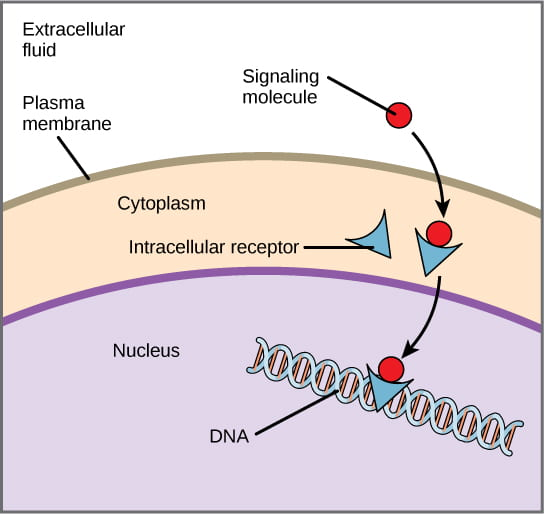
All around you are examples of how your body can respond. Your heart beats faster when you run. You feel hungry at noon. When you look at a bright light your pupils get smaller. When do you body knows when to respond to something?
Cells cannot scream or shout or anything like that. They communicate by using special molecules. This system is known as the chemical signaling system.
Chemical signaling helps us explain the way that cells coordinate activities to keep the body working as one unit by maintaining homeostasis. Chemical signaling also helps us to explain how cells control growth and how they respond to changes in their environment. Without chemical signaling, life as we know it would be impossible.
Chemical signaling is the means of communication between cells using signaling molecules. A signaling cell releases chemical messengers that are subsequently absorbed by a target cell that possesses the receptor for the particular chemical to initiate a cellular response.
Every signaling pathway can be divided into three main components:
These three components are essential in the development of the cell, enabling the cell to respond to her environment, through information, in a distinct way.
Cells communicate in different ways depending on how far apart they are.
In endocrine signaling, a chemical signaling pathway that involves the secretion of hormones directly into the bloodstream, which then disperse and act at distant target cells.
Example: Insulin is a protein that is produced by the pancreas and released into the bloodstream. From there, it travels to the liver, muscle, and fat cells binds to receptors, and helps the cells absorb glucose, lowering blood glucose levels.
In the case of endocrine signaling, because of the distance that hormones travel, it is slower than other signaling methods. However, the effects of endocrine signaling may last longer than the other methods.
In paracrine signaling, a chemical messenger acts on neighboring cells. These messengers enter the interstitial fluid and do not enter the bloodstream.
Example: Growth factors are frequently utilized paracrine signals. They control the rate of cell division and the rate of repair of tissues.
In autocrine signaling, a cell targets itself. In the case of this type of signaling, one cell releases a signal, and that signal has receptors on that same cell.
This type of signaling is significant when considering immune reactions and the regulation of cancer cells.
In synaptic signaling, cells communicate by releasing chemical messengers called neurotransmitters.
Example: A good example is the release of a neurotransmitter called acetylcholine at a synapse to trigger the contraction of a muscle. This type of signaling is very fast and is highly specific.
Signaling molecules are chemical messengers and can be classified into the following categories:
Some good examples are:
These signaling molecules vary in their structures, solubility, and the way in which they exert their effects.
We can categorize signaling molecules based on their ability to span the plasma membrane.
Cannot cross the lipid bilayer. As such, they are required to bind to receptors on the cell surface.
Example: Insulin is an example of a hydrophilic signal that is bound by a surface membrane receptor.
Are able to span the membrane. Therefore, they bind to receptors that are present in the cytoplasm.
Example: Estrogen is an example of a hydrophobic steroid hormone that is bound to receptors in the cytoplasm.
Receptors are regarded as proteins that are specifically designed to bind to signaling molecules.
Receptors are generally specific. The shape of the receptor is tailored to fit that of the signaling molecule. This is similar to a lock.
Receptors can be grouped in two major classes. These are cell surface receptors and intracellular receptors.
Receptors that are embedded on the plasma membrane are referred to as surface receptors. These receptors bind hydrophilic signals.
In surface receptors, we can distinguish at least three major classes:
Example: Adrenaline works via GPCRs to increase the rate of heartbeat and the levels of blood glucose.
Example: Insulin receptor.
Certain hormones can pass through the plasma membrane because they are hydrophobic. These include steroid hormones. Once they have crossed the membrane, they can attach to receptors in the cytoplasm of the cell or in the nucleus.
The complex of the hormone and its receptor can then act as a transcription factor. They can attach to DNA and help in the regulation of the expression of specific genes.
Example: Testosterone triggers protein synthesis and affects the development of male traits.
The binding of a signaling molecule and the subsequent cellular response is called signal transduction.
This process can have a number of steps, which can create what is called a signaling cascade. This means that one activated molecule in the cascade activates the next molecule, which activates the next molecule, and so on.
These cascades help:
These are typically small molecules in the cell that help send or relay signals to the molecules that are the intended targets of the signal.
Some examples of these second messengers include:
Example: When adrenaline binds to one of its receptors, it causes an elevation of cAMP in the cell. cAMP then activates a protein kinase called A which produces changes in metabolism, including the breakdown of glycogen.
Each signaling molecule can trigger several receptor molecules. Each receptor can trigger several G-proteins. Each G-protein can trigger several enzymes. This creates amplification. A large cellular response can result from a small amount of a signaling molecule.
The final stage of signaling is the cellular response. This may include:
Example: In response to insulin signaling, a cell increases its uptake of glucose by inserting glucose transporters into the cell membrane.
Maintaining homeostasis is a critical function of chemical signaling.
Homeostasis is the state of steady internal, physical, and chemical conditions in the body. A classic example is blood glucose levels.
When blood glucose levels rise after a meal, the pancreas releases insulin. Insulin decreases blood glucose levels by increasing uptake and storage. When blood glucose levels drop, the hormone glucagon is released. Glucagon increases blood glucose levels by stimulating the breakdown of glycogen in the liver.
In negative feedback, the response reduces the original stimulus.
Example: Blood glucose regulation
Positive feedback is less common but also exists. In positive feedback, the response increases the stimulus.
Example: Release of oxytocin during childbirth
Not every type of cell will respond to every type of hormone, as a cell will respond back to a hormone only if it has the specific receptor. For instance, insulin receptors will only respond to insulin. The rest of the body cells will ignore insulin. This is how multicellular organisms ensure precise coordination of cellular activities.
Cells can become less responsive to persistent stimulation. This is called desensitization. To maintain the body's balance, receptors can be removed from the membrane or inactivated to overreaction.
Cellular communication involves the reception of numerous signals. The type of response from a cell will depend on the combination of the signals. Some response signals can enhance the overall response, while some will inhibit further response. For instance, a cell can receive both growth and inhibitory signals. The balance of inhibitory and growth signals will determine cell division.
Plants also employ chemical signaling. They also produce hormones that assist in growth and development.
Signaling within a plant cell may also result in the alteration of the cell's gene expression and the long-distance movement of fluids within the plant's vascular cells.
Signaling is a cell's way of communicating with itself and the surrounding cells. Disturbances that inhibit a cell's signaling can lead to disease.
Targeted medications (or targeted therapies) are possible due to the understanding of these pathways by scientists. A number of drugs target specific receptors or enzymes within signaling pathways.
In Biology, the topics integrated with chemical signaling are:
Chemical signaling is how organisms, particularly complex ones, coordinate their cells to work together. Without chemical signaling, organs and tissues would not work in unison.
Pathways of signaling are what enable thought, movement, and the release of hormones.
In chemical signaling, cells are able to communicate. They perceive a change or stimulus, process the information through a series of reactions called signal transduction pathways, and respond to it. This is a process that involves signaling molecules, receptors, and second messengers, and also includes mechanisms of response amplification and feedback.
Chemical signaling is how life responds to change, maintains equilibrium and survives in a constantly changing environment.