

Take a good look at your hand. It looks solid and continuous. But if we could zoom in millions of times, you would see that your hand is made of tiny living units called cells. Every plant, animal, fungus, and bacterium is built from cells.
The cells of all living things are, in a sense, like the atoms of all matter. Cells are the basic structural and functional units of all living organisms. Once we know the structure of a cell, it is easier to understand the life processes that all living things share.
The history of cell study began in 1665 when Robert Hooke used a microscope to look at cork. He described the cells (boxlike structures) that he saw. Later, other scientists such as Matthias Schleiden and Theodor Schwann proposed the Cell Theory.
Cell Theory states:
This is one of the many theories of modern biology.
There are two main types of cells: prokaryotic and eukaryotic.
Prokaryotes are simple and smaller. They have no nucleus and their genetic materials are in the cytoplasm. An example of a prokaryotic cell is Escherichia coli.
Main features:
Prokaryotes can have other features like:
Eukaryotic cells are the opposite. They are larger and have a more complex structure. They have a true and Membrane-bound nucleus. Plants, animals, fungi, and protists are all eukaryotes.
Main features:
Later on, we will discuss the differences that exist between animal and plant cells.
Cells, on average, are 1–100 micrometers (µm) in size. Their size is determined by the amount of surface area they have in relation to their volume.
Cells also have to exchange materials, which is more difficult and less efficient the larger a cell is. Cells can only grow to a certain limit, which is why they remain small. Once they have reached their limit, they have to divide to produce more cells.
Microscopy is the study of objects that are too small to be seen by the naked eye. Cells are studied using various types of microscopes.
Light microscopes provide a magnification of about 1000–1500 times by utilising light. This type of microscope is useful when studying living cells and tissues.
Rather than light, electron microscopes use streams of electrons to generate images. This means that they have much higher resolution than light microscopes.
There are two major types of electron microscopes:
The details of certain organelles are only seen by means of electron microscopes.
The membrane of a cell in different types of cells is described by the Fluid Mosaic Model introduced by Singer and Nicolson.
The membrane consists of:
Phospholipids are made of:
They are arranged in two layers with the tails of the phospholipids facing one another in the center of the membrane. This enables the membrane’s fluidity due to the ability of the phospholipids to move from side to side. It’s mosaic in appearance due to the proteins scattered throughout it.
The membrane has the following functions:
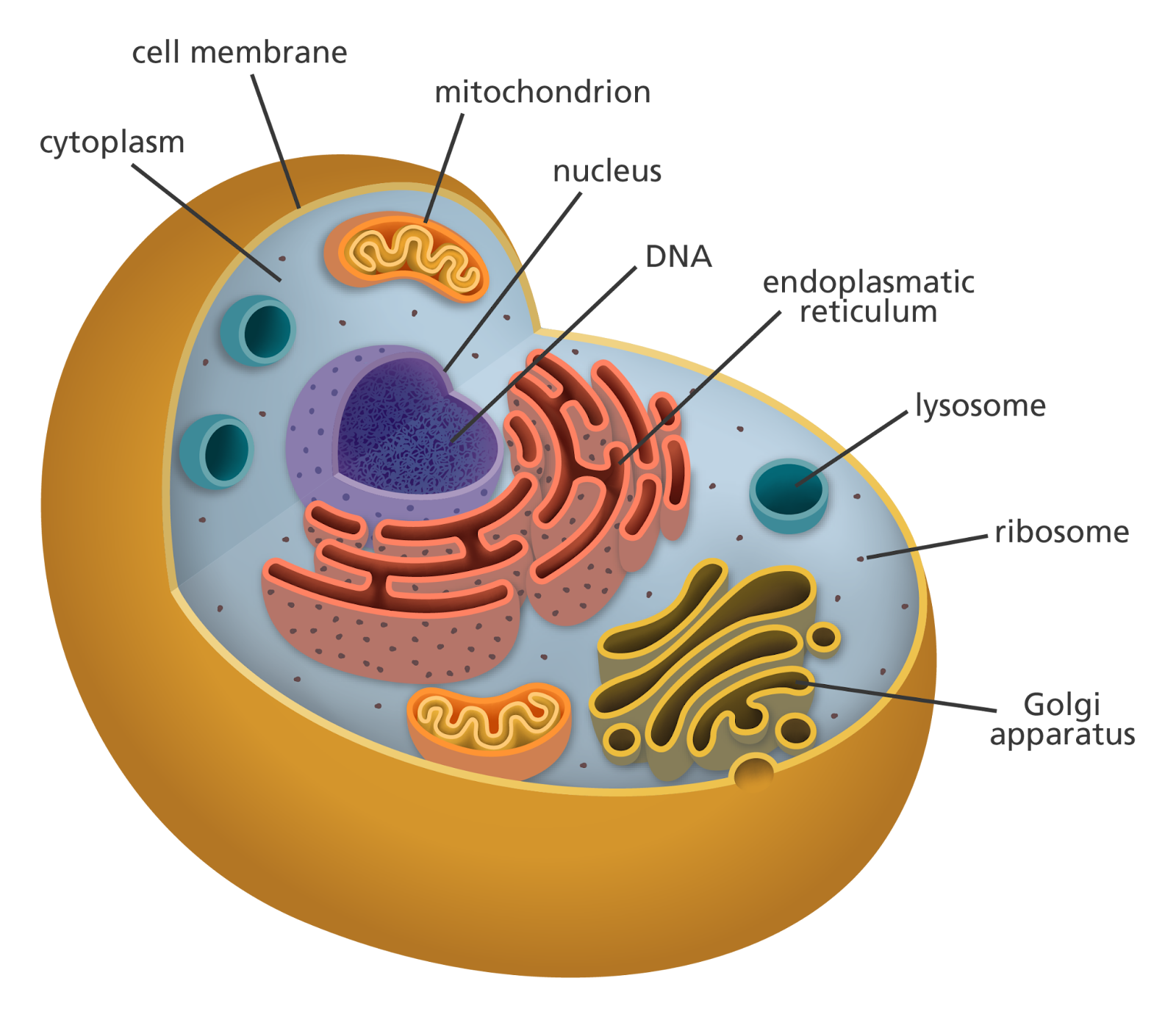
The nucleus is known as the control center of the cell since it holds the cell’s genetic material (DNA).
The structure contains:
The nucleus has its DNA stored in the structures known as chromosomes. The DNA is the only material that can control the building of proteins and regulating of ALL activities of the cell.
The cytoplasm is the gel-like material that fills the cell. It has within it the enzymes and nutrients, as well as the organelles. It is the site for many of the cell’s metabolic reactions.
Ribosomes are structures that are made of proteins and RNA and are the main site of protein synthesis. They can be classified into two types:
Prokaryotic ribosomes are called 70S ribosomes, while eukaryotic ribosomes are known as 80S ribosomes.
The endoplasmic reticulum is a membranous organelle that consists of a series of folds that looks like a net. It is classified into two types:
Smooth ER Functions: Smooth ER is a network of tubules that does not have ribosomes. Its function is to synthesize lipids, detoxify chemicals, and store calcium ions.
The Golgi apparatus performs the functions of modifying, sorting, and packaging proteins from the ER. The proteins arrive in vesicles at the Golgi and are modified, then sent to the final destination.
Mitochondria are the main site of aerobic respiration, which is how cells produce ATP. This is also why they are called the powerhouse of the cell.
Structure:
Mitochondria possess their own DNA and ribosomes, which is one of the reasons the endosymbiotic theory is supported.
The endosymbiotic theory, which was developed by Lynn Margulis, posits that the mitochondria and chloroplasts of cells were originally autonomously replicating prokaryotic cells that were taken in by others.
Evidence of this theory includes:
Chloroplasts are the site of photosynthesis in plant cells.
Structure:
Chloroplasts also hold chlorophyll, allowing them to absorb the light energy.
Lysosomes have digestive enzymes that dismantle cells' waste, damage organelles, and attack pathogens. This organelle is more prevalent in animal cells.
Vacuoles are membrane-bound sacs.
In the cells of plants and some bacteria:
In the cells of animals, the vacuoles are smaller and less numerous.
Cell walls help plant cells provide support and protection. Cell walls are composed of cellulose. In some bacteria, the cell walls are also composed of cellulose, but it is called peptidoglycan. Animal cells do not have cell walls.
The cytoskeleton is made of microtubules, microfilaments, and intermediate filaments.
The cytoskeleton has three functions:
Some cells have structures that help them move.
In eukaryotic cells, cilia and flagella have a 9 + 2 arrangement of microtubules. In prokaryotic cells, cilia and flagella have a different arrangement.
Both types of cells have a nucleus, mitochondria, ER, Golgi apparatus, ribosomes, and cell membranes.
In multicellular organisms, cells specialize. This means cells adapt to perform different functions.
Examples include:
When cells separate different tasks, they become more efficient. Because of this, specialized cells are able to help more complex organisms exist.
One of the benefits of eukaryotic cells is having compartmentalization. Each organelle is able to focus on different parts of the process. This increases efficiency and stops various reactions from interfering with one another.
For example:
This is why compartmentalization is a huge evolutionary advantage.
Function and Structure are intertwined in biology. Mitochondria have folded membranes to help them produce more ATP. Nerve cells are designed to help expedite the process of signal transmission.
Essentially, the proper understanding of how cells are designed, it gives us an idea of how life exists on a small, microscopic scale.
Life's building blocks are the cells. These cells, whether they are simple cells like the prokaryotic cells or more complex cells like the eukaryotic cells, are very organized and structured. Because of the discovery of cells, modern biological research, and the development of microscopy, a very complex and detailed structure inside small units has been revealed.
In Biology, cell structure provides the foundation for understanding metabolism, genetics, physiology, and evolution. Understanding the structure of cells allows us to understand the mechanisms of life in organisms.