

On this page:
Introduction What Is Cell Specialization? Differentiation Across the Animal Kingdom Examples of Specialized Animal Cells Differentiation in Plants Examples of Specialized Plant Cells Structure-Function Relationship Stem Cells Gene Expression in Specialized Cells Formation of Tissues Cell Specialization Importance Specialized vs Unspecialized Cells Recent Advances Summary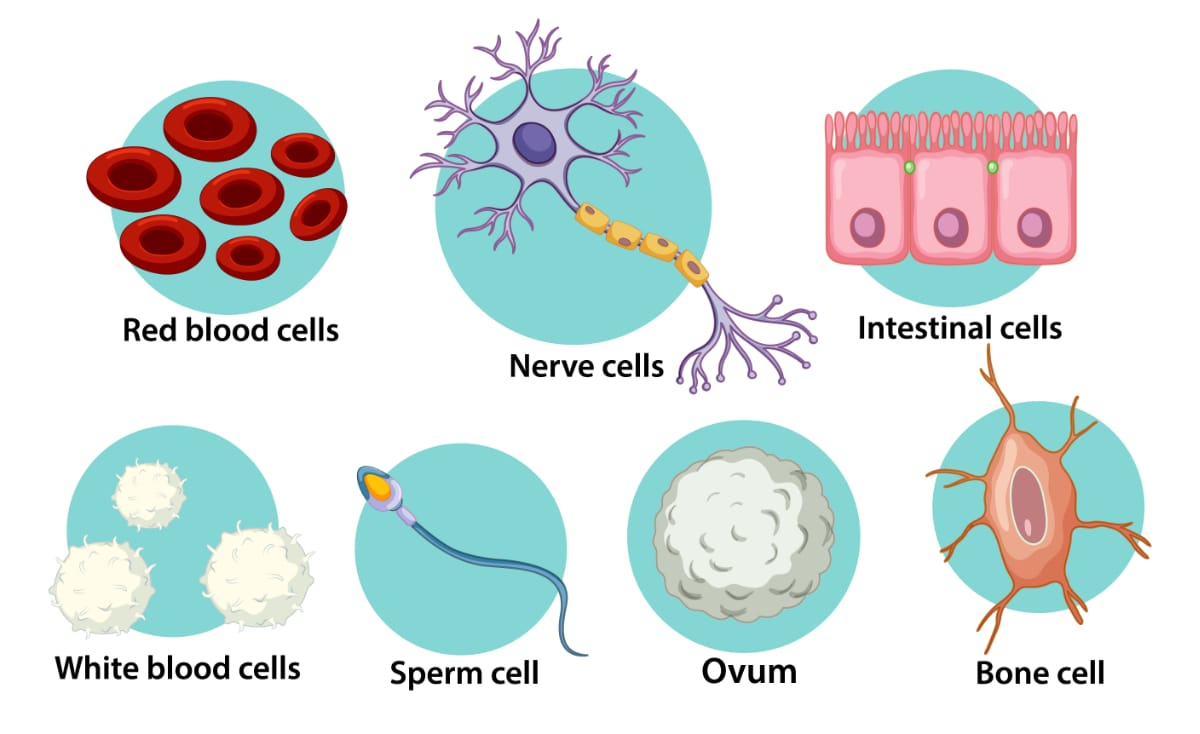
Every time the heart beats, the muscles contract, and the roots absorb water, what happens? Each function in a living organism is carried out with the help of particular cells, which are designed for specific functions. This phenomenon is cell specialization. Specialized cells contain structures that are aligned to assist and perform specific functions. This is how multicellular organisms function in a coordinated manner.
Cell specialization is important for the survival of organisms because a single cell is not able to perform all the functions that are needed for sustaining life. In multicellular living beings, there is a division of labor that is organized, efficient, and adaptable.
Cell specialization is also known as cell differentiation. This term describes the process by which generic cells develop into more specific cells, which are designed to perform specific structures and functions. All the cells in an organism, while having the same DNA, express only a specific subset of genes. This selective expression of genes determines the particular structure that cells will form, and what role they will play in the organism.
Consider the following examples:
The specialization of a differentiated cell also allows it to fully develop its shape and internal structures. They can even optimize their use of energy for a distinct task. This is why cardiac muscle cells have several mitochondria and why a leaf's palisade cell is packed with chloroplasts.
Differentiation in animals, especially during the embryonic stage, involves the development of a zygote. A zygote is one single cell that is undifferentiated and is formed after fertilization occurs. This zygote undergoes several rounds of cell division by a process called mitosis. This process will eventually lead to the specialization of those cells into particular tissues and also the organs that they will eventually develop into.
The process of differentiation is based on multiple cell signaling, a process called gene regulation, and cells' interactions with their environment.
Function: Their job is to transport oxygen from the lungs to the various tissues in the body and also to transport carbon dioxide back.
Structure: Their shape looks like a biconcave to create more surface area; they do not have a nucleus, so that they can have more space for hemoglobin, and their flexible membrane allows them to easily pass through the narrowest of capillaries.
Function: Send and receive signals. Their job is to transmit electrical impulses and coordinate responses in the body.
Structure: Start with a long axon that carries signals, and have dendrites that receive signals, have myelin sheaths that insulate and speed up impulses, and have synaptic terminals that communicate with other neurons.
Function: Provide the ability to contract and provide the ability to move.
Structure: Contain many mitochondria to provide ATP, have fibers that are arranged in bundles so they can contract in the same direction, and contain proteins actin and myosin.
Function: Fertilize the egg.
Structure: Have a tail (flagellum) for movement, have a head that contains DNA, and have a midpiece that contains a lot of mitochondria for energy, and have an acrosome that contains enzymes to penetrate the egg.
Function: Aids the movement of mucus and particles trapped in the respiratory tract.
Structure: Have hair-like extensions that beat in a coordinated manner, are supported by a flexible cytoskeleton, and are often supported by goblet cells that secrete mucus.
Function: Protect the body by fighting against infections.
Structure: Have flexible chemistry to move through the body, have lysosomes to digest pathogens, and have specific receptors to detect foreign molecules.
Plant cells also specialize in performing specific tasks. Many plant cells remain totipotent in early stages, meaning they can become any cell type. However, once differentiation occurs, in a fully developed plant, its function becomes fixed.
Function: Absorb water and minerals from the soil.
Structure: Long extensions increase surface area. Cell walls are thin for easy absorption. The cytoplasm has many proteins for transport.
Function: To transport water and certain needed minerals from the roots to the leaves.
Structure: They secrete lignin for walls to provide support. They also create hollow tubes for continuing water flow. At the end of their life cycle, some xylem cells are meant to die to create more efficient tubes.
Function: To transport sugars and other nutrients from the leaves to other areas of the organism.
Structure: Sieve tubes are missing their nuclei to create less blockage. Companion cells provide support to the living and metabolic cells. Plasmodesmata are connections between other cells that serve for the transport of nutrients.
Function: Control and regulate the exchange of gases and the loss of water by the open and closed stomata.
Structure: Cells are shaped like a kidney; they can swell and open, and shrink and close the stomata. These cells are controlled by osmotic pressure.
Function: To perform photosynthesis.
Structure: Mesophyll cells have a shape that can accommodate the greatest number of chloroplasts. They are positioned so that the maximum amount of light can be captured to be used to perform photosynthesis.
Function: Provide flexible support to areas of the organism that are still growing.
Structure: They have walls that are thickened to provide support. They are living at maturity and are able to elongate in length with the rest of the plant.
This relation describes that the structure of the specialized cells describes their function. There is a pattern that repeats itself, and a description of a cell's shape predicts its role.
Stem cells have an exceptional capability; they are able to develop into any type of cell within an organism, including specialized cells. Because of this unique ability, they have an essential function in development, regenerative medicine, tissue repair, cellular differentiation, and organ repair.
Stem cells are also employed in the investigation of cellular differentiation and the regulation of genes.
All cells in an organism possess identical DNA; however, they play diverse roles in the body, which is a result of differential gene expression, which signifies that in a specific cell, only a certain gene is operational.
The genes that are operational in a cell synthesize certain proteins that shape the specific cell and also govern its function.
For cells to differentiate and function properly, a variety of regulatory mechanisms, such as cell signalling, epigenetic modifications, and transcription factors, are utilized.
Different types of cells come together to form the following types of tissues:
Various types of tissues combine to form organs. These organs, functioning together as Organ Systems, form the basis of complex multicellular organisms.
Multicellular organisms require cell specialization for essential functions and processes.
| Feature | Specialized Cell | Unspecialized Cell (Stem Cell) |
|---|---|---|
| Function | Performs a specific function | Can develop into any cell type |
| Structure | Adapted for a particular role | Simple, generic structure |
| Gene Expression | Only certain genes are active | Most genes are available for activation |
| Example | Red blood cell, neuron | Zygote, embryonic stem cell |
Current research focuses on stem cells and induced pluripotent stem cells (iPSCs) to see how they may be used to treat diseases such as diabetes, spinal cord injuries, and blood disorders. Another field of study is epigenetics, which looks at how the environment affects gene expression and how cells may change from one type to another. The discoveries in this area may change the way we practice medicine and how we use technology in the field.
Cell specialization allows organisms made of many cells to function efficiently by carrying out different roles, like sending and receiving signals and transporting oxygen.
Stem cells undergo the process of differentiation to become specialized cells as a result of selective gene expression. Specialized cells work in cooperation to create tissues and organs, and this division of work ensures the organism's survival and adaptation.
Cell specialization is critical for understanding how to connect structure to function, how to explain the complexity of organisms, and even how to inform contemporary medical treatments, which is why it is a key topic in Biology. When looking at cells in a microscope, one can often guess a cell's function based on its shape, which reinforces another fundamental principle in biology: structure and function will always align.