
All living things have cells as their basic building blocks. An organism starts as a single cell, and it grows by cell division. But how exactly does a single cell divide and make copies of itself? What is the process of gametics in sexual reproduction?
In order to answer these questions, one has to grasp the fundamental concepts of cell division and the cell cycle, as well as nuclear division.
The smallest unit of life is called a cell. Cells have different organelles (small organelles) that perform functions for the cell to survive.
Some important organelles are:
Cell Types:
Nuclear division is a process that only takes place in eukaryotic cells.
There are many reasons for cells to divide:
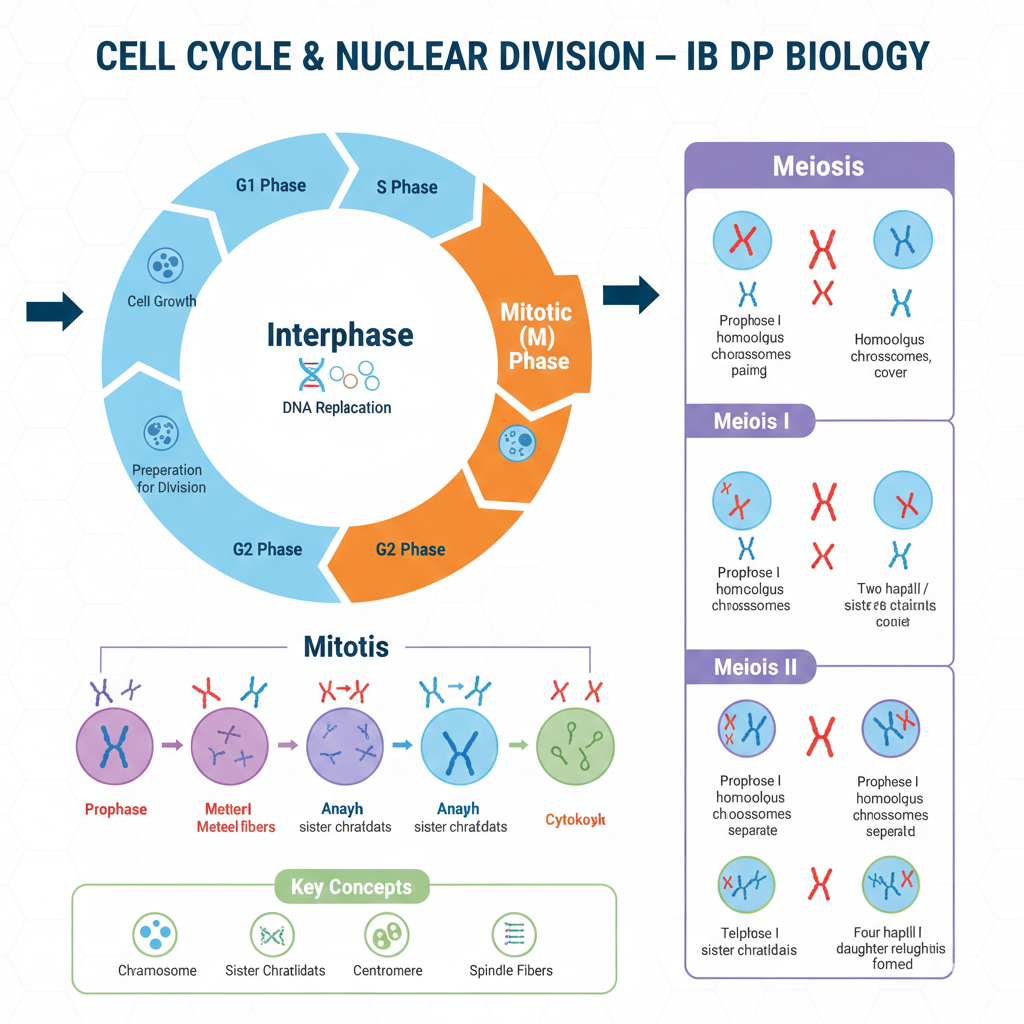
The cell cycle is a sequence of phases a cell goes through from its creation to its division into daughter cells. This cycle is characterized by two primary phases:
The longest period of the cell cycle. Characterized by preparation for cell division.
Involves the division of the nucleus (mitosis or meiosis) and the division of the cytoplasm (cytokinesis).
Interphase is the longest period of the cell cycle. This phase is characterized by preparation for cell division, which can be divided into three phases:
G₁ Phase (Gap 1): The cell increases its size and the quantity of proteins and organelles.
S Phase (Synthesis): The cell replicates its DNA and forms identical chromatids.
G₂ Phase (Gap 2): The cell undergoes a series of preparations for mitosis and corrects any DNA errors.
During this phase, the nucleus is visible, and the cell is metabolically active but is not undergoing division.
This phase involves the division of the nucleus (mitosis or meiosis) and the division of the cytoplasm (cytokinesis), resulting in two new daughter cells.
Nuclear division ensures that the correct amount of DNA is divided among the daughter cells. This division can be of two forms:
Produces cells that are genetically identical. Happens in somatic (body) cells during growth, repair, and asexual reproduction.
Produces sex cells that contain half of the chromosomes. Happens in gamete-producing cells for sexual reproduction.
Mitosis happens in somatic (body) cells during growth, repair, and asexual reproduction. The result is two identical cells with the same number of chromosomes as the parent cell.
Mitosis has four stages:
Cytokinesis: Happens during telophase, dividing the cytoplasm and organelles into two cells.
Key Points: Mitosis is needed for growth, repair, and asexual reproduction.
Meiosis happens in gamete-producing cells (ovaries and testes) for sexual reproduction. The number of chromosomes is reduced by half, producing haploid cells, in two divisions:
Prophase I: Chromosomes make copies of themselves (sister chromatids) and pair together. Crossing over occurs—homologous chromosomes exchange DNA segments, introducing genetic variation.
Metaphase I: Pairs of homologous chromosomes move to the center of the cell.
Anaphase I: Pairs of chromosomes are separated and moved to either side of the cell.
Telophase I & Cytokinesis: Cell splitting begins. Two cells are formed, each with half the number of chromosomes.
Sister chromatids are separated, resulting in 4 haploid cells that are genetically distinct from the original parent cell.
Chromosomes are made of DNA and proteins called histones that keep DNA organized and wrapped.
Key Terminology:
Chromosome Numbers in Species:
Each species has a characteristic chromosome number. Humans have 46 chromosomes (23 pairs). Meiosis ensures gametes have half this number (23), so fertilization restores the diploid number.
| Feature | Mitosis | Meiosis |
|---|---|---|
| Cell type | Somatic cells | Gametes (sex cells) |
| Number of divisions | 1 | 2 |
| Number of daughter cells | 2 | 4 |
| Chromosome number | Same as parent (diploid) | Half of parent (haploid) |
| Genetic similarity | Identical | Genetically unique |
| Function | Growth, repair, asexual reproduction | Sexual reproduction, genetic variation |
Cell division is governed by cyclin proteins and cyclin-dependent kinase (CDK) enzymes.
Checkpoints:
Errors in cell division can lead to mutations and cancer—a condition in which cells divide beyond control due to checkpoint failures.