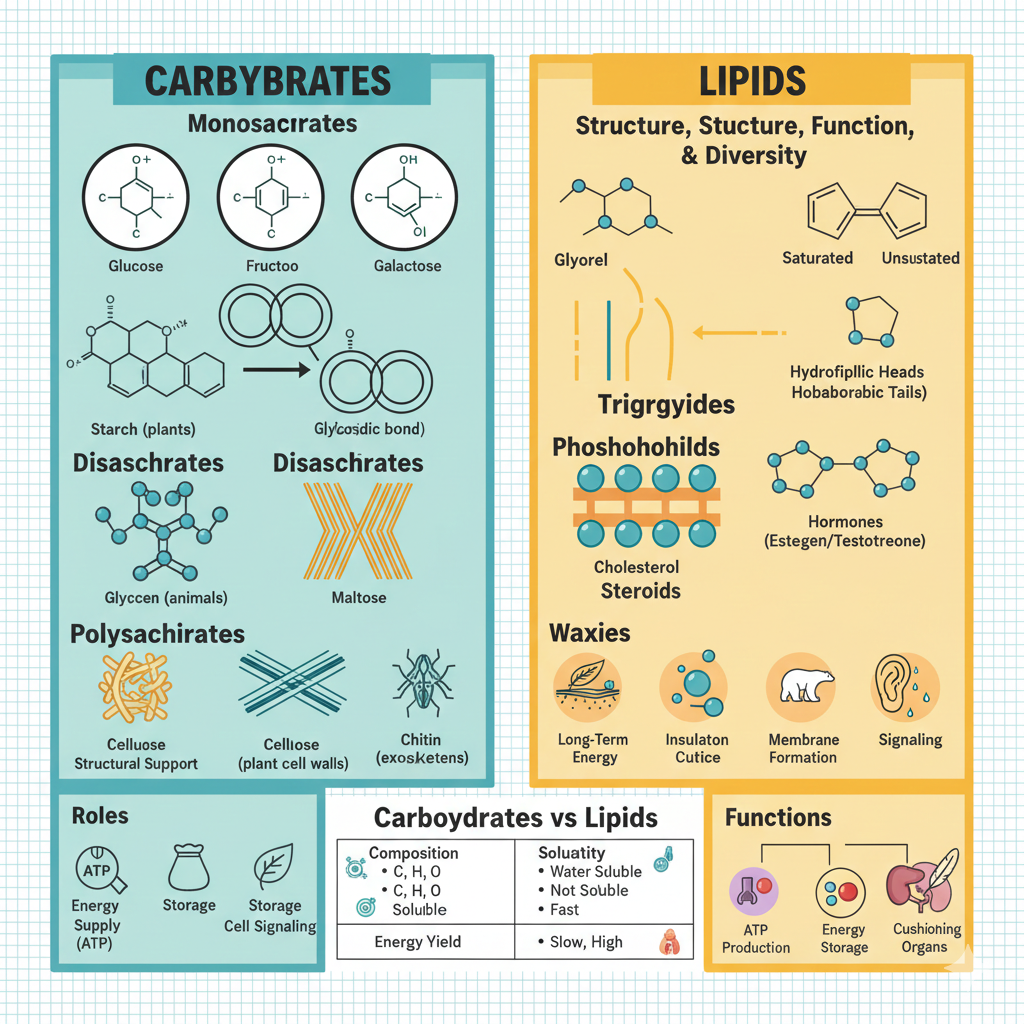
Carbohydrates and Lipids
How does your body store and obtain energy? How does it construct stuff like cell walls and cell membranes? The answer lies with carbohydrates and lipids.
Carbohydrates and lipids are both considered organic compounds. This means that they are made of carbon (C), hydrogen (H), and oxygen (O). These compounds will aid an organism in supplying and storing energy as well as providing structure.
Carbohydrates
Carbohydrates are a type of compound that is considered a hydrated carbon and is most often made with the structure of Cₓ(H₂O)ᵧ. These compounds are considered the primary energy source in most life forms. Carbohydrates can be broken down into simple sugars (monosaccharides) or complex carbohydrates (polysaccharides).
Monosaccharides
Monosaccharides are the basic units of carbohydrates and cannot be broken down into smaller units. Glucose, fructose, and galactose are all examples.
Formula: CₙH₂ₙOₙ
Three important facts about monosaccharides are that they:
- are soluble in water
- have a sweet taste
- can be in a straight-chain or a ring form.
Glucose, the main source of energy for cells, has two different forms called α-glucose and β-glucose, which are differentiated based on the position of the OH group attached to the first carbon.
Monosaccharides can participate in condensation reactions and form covalent bonds called glycosidic bonds with other monosaccharides.
Disaccharides
Disaccharides are formed from the linkage of two monosaccharides.
Some examples include:
- Glucose + Fructose → Sucrose (table sugar)
- Glucose + Galactose → Lactose (milk sugar)
- Glucose + Glucose → Maltose
They are formed by glycosidic bonds.
Polysaccharides
Polysaccharides are large molecules that are insoluble in water and are formed from monosaccharides. They have structural and storage functions.
Starch
- A major storage carbohydrate in plants.
- It is composed of two other sugars called amylose (a straight-chain form) and amylopectin (a branched form), and can be broken down into glucose by the enzyme amylase for energy.
Glycogen
- A storage carbohydrate found in the muscles and liver of animals.
- It has a highly branched structure that allows for the rapid release of energy and provides short-term energy storage.
Cellulose
- Found in the cell wall of plants.
- Is made of β-glucose.
- Strong fibers form via hydrogen bonding.
- Provides structural support, but is indigestible for humans.
Chitin
- Insect exoskeletons and fungal cell walls.
- Provides rigidity and protection.
Carbohydrates Functions
- Energy supply – During cellular respiration, glucose is oxidized, and ATP is released.
- Energy storage – Starch and glycogen are reserves of energy.
- Structural support – Cells and tissues are strengthened by cellulose and chitin.
- Recognition and signaling – Some carbohydrates form glycoproteins for cell recognition.
Lipids
Lipids are hydrophobic organic molecules, meaning they do not dissolve in water. However, they do dissolve in non-polar solvents such as ethanol or ether. They are diverse, including fats, oils, phospholipids, steroids, and waxes.
Lipids are more energy-dense than carbohydrates. As a result, they function as an efficient form of long-term energy storage.
Fats or Triglycerides
Fats consist of a glycerol and three fatty acids.
Formation: Triglycerides are formed by a process called esterification in which glycerol and fatty acids react, and during which three water molecules are released.
Types of fatty acids:
Saturated fatty acids
- No double bonds are present in the carbon chain.
- They are solid at room temperature, e.g., butter.
- Increased consumption of this fatty acid can increase the risk of cardiovascular disease.
Unsaturated fatty acids
- One or more double bonds are present in the carbon chain.
- They are liquid at room temperature, e.g., olive oil.
- Lipids can be further classified into monounsaturated (one double bond) and polyunsaturated (multiple double bonds).
Phospholipids
Phospholipids are like fats, and instead of one fatty acid, there is a phosphate group.
Structure: Hydrophilic head - Phosphate group - attracted to water. Hydrophobic tail - fatty acids - repelled by water.
Phospholipids are the key ingredients in cell membranes, making the phospholipid bilayer and determining the permeability of the cell to various substances.
Steroids
Steroids are classified as lipids and have a structure that consists of 4 rings. Example: Cholesterol - maintains cell membrane fluidity in animals. Estrogen and Testosterone - hormones that control and regulate reproduction.
Waxes
Waxes are long-chain fatty acids that are linked to alcohol. They are the reason for the waterproofing in plants (cuticle) and animals (ear wax).
Functions of Lipids
- Energy storage - Lipids store 2 times more energy than carbohydrates.
- Insulation and protection - Fats can help in the prevention of heat loss and can help in the protection of the organs.
- Structural roles - Phospholipids form membranes and stabilize membranes, steroids.
- Chemical messengers - Steroid hormones regulate and control growth, metabolism, and reproduction.
- Waterproofing - Waxes help in the prevention of loss of water in plants and animals.
Comparing Carbohydrates and Lipids
| Feature |
Carbohydrates |
Lipids |
| Composition |
C, H, O |
C, H, O (less O) |
| Solubility |
Water-soluble |
Hydrophobic |
| Energy storage |
Short-term |
Long-term |
| Energy yield |
~4 kcal/g |
~9 kcal/g |
| Examples |
Glucose, Starch, Cellulose |
Fats, Oils, Phospholipids |
| Functions |
Energy, structure, signaling |
Energy, insulation, membranes, hormones |
Biological Importance
- Energy metabolism: Carbohydrates and lipids play an important role in metabolism, as carbohydrates provide immediate sources of energy, whereas lipids provide sources of energy after long durations.
- Cell structure: Cholesterol and Phospholipids are important in providing structure to membranes.
- Protection: Layers of fat cushion and protect different organs of the body, and waxes assist in preventing the loss of fluid.
- Signaling: Glycolipids and Steroid hormones play an important role in communication, as hormones and lipids are the main components of cellular membranes.
- Dietary relevance: An adequate supply of carbohydrates and fats in the diet is important for the normal growth and metabolism of an individual.
Summary
- Carbohydrates consist of basic units called monosaccharides, which combine to form disaccharides and eventually, polysaccharides. Carbohydrates provide energy and also function as the storage and structural component of the organism.
- Lipids are molecules that are hydrophobic in nature. These molecules include fats, phospholipids, and steroids. These molecules store energy that is required for a long duration in the form of fat. Lipids also function in providing structure to membranes and also act as hormones and waterproofing substances.
- Polysaccharides, which include carbohydrates such as starch and glycogen as well as structural carbohydrates such as cellulose and chitin, play important and distinct roles in storage and structure.
- Fatty acids play a crucial role in the formation of membranes, and these fatty acids are of two types, namely, saturated and unsaturated. The presence of either type of fatty acid alters the physical characteristics as well as the health of an individual.
- Steroids and waxes also serve important structural, hormonal, and protective roles within and upon the body.
- Both carbohydrates and lipids are organic compounds that serve important roles in energy, structure, and signaling, and also serve to sustain the life of the organisms.
- Carbohydrates and lipids are essential to understanding cell biology, metabolism, and physiology. These are the building blocks for subjects such as enzymes, respiration, and nutrition.